
Pulp Fiction, 1865 · page 63 of 400
The Argosy — page 63: what you’re looking at
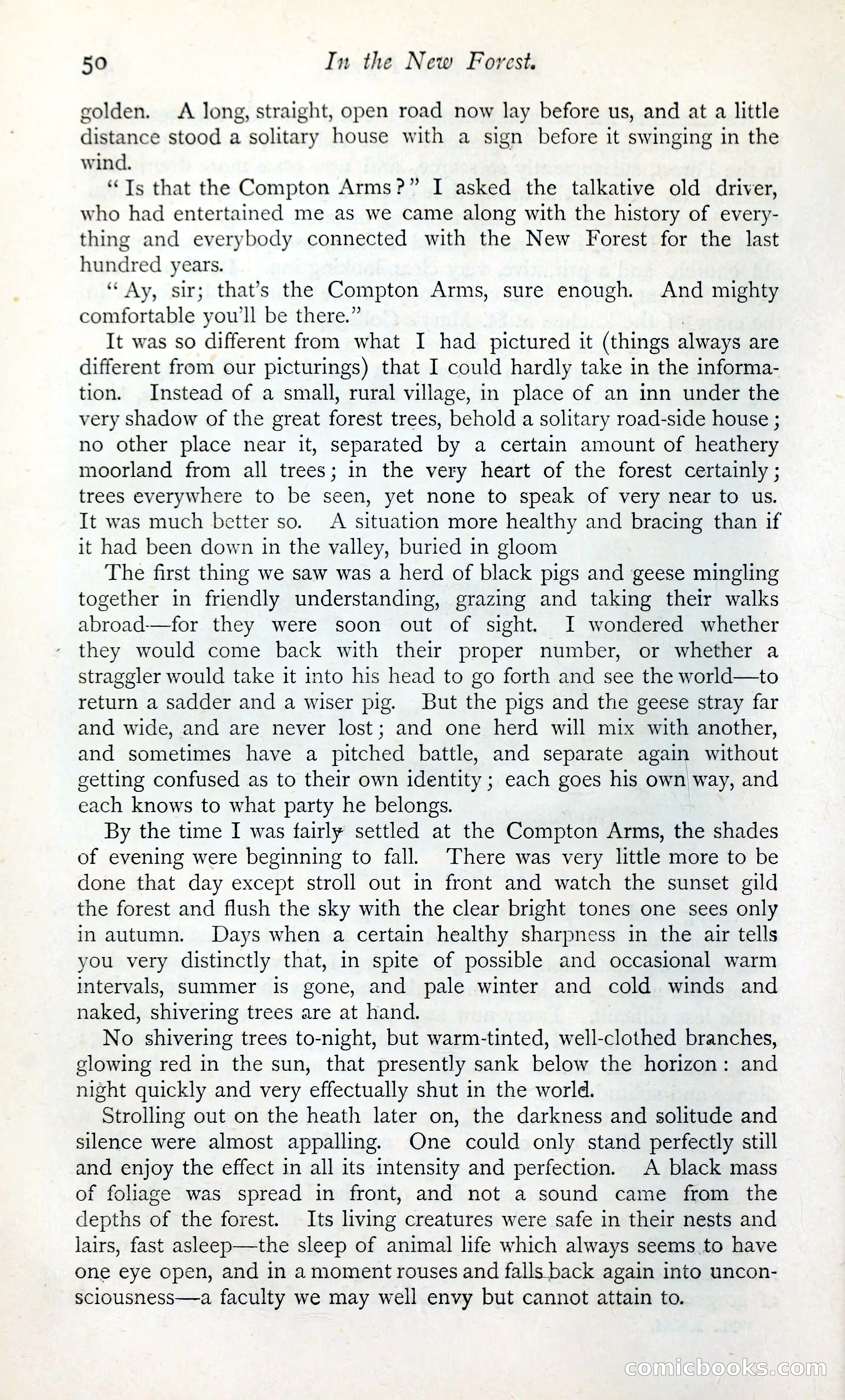
A restored page from Pulp Fiction, 1865. Page through the whole issue in the reader above.
📄 Transcribed text from this page (OCR, searchable)
Machine-transcribed from the original scan — historical spelling and the odd misread are preserved.
50 In the New Forest. golden. A long, straight, open road now lay before us, and at a little distance stood a solitary house with a sign before it swinging in the wind. ‘Ts that the Compton Arms?” I asked the talkative old driver, who had entertained me as we came along with the history of every- thing and everybody connected with the New Forest for the last hundred years. “Ay, sir; that’s the Compton Arms, sure enough. And mighty comfortable you'll be there.” It was so different from what I had pictured it (things always are different from our picturings) that I could hardly take in the informa- tion. Instead of a small, rural village, in place of an inn under the very shadow of the great forest trees, behold a solitary road-side house ; no other place near it, separated by a certain amount of heathery moorland from all trees; in the very heart of the forest certainly ; trees everywhere to be seen, yet none to speak of very near to us. It was much better so. A situation more healthy and bracing than if it had been down in the valley, buried in gloom The first thing we saw was a herd of black pigs and geese mingling together in friendly understanding, grazing and taking their walks abroad-—for they were soon out of sight. I wondered whether they would come back with their proper number, or whether a straggler would take it into his head to go forth and see the world—to return a sadder and a wiser pig. But the pigs and the geese stray far and wide, and are never lost; and one herd will mix with another, and sometimes have a pitched battle, and separate again without getting confused as to their own identity ; each goes his own way, and each knows to what party he belongs. By the time I was fairly settled at the Compton Arms, the shades of evening were beginning to fall. ‘There was very little more to be done that day except stroll out in front and watch the sunset gild the forest and flush the sky with the clear bright tones one sees only in autumn. Days when a certain healthy sharpness in the air tells you very distinctly that, in spite of possible and occasional warm intervals, summer is gone, and pale winter and cold winds and naked, shivering trees are at hand. No shivering trees to-night, but warm-tinted, well-clothed branches, glowing red in the sun, that presently sank below the horizon: and night quickly and very effectually shut in the world. Strolling out on the heath later on, the darkness and solitude and silence were almost appalling. One could only stand perfectly still and enjoy the effect in all its intensity and perfection. A black mass of foliage was spread in front, and not a sound came from the depths of the forest. Its living creatures were safe in their nests and lairs, fast asleep—the sleep of animal life which always seems to have one eye open, and in a moment rouses and falls back again into uncon- sclousness—a faculty we may well envy but cannot attain to. eonnichbooks (C(O)