
Pulp Fiction, 1865 · page 309 of 400
The Argosy — page 309: what you’re looking at
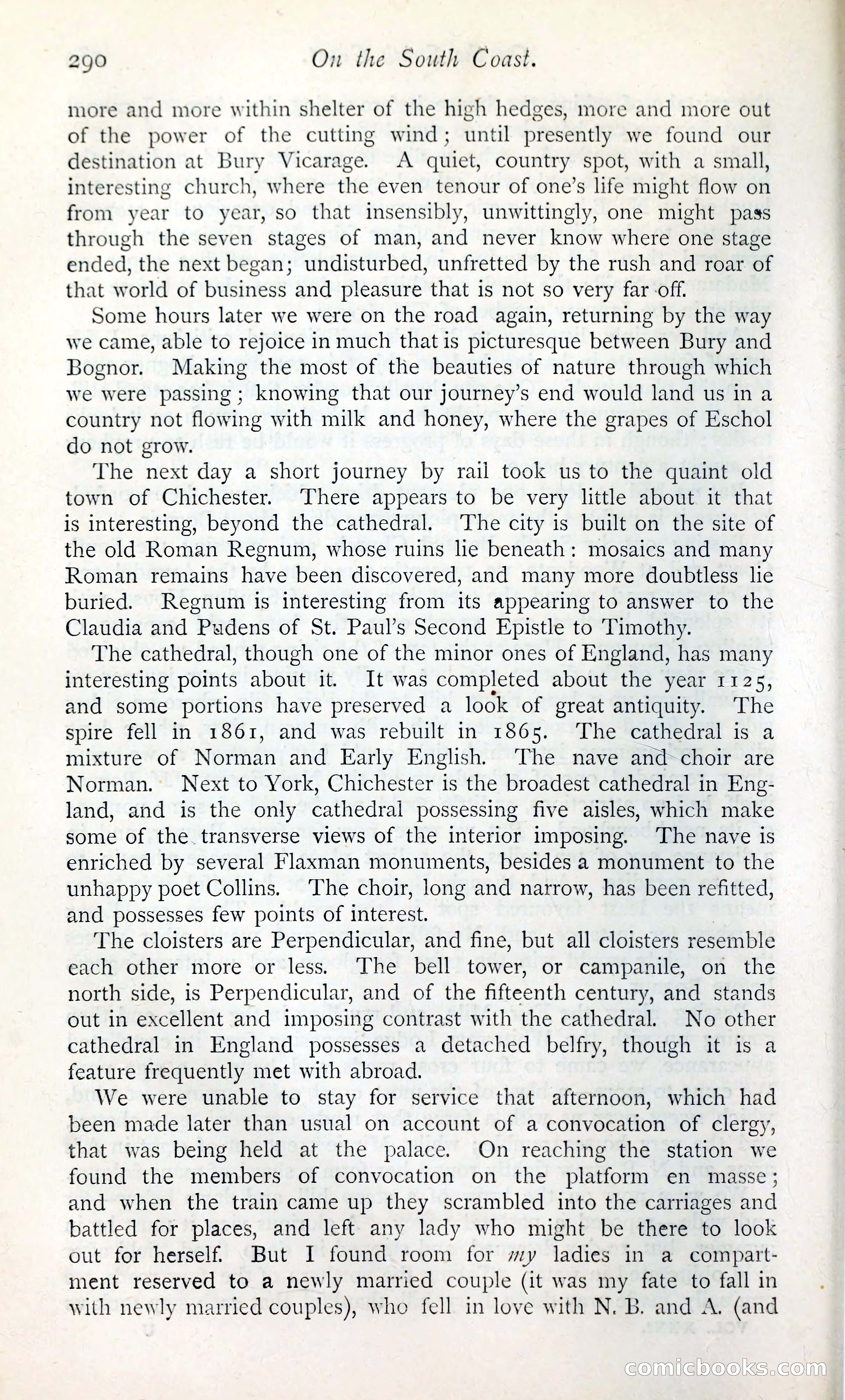
A restored page from Pulp Fiction, 1865. Page through the whole issue in the reader above.
📄 Transcribed text from this page (OCR, searchable)
Machine-transcribed from the original scan — historical spelling and the odd misread are preserved.
290 On the South Coast. more and more within shelter of the high hedges, more and more out of the power of the cutting wind; until presently we found our destination at Bury Vicarage. A quiet, country spot, with a small, interesting church, where the even tenour of one’s life might flow on from year to year, so that insensibly, unwittingly, one might pass through the seven stages of man, and never know where one stage ended, the next began; undisturbed, unfretted by the rush and roar of that world of business and pleasure that is not so very far off. Some hours later we were on the road again, returning by the way we came, able to rejoice in much that is picturesque between Bury and Bognor. Making the most of the beauties of nature through which we were passing; knowing that our journey’s end would land us ina country not flowing with milk and honey, where the grapes of Eschol do not grow. The next day a short journey by rail took us to the quaint old town of Chichester. ‘There appears to be very little about it that is Interesting, beyond the cathedral. The city is built on the site of the old Roman Regnum, whose ruins lie beneath: mosaics and many Roman remains have been discovered, and many more doubtless le buried. Regnum is interesting from its appearing to answer to the Claudia and Pudens of St. Paul’s Second Epistle to Timothy. The cathedral, though one of the minor ones of England, has many interesting points about it. It was completed about the year 1125, and some portions have preserved a look of great antiquity. The spire fell in 1861, and was rebuilt in 1865. ‘The cathedral is a mixture of Norman and Early English. The nave and-choir are Norman. Next to York, Chichester 1s the broadest cathedral in Eng- land, and is the only cathedral possessing five aisles, which make some of the. transverse views of the interior imposing. ‘The nave is enriched by several Flaxman monuments, besides a monument to the unhappy poet Collins. The choir, long and narrow, has been refitted, and possesses few points of interest. The cloisters are Perpendicular, and fine, but all cloisters resemble each other more or less. The bell tower, or campanile, on the north side, is Perpendicular, and of the fifteenth century, and stands out in excellent and imposing contrast with the cathedral. No other cathedral in England possesses a detached belfry, though it is a feature frequently met with abroad. We were unable to stay for service that afternoon, which had been made later than usual on account of a convocation of clergy, that was being held at the palace. On reaching the station we found the members of convocation on the platform en masse; and when the train came up they scrambled into the carriages and battled for places, and left any lady who might be there to look out for herself. But I found room for my ladies in a compart- ment reserved to a newly married couple (it was my fate to fall in with newly married couples), who fell in love with N. B. and A. (and EMORNIELOOOKS.E@ im