
Pulp Fiction, 1865 · page 308 of 400
The Argosy — page 308: what you’re looking at
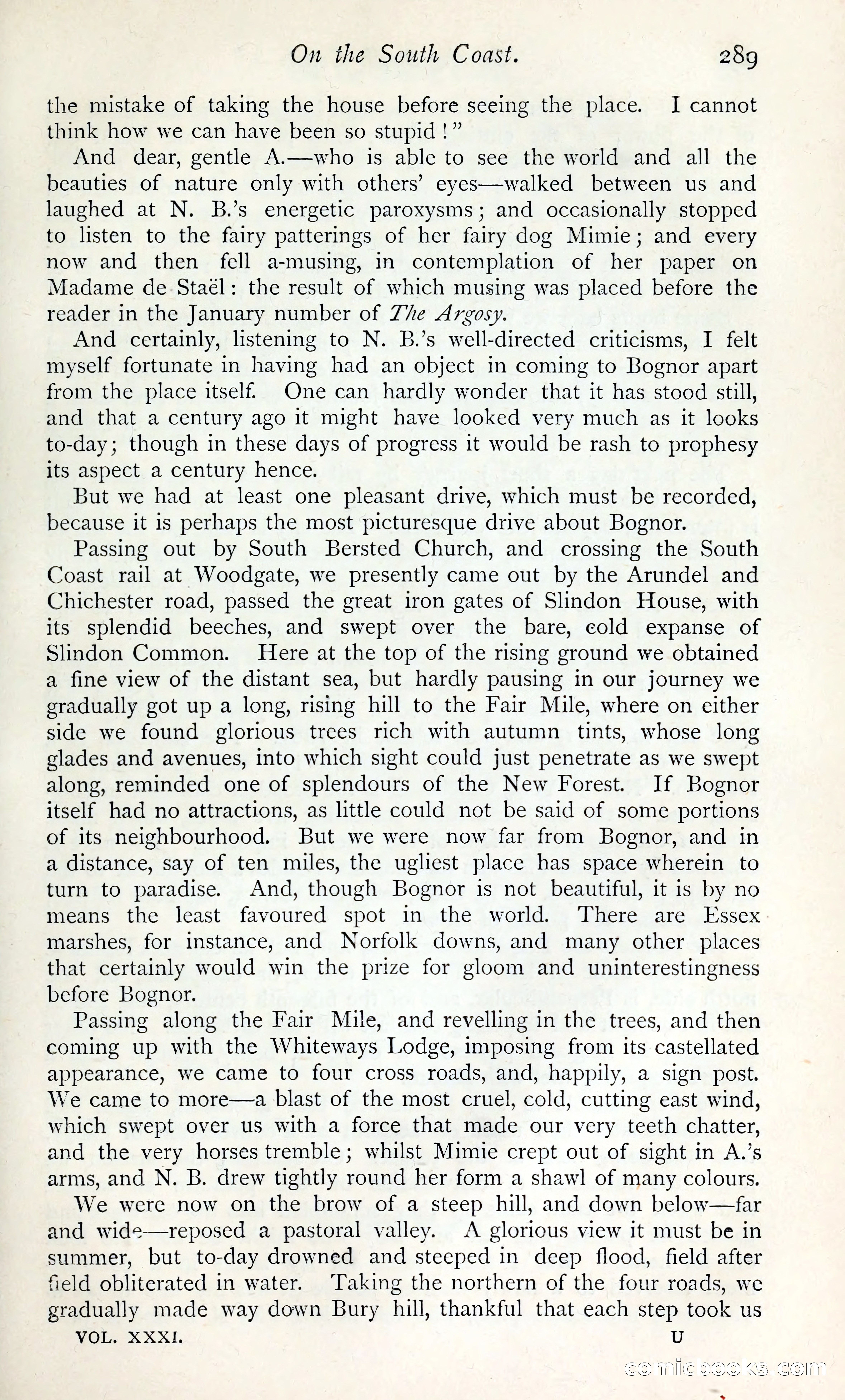
A restored page from Pulp Fiction, 1865. Page through the whole issue in the reader above.
📄 Transcribed text from this page (OCR, searchable)
Machine-transcribed from the original scan — historical spelling and the odd misread are preserved.
On the South Coast. 289 the mistake of taking the house before seeing the place. I cannot think how we can have been so stupid!” And dear, gentle A.—who is able to see the world and all the beauties of nature only with others’ eyes—walked between us and laughed at N. B.’s energetic paroxysms; and occasionally stopped to listen to the fairy patterings of her fairy dog Mimie; and every now and then fell a-musing, in contemplation of her paper on Madame de Stael: the result of which musing was placed before the reader in the January number of Zze Argosy. And certainly, listening to N. B.’s well-directed criticisms, I felt myself fortunate in having had an object in coming to Bognor apart from the place itself. One can hardly wonder that it has stood still, and that a century ago it might have looked very much as it looks to-day; though in these days of progress it would be rash to prophesy its aspect a century hence. But we had at least one pleasant drive, which must be recorded, because it 1s perhaps the most picturesque drive about Bognor. Passing out by South Bersted Church, and crossing the South Coast rail at Woodgate, we presently came out by the Arundel and Chichester road, passed the great iron gates of Slindon House, with its splendid beeches, and swept over the bare, cold expanse of Slindon Common. Here at the top of the rising ground we obtained a fine view of the distant sea, but hardly pausing in our journey we gradually got up a long, rising hill to the Fair Mile, where on either side we found glorious trees rich with autumn tints, whose long glades and avenues, into which sight could just penetrate as we swept along, reminded one of splendours of the New Forest. If Bognor itself had no attractions, as little could not be said of some portions of its neighbourhood. But we were now far from Bognor, and in a distance, say of ten miles, the ugliest place has space wherein to turn to paradise. And, though Bognor is not beautiful, it is by no means the least favoured spot in the world. ‘There are Essex marshes, for instance, and Norfolk downs, and many other places that certainly would win the prize for gloom and uninterestingness before Bognor. Passing along the Fair Mile, and revelling in the trees, and then coming up with the Whiteways Lodge, imposing from its castellated appearance, we came to four cross roads, and, happily, a sign post. We came to more—a blast of the most cruel, cold, cutting east wind, which swept over us with a force that made our very teeth chatter, and the very horses tremble; whilst Mimie crept out of sight in A.’s arms, and N. B. drew tightly round her form a shawl of many colours. We were now on the brow of a steep hill, and down below—far and wide—reposed a pastoral valley. <A glorious view it must be in summer, but to-day drowned and steeped in deep flood, field after field obliterated in water. ‘Taking the northern of the four roads, we gradually made way down Bury hill, thankful that each step took us VOL. XXXI. U CoOnniclooolkks (C(O) *%