
Pulp Fiction, 1865 · page 304 of 400
The Argosy — page 304: what you’re looking at
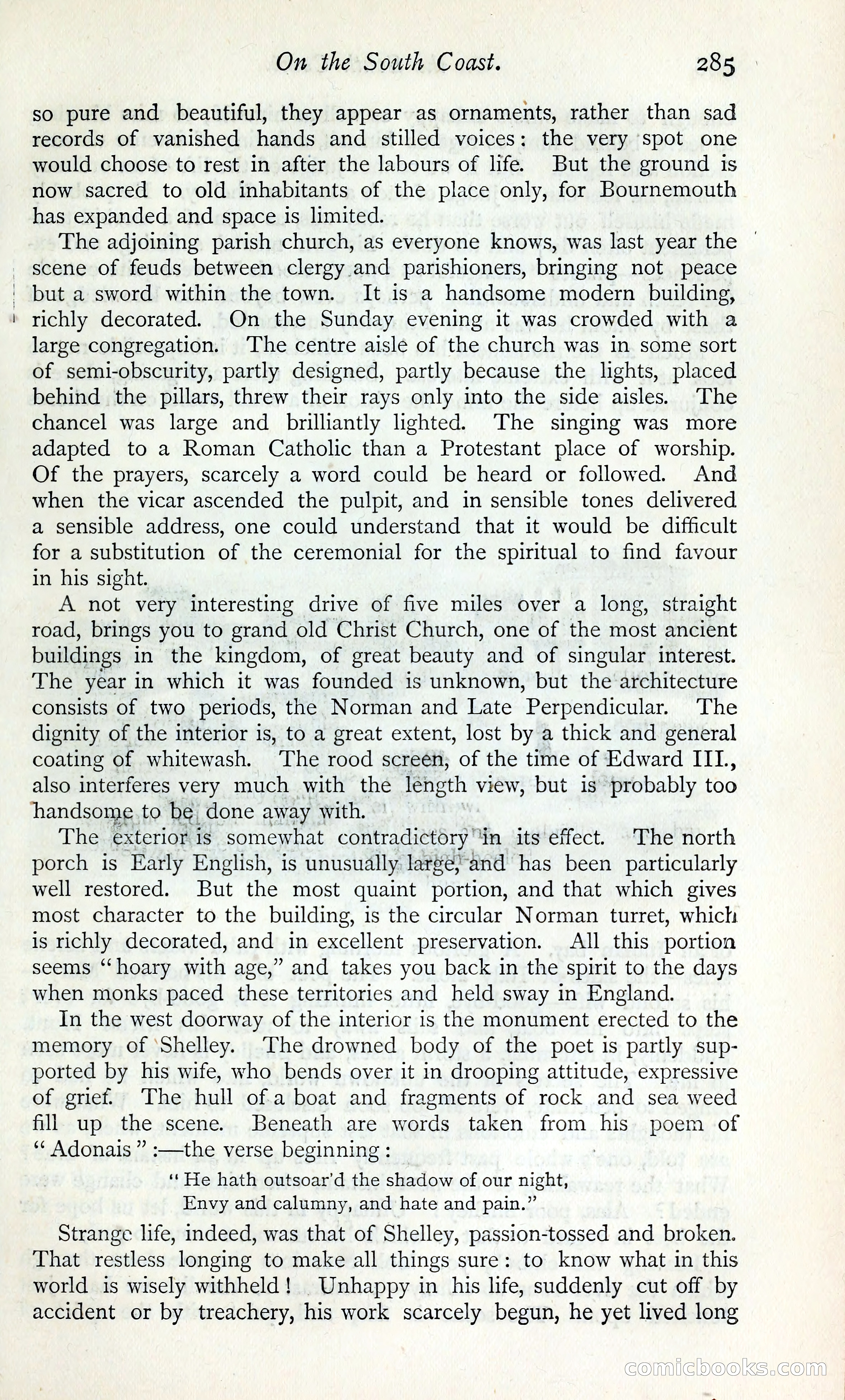
A restored page from Pulp Fiction, 1865. Page through the whole issue in the reader above.
📄 Transcribed text from this page (OCR, searchable)
Machine-transcribed from the original scan — historical spelling and the odd misread are preserved.
— On the South Coast. 285 so pure and beautiful, they appear as ornaments, rather than sad records of vanished hands and stilled voices: the very spot one would choose to rest in after the labours of life. But the ground ts now sacred to old inhabitants of the place only, for Bournemouth has expanded and space is limited. The adjoining parish church, as everyone knows, was last year the © scene of feuds between clergy and parishioners, bringing not peace but a sword within the town. It is a handsome modern building, richly decorated. On the Sunday evening it was crowded with a large congregation. ‘The centre aisle of the church was in some sort of semi-obscurity, partly designed, partly because the lghts, placed behind the pillars, threw their rays only into the side aisles. ‘The chancel was large and brilliantly lighted. The singing was more adapted to a Roman Catholic than a Protestant place of worship. Of the prayers, scarcely a word could be heard or followed. And when the vicar ascended the pulpit, and in sensible tones delivered a sensible address, one could understand that it would be difficult for a substitution of the ceremonial for the spiritual to find favour in his sight. A not very interesting drive of five miles over a long, straight road, brings you to grand old Christ Church, one of the most ancient buildings in the kingdom, of great beauty and of singular interest. The year in which it was founded is unknown, but the architecture consists of two periods, the Norman and Late Perpendicular. The dignity of the interior is, to a great extent, lost by a thick and general coating of whitewash. ‘The rood screen, of the time of Edward IIL, also interferes very much with the length view, but is probably too handsome. to be done away with. The exterior is somewhat contradictory"in its effect. The north porch is Early English, is unusually large} and has been particularly well restored. But the most quaint portion, and that which gives most character to the building, is the circular Norman turret, which is richly decorated, and in excellent preservation. All this portion seems “hoary with age,” and takes you back in the spirit to the days when monks paced these territories and held sway in England. In the west doorway of the interior is the monument erected to the memory of ‘Shelley. ‘The drowned body of the poet is partly sup- ported by his wife, who bends over it in drooping attitude, expressive of grief. ‘The hull of.a boat and fragments of rock and sea weed fill up the scene. Beneath are words taken from his poem of ‘‘ Adonais ” :—the verse beginning : . ‘‘ Fe hath outsoar’d the shadow of our night, Envy and calumny, and hate and pain.” Strange life, indeed, was that of Shelley, passion-tossed and broken. That restless longing to make all things sure: to know what in this world is wisely withheld! Unhappy in his life, suddenly cut off by accident or by treachery, his work scarcely begun, he yet lived long COMIC OOO SS (C(O)