
Pulp Fiction, 1865 · page 115 of 400
The Argosy — page 115: what you’re looking at
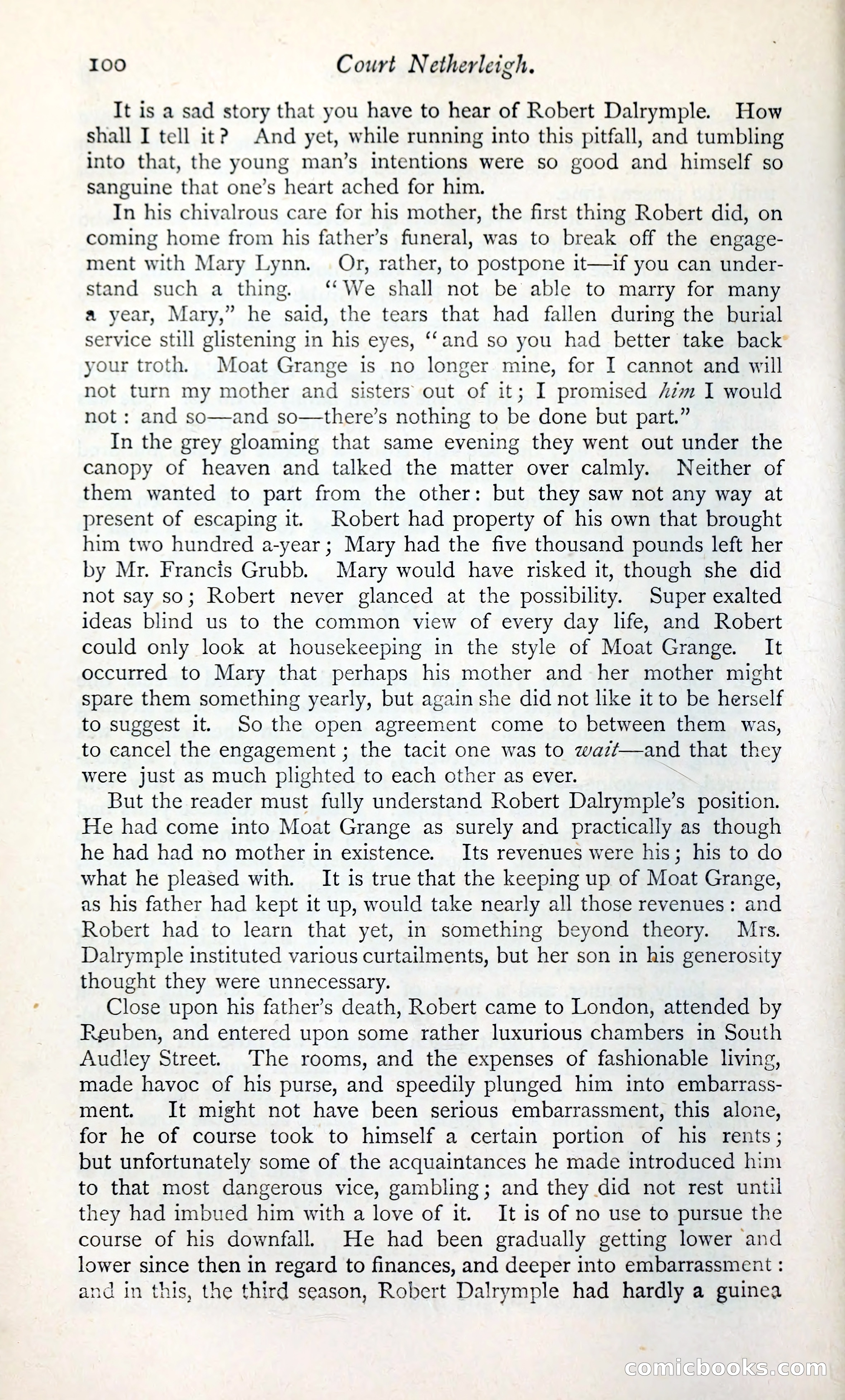
A restored page from Pulp Fiction, 1865. Page through the whole issue in the reader above.
📄 Transcribed text from this page (OCR, searchable)
Machine-transcribed from the original scan — historical spelling and the odd misread are preserved.
100 Court Netherleigh. It is a sad story that you have to hear of Robert Dalrymple. How shall I tell it? And yet, while running into this pitfall, and tumbling into that, the young man’s intentions were so good and himself so sanguine that one’s heart ached for him. In his chivalrous care for his mother, the first thing Robert did, on coming home from his father’s funeral, was to break off the engage- ment with Mary Lynn. Or, rather, to postpone it—if you can under- stand such a thing. ‘‘We shall not be able to marry for many a year, Mary,” he said, the tears that had fallen during the burial service still glistening in his eyes, ‘“‘and so you had better take back’ your troth. Moat Grange is no longer mine, for I cannot and will not turn my mother and sisters out of it; I promised Azm I would not : and so—and so—there’s nothing to be done but part.” In the grey gloaming that same evening they went out under the canopy of heaven and talked the matter over calmly. Neither of them wanted to part from the other: but they saw not any way at present of escaping it. Robert had property of his own that brought him two hundred a-year; Mary had the five thousand pounds left her by Mr. Francis Grubb. Mary would have risked it, though she did not say so; Robert never glanced at the possibility. Super exalted ideas blind us to the common view of every day life, and Robert could only look at housekeeping in the style of Moat Grange. It occurred to Mary that perhaps his mother and her mother might spare them something yearly, but again she did not like it to be herself to suggest it. So the open agreement come to between them was, to cancel the engagement ; the tacit one was to watt—and that they were just as much plighted to each other as ever. > But the reader must fully understand Robert Dalrymple’s position. He had come into Moat Grange as surely and practically as though he had had no mother in existence. Its revenues were his; his to do what he pleased with. It is true that the keeping up of Moat Grange, as his father had kept it up, would take nearly all those revenues: and Robert had to learn that yet, in something beyond theory. Mrs. Dalrymple instituted various curtailments, but her son in his generosity thought they were unnecessary. Close upon his father’s death, Robert came to London, attended by Reuben, and entered upon some rather luxurious chambers in South Audley Street. The rooms, and the expenses of fashionable living, made havoc of his purse, and speedily plunged him into embarrass- ment. It might not have been serious embarrassment, this alone, for he of course took to himself a certain portion of his rents; but unfortunately some of the acquaintances he made introduced isn to that most dangerous vice, gambling; and they did not rest unti they had imbued him with a love of it. It 1s of no use to pursue the course of his downfall. He had been gradually getting lower and lower since then in regard to finances, and deeper into embarrassment : and in this, the third season, Robert Dalrymple had hardly a guinea EOPNIELOIOO KS. EO) im