
Pulp Fiction, 1865 · page 113 of 400
The Argosy — page 113: what you’re looking at
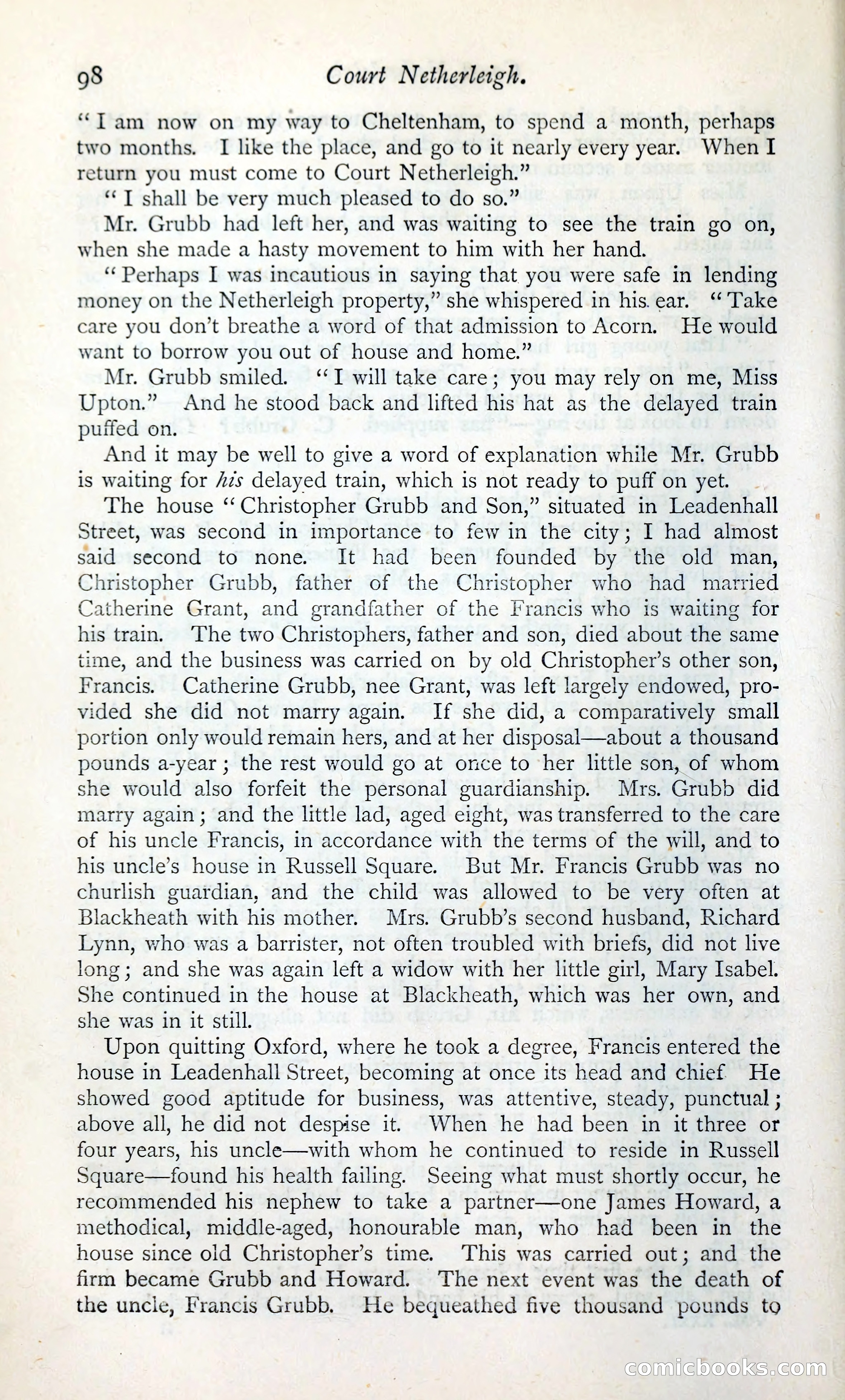
A restored page from Pulp Fiction, 1865. Page through the whole issue in the reader above.
📄 Transcribed text from this page (OCR, searchable)
Machine-transcribed from the original scan — historical spelling and the odd misread are preserved.
98 Court Netherleigh. ‘Tam now on my way to Cheltenham, to spend a month, perhaps two months. I like the place, and go to it nearly every year. When I return you must come to Court Netherleigh.” ‘*T shall be very much pleased to do so.” Mr. Grubb had left her, and was waiting to see the train go on, when she made a hasty movement to him with her hand. ‘Perhaps I was incautious in saying that you were safe in lending money on the Netherleigh property,” she whispered in his.ear. ‘“ Take care you don’t breathe a word of that admission to Acorn. He would want to borrow you out of house and home.” Mr. Grubb smiled. ‘I will take care; you may rely on me, Miss Upton.” And he stood back and lifted his hat as the delayed train puffed on. And it may be well to give a word of explanation while Mr. Grubb is waiting for Azs delayed train, which is not ready to puff on yet. The house ‘‘ Christopher Grubb and Son,” situated in Leadenhall Street, was second in importance to few in the city; I had almost said second to none. It had been founded by the old man, Christopher Grubb, father of the Christopher who had married Catherine Grant, and grandfather of the Francis who 1s waiting for his train. ‘The two Christophers, father and son, died about the same time, and the business was carried on by old Christopher’s other son, Francis. Catherine Grubb, nee Grant, was left largely endowed, pro- vided she did not marry again. If she did, a comparatively small portion only would remain hers, and at her disposal—about a thousand pounds a-year ; the rest would go at once to her httle son, of whom she would also forfeit the personal guardianship. Mrs. Grubb did marry again; and the little lad, aged eight, was transferred to the care of his uncle Francis, in accordance with the terms of the will, and to his uncle’s house in Russell Square. But Mr. Francis Grubb was no churlish guardian, and the child was allowed to be very often at Blackheath with his mother. Mrs. Grubb’s second husband, Richard Lynn, who was a barrister, not often troubled with briefs, did not live long; and she was again left a widow with her little girl, Mary Isabel. She continued in the house at Blackheath, which was her own, and she was in it still. Upon quitting Oxford, where he took a degree, Francis entered the house in Leadenhall Street, becoming at once its head and chief He showed good aptitude for business, was attentive, steady, punctual ; above all, he did not despise it. When he had been in it three or four years, his uncle—with whom he continued to reside in Russell Square—found his health failing. Seeing what must shortly occur, he recommended his nephew to take a partner—one James Howard, a methodical, middle-aged, honourable man, who had been in the house since old Christopher’s time. This was carried out; and the firm became Grubb and Howard. The next event was the death of the uncle, Francis Grubb. He bequeathed five thousand pounds to EOPMIE LOO KS .(E) im