
Pulp Fiction, 1865 · page 288 of 400
The Argosy — page 288: what you’re looking at
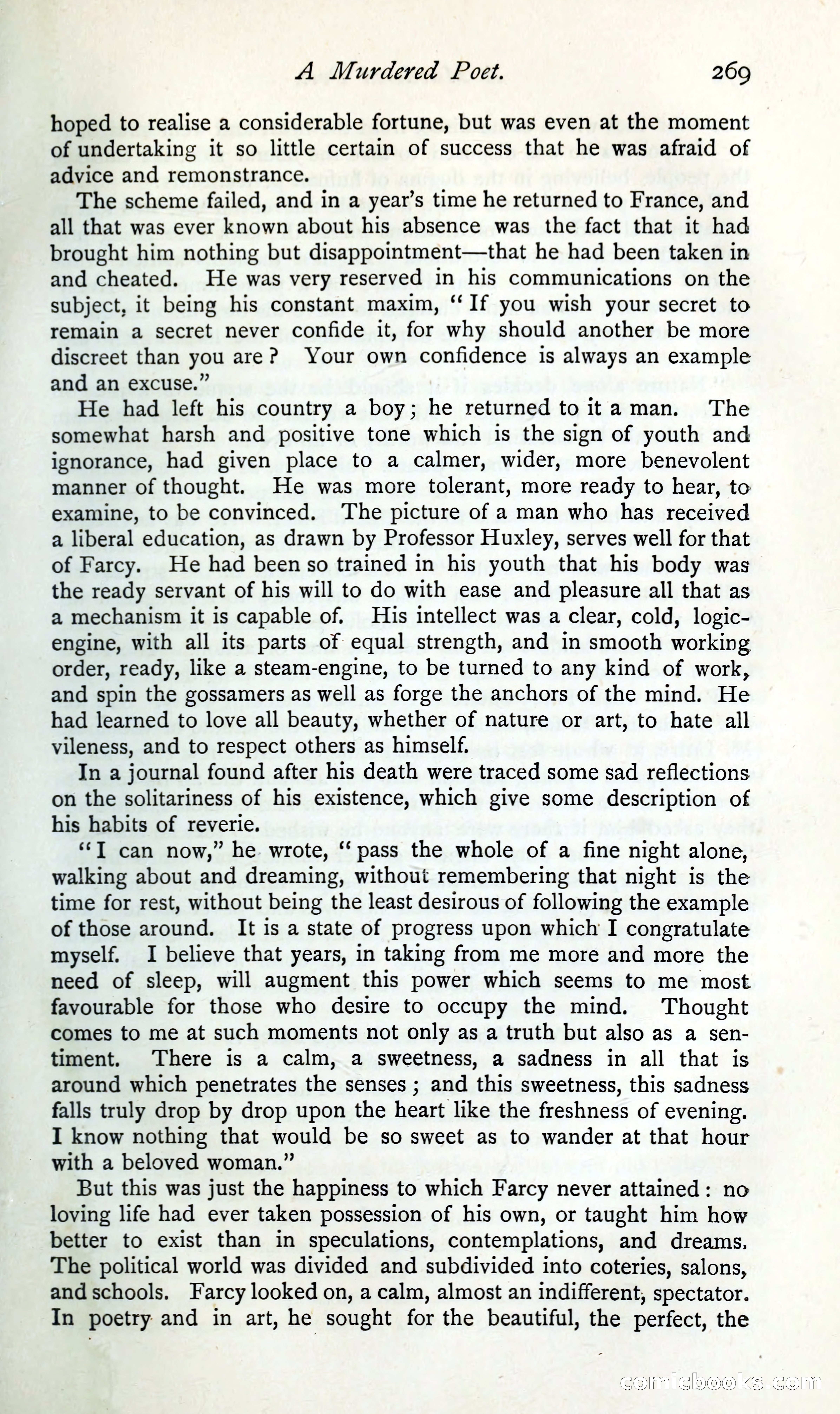
A restored page from Pulp Fiction, 1865. Page through the whole issue in the reader above.
📄 Transcribed text from this page (OCR, searchable)
Machine-transcribed from the original scan — historical spelling and the odd misread are preserved.
A Murdered Poet. 269 hoped to realise a considerable fortune, but was even at the moment of undertaking it so little certain of success that he was afraid of advice and remonstrance. The scheme failed, and in a year’s time he returned to France, and all that was ever known about his absence was the fact that it had brought him nothing but disappointment—that he had been taken in and cheated. He was very reserved in his communications on the subject, it being his constant maxim, “‘If you wish your secret to remain a secret never confide it, for why should another be more discreet than you are? Your own confidence is always an example and an excuse.” He had left his country a boy; he returned toita man. The somewhat harsh and positive tone which is the sign of youth and ignorance, had given place to a calmer, wider, more benevolent manner of thought. He was more tolerant, more ready to hear, to examine, to be convinced. The picture of a man who has received a liberal education, as drawn by Professor Huxley, serves well for that of Farcy. He had been so trained in his youth that his body was the ready servant of his will to do with ease and pleasure all that as a mechanism it is capable of. His intellect was a clear, cold, logic- engine, with all its parts of equal strength, and in smooth working order, ready, like a steam-engine, to be turned to any kind of work, and spin the gossamers as well as forge the anchors of the mind. He had learned to love all beauty, whether of nature or art, to hate all vileness, and to respect others as himself. In a journal found after his death were traced some sad reflections on the solitariness of his existence, which give some description of his habits of reverie. ‘‘T can now,” he wrote, ‘‘ pass the whole of a fine night alone, walking about and dreaming, without remembering that night is the time for rest, without being the least desirous of following the example of those around. It is a state of progress upon which I congratulate myself. I believe that years, in taking from me more and more the need of sleep, will augment this power which seems to me most favourable for those who desire to occupy the mind. Thought comes to me at such moments not only as a truth but also as a sen- timent. There is a calm, a sweetness, a sadness in all that is around which penetrates the senses ; and this sweetness, this sadness falls truly drop by drop upon the heart like the freshness of evening. I know nothing that would be so sweet as to wander at that hour with a beloved woman.” But this was just the happiness to which Farcy never attained: no loving life had ever taken possession of his own, or taught him how better to exist than in speculations, contemplations, and dreams, The political world was divided and subdivided into coteries, salons, and schools. Farcy looked on, a calm, almost an indifferent, spectator. In poetry and in art, he sought for the beautiful, the perfect, the CoOnnicloookKks (SO) an