
Pulp Fiction, 1865 · page 287 of 400
The Argosy — page 287: what you’re looking at
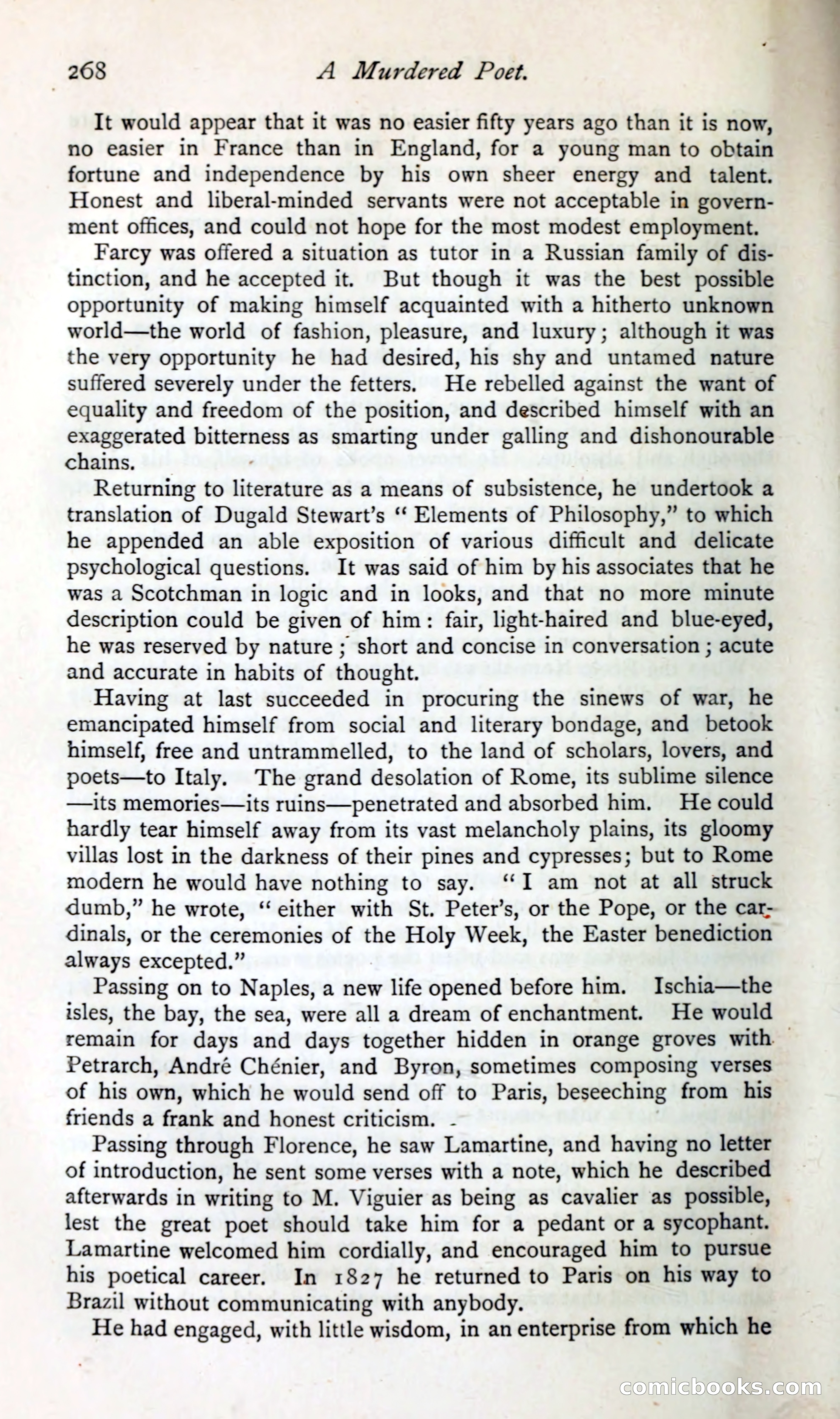
A restored page from Pulp Fiction, 1865. Page through the whole issue in the reader above.
📄 Transcribed text from this page (OCR, searchable)
Machine-transcribed from the original scan — historical spelling and the odd misread are preserved.
| 208 A Murdered Poet. It would appear that it was no easier fifty years ago than it is now, no easier in France than in England, for a young man to obtain fortune and independence by his own sheer energy and talent. Honest and liberal-minded servants were not acceptable in govern- ment offices, and could not hope for the most modest employment. Farcy was offered a situation as tutor in a Russian family of dis- tinction, and he accepted it. But though it was the best possible opportunity of making himself acquainted with a hitherto unknown world—the world of fashion, pleasure, and luxury; although it was the very opportunity he had desired, his shy and untamed nature suffered severely under the fetters. He rebelled against the want of equality and freedom of the position, and described himself with an exaggerated bitterness as smarting under galling and dishonourable chains, _ ' Returning to literature as a means of subsistence, he undertook a translation of Dugald Stewart’s ‘‘ Elements of Philosophy,” to which he appended an able exposition of various difficult and delicate psychological questions. It was said of him by his associates that he was a Scotchman in logic and in looks, and that no more minute description could be given of him: fair, light-haired and blue-eyed, he was reserved by nature ; short and concise in conversation ; acute and accurate in habits of thought. Having at last succeeded in procuring the sinews of war, he emancipated himself from social and literary bondage, and betook himself, free and untrammelled, to the land of scholars, lovers, and poets—to Italy. The grand desolation of Rome, its sublime silence —1its memories—its ruins—penetrated and absorbed him. He could hardly tear himself away from its vast melancholy plains, its gloomy villas lost in the darkness of their pines and cypresses; but to Rome modern he would have nothing to say. “I am not at all struck dumb,” he wrote, “either with St. Peter’s, or the Pope, or the car- dinals, or the ceremonies of the Holy Week, the Easter benediction always excepted.” Passing on to Naples, a new life opened before him. Ischia—the isles, the bay, the sea, were all a dream of enchantment. He would remain for days and days together hidden in orange groves with Petrarch, André Chénier, and Byron, sometimes composing verses of his own, which he would send off to Paris, beseeching from his friends a frank and honest criticism. - Passing through Florence, he saw Lamartine, and having no letter of introduction, he sent some verses with a note, which he described afterwards in writing to M. Viguier as being as cavalier as possible, lest the great poet should take him for a pedant or a sycophant. Lamartine welcomed him cordially, and encouraged him to pursue his poetical career. In 1827 he returned to Paris on his way to Brazil without communicating with anybody. He had engaged, with little wisdom, in an enterprise from which he Gomichbooks. com