
Pulp Fiction, 1865 · page 289 of 400
The Argosy — page 289: what you’re looking at
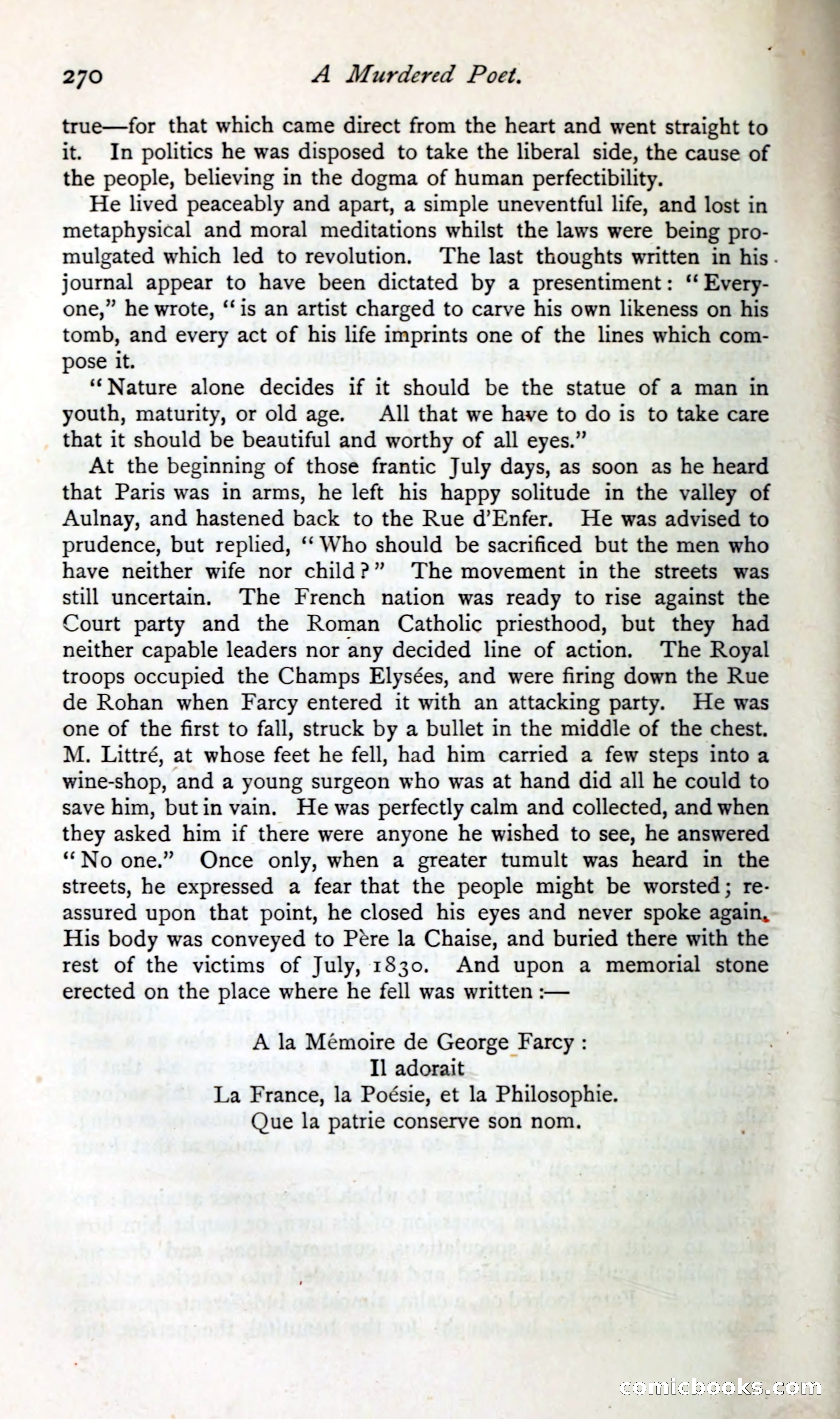
A restored page from Pulp Fiction, 1865. Page through the whole issue in the reader above.
📄 Transcribed text from this page (OCR, searchable)
Machine-transcribed from the original scan — historical spelling and the odd misread are preserved.
270 A Murdered Poet. true—for that which came direct from the heart and went straight to it. In politics he was disposed to take the liberal side, the cause of the people, believing in the dogma of human perfectibility. He lived peaceably and apart, a simple uneventful life, and lost in metaphysical and moral meditations whilst the laws were being pro- mulgated which led to revolution. The last thoughts written in his. journal appear to have been dictated by a presentiment: ‘‘ Every- one,” he wrote, ‘‘is an artist charged to carve his own likeness on his tomb, and every act of his life imprints one of the lines which com- pose it. ‘‘Nature alone decides if it should be the statue of a man in youth, maturity, or old age. All that we have to do is to take care that it should be beautiful and worthy of all eyes.” At the beginning of those frantic July days, as soon as he heard that Paris was in arms, he left his happy solitude in the valley of Aulnay, and hastened back to the Rue d’Enfer. He was advised to prudence, but replied, ‘‘ Who should be sacrificed but the men who have neither wife nor child?” The movement in the streets was still uncertain. The French nation was ready to rise against the Court party and the Roman Catholic priesthood, but they had neither capable leaders nor any decided line of action. The Royal troops occupied the Champs Elysées, and were firing down the Rue de Rohan when Farcy entered it with an attacking party. He was one of the first to fall, struck by a bullet in the middle of the chest. M. Littré, at whose feet he fell, had him carried a few steps into a wine-shop, and a young surgeon who was at hand did all he could to save him, butin vain. He was perfectly calm and collected, and when they asked him if there were anyone he wished to see, he answered “No one.” Once only, when a greater tumult was heard in the streets, he expressed a fear that the people might be worsted; re- assured upon that point, he closed his eyes and never spoke again, His body was conveyed to Pére la Chaise, and buried there with the rest of the victims of July, 1830. And upon a memorial stone erected on the place where he fell was written :-— A la Mémoire de George Farcy : Il adorait La France, la Poésie, et la Philosophie. Que la patrie conserve son nom. (E(0) GoImiGghvooks;