
Pulp Fiction, 1865 · page 286 of 400
The Argosy — page 286: what you’re looking at
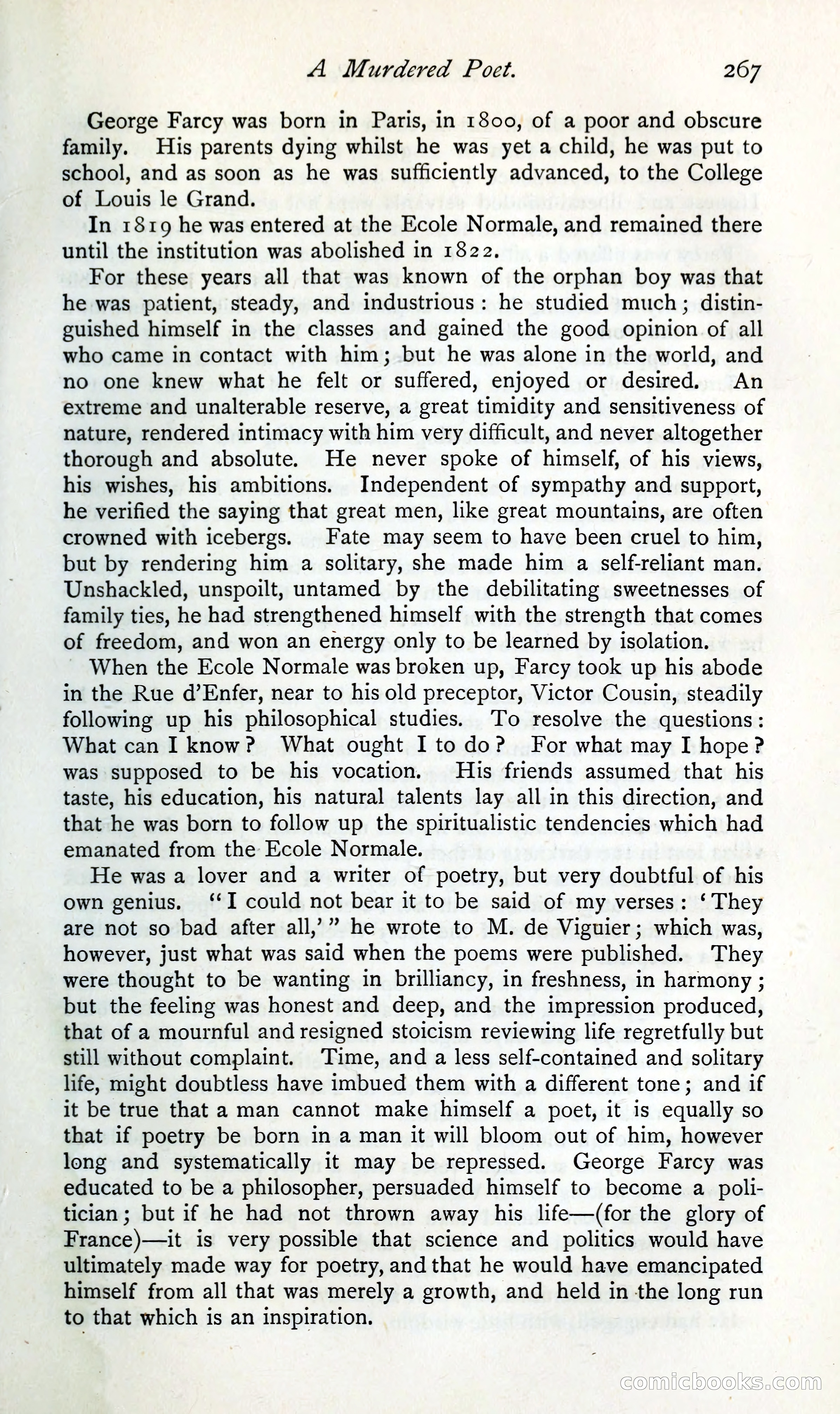
A restored page from Pulp Fiction, 1865. Page through the whole issue in the reader above.
📄 Transcribed text from this page (OCR, searchable)
Machine-transcribed from the original scan — historical spelling and the odd misread are preserved.
A Murdered Poet. 267 George Farcy was born in Paris, in 1800, of a poor and obscure family. His parents dying whilst he was yet a child, he was put to school, and as soon as he was sufficiently advanced, to the College of Louis le Grand. In 1819 he was entered at the Ecole Normale, and remained there until the institution was abolished in 1822. For these years all that was known of the orphan boy was that he was patient, steady, and industrious: he studied much; distin- guished himself in the classes and gained the good opinion of all who came in contact with him; but he was alone in the world, and no one knew what he felt or suffered, enjoyed or desired. An extreme and unalterable reserve, a great timidity and sensitiveness of nature, rendered intimacy with him very difficult, and never altogether thorough and absolute. He never spoke of himself, of his views, his wishes, his ambitions. Independent of sympathy and support, he verified the saying that great men, like great mountains, are often crowned with icebergs. Fate may seem to have been cruel to him, but by rendering him a solitary, she made him a self-reliant man. Unshackled, unspoilt, untamed by the debilitating sweetnesses of family ties, he had strengthened himself with the strength that comes of freedom, and won an energy only to be learned by isolation. When the Ecole Normale was broken up, Farcy took up his abode in the Rue d’Enfer, near to his old preceptor, Victor Cousin, steadily following up his philosophical studies. To resolve the questions: What can I know? What ought I todo? For what may I hope? was supposed to be his vocation. His friends assumed that his taste, his education, his natural talents lay all in this direction, and that he was born to follow up the spiritualistic tendencies which had emanated from the Ecole Normale. He was a lover and a writer of poetry, but very doubtful of his own genius. ‘‘I could not bear it to be said of my verses: ‘ They are not so bad after all,’” he wrote to M. de Viguier; which was, however, just what was said when the poems were published. They were thought to be wanting in brilliancy, in freshness, in harmony ; but the feeling was honest and deep, and the impression produced, that of a mournful and resigned stoicism reviewing life regretfully but still without complaint. ‘Time, and a less self-contained and solitary life, might doubtless have imbued them with a different tone; and if it be true that a man cannot make himself a poet, it is equally so that if poetry be born in a man it will bloom out of him, however long and systematically it may be repressed. George Farcy was educated to be a philosopher, persuaded himself to become a poli- tician; but if he had not thrown away his life—(for the glory of France)—it is very possible that science and politics would have ultimately made way for poetry, and that he would have emancipated himself from all that was merely a growth, and held in the long run to that which is an inspiration. an CcoOnnicloooKks