
Pulp Fiction, 1865 · page 169 of 400
The Argosy — page 169: what you’re looking at
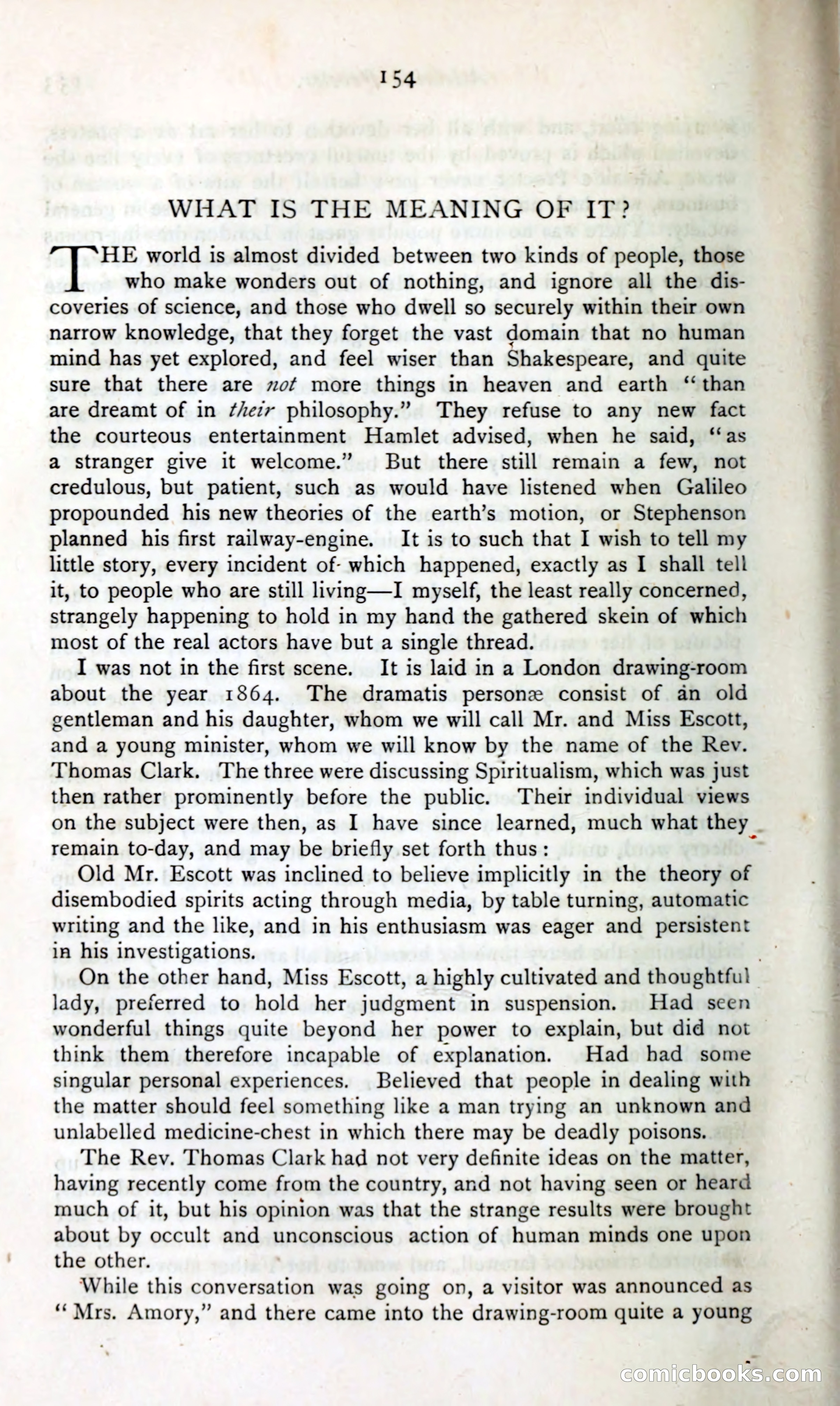
A restored page from Pulp Fiction, 1865. Page through the whole issue in the reader above.
📄 Transcribed text from this page (OCR, searchable)
Machine-transcribed from the original scan — historical spelling and the odd misread are preserved.
154 WHAT IS THE MEANING OF IT? vi ace world is almost divided between two kinds of people, those who make wonders out of nothing, and ignore all the dis- coveries of science, and those who dwell so securely within their own narrow knowledge, that they forget the vast domain that no human mind has yet explored, and feel wiser than Shakespeare, and quite sure that there are zo¢ more things in heaven and earth “ than are dreamt of in ¢hezr philosophy.” They refuse to any new fact the courteous entertainment Hamlet advised, when he said, ‘‘as a stranger give it welcome.” But there still remain a few, not credulous, but patient, such as would have listened when Galileo propounded his new theories of the earth’s motion, or Stephenson planned his first railway-engine. It is to such that I wish to tell my little story, every incident of- which happened, exactly as I shall tell it, to people who are still living—I myself, the least really concerned, strangely happening to hold in my hand the gathered skein of which most of the real actors have but a single thread. I was not in the first scene. It is laid in a London drawing-room about the year 1864. The dramatis personz consist of an old gentleman and his daughter, whom we will call Mr. and Miss Escott, and a young minister, whom we will know by the name of the Rev. Thomas Clark. The three were discussing Spiritualism, which was just then rather prominently before the public. Their individual views on the subject were then, as I have since learned, much what they . remain to-day, and may be briefly set forth thus: Old Mr. Escott was inclined to believe implicitly in the theory of disembodied spirits acting through media, by table turning, automatic writing and the like, and in his enthusiasm was eager and persistent in his investigations, On the other hand, Miss Escott, a highly cultivated and thoughtful | lady, preferred to hold her judgment in suspension. Had seen wonderful things quite beyond her power to explain, but did not — think them therefore incapable of explanation. Had had some singular personal experiences. Believed that people in dealing with the matter should feel something like a man trying an unknown and unlabelled medicine-chest in which there may be deadly poisons. The Rev. Thomas Clark had not very definite ideas on the matter, having recently come from the country, and not having seen or heard much of it, but his opinion was that the strange results were brought about by occult and unconscious action of human minds one upon the other. While this conversation was going on, a visitor was announced as ‘‘Mrs. Amory,” and there came into the drawing-room quite a young ; Gomicbooks nm