
Pulp Fiction, 1865 · page 170 of 400
The Argosy — page 170: what you’re looking at
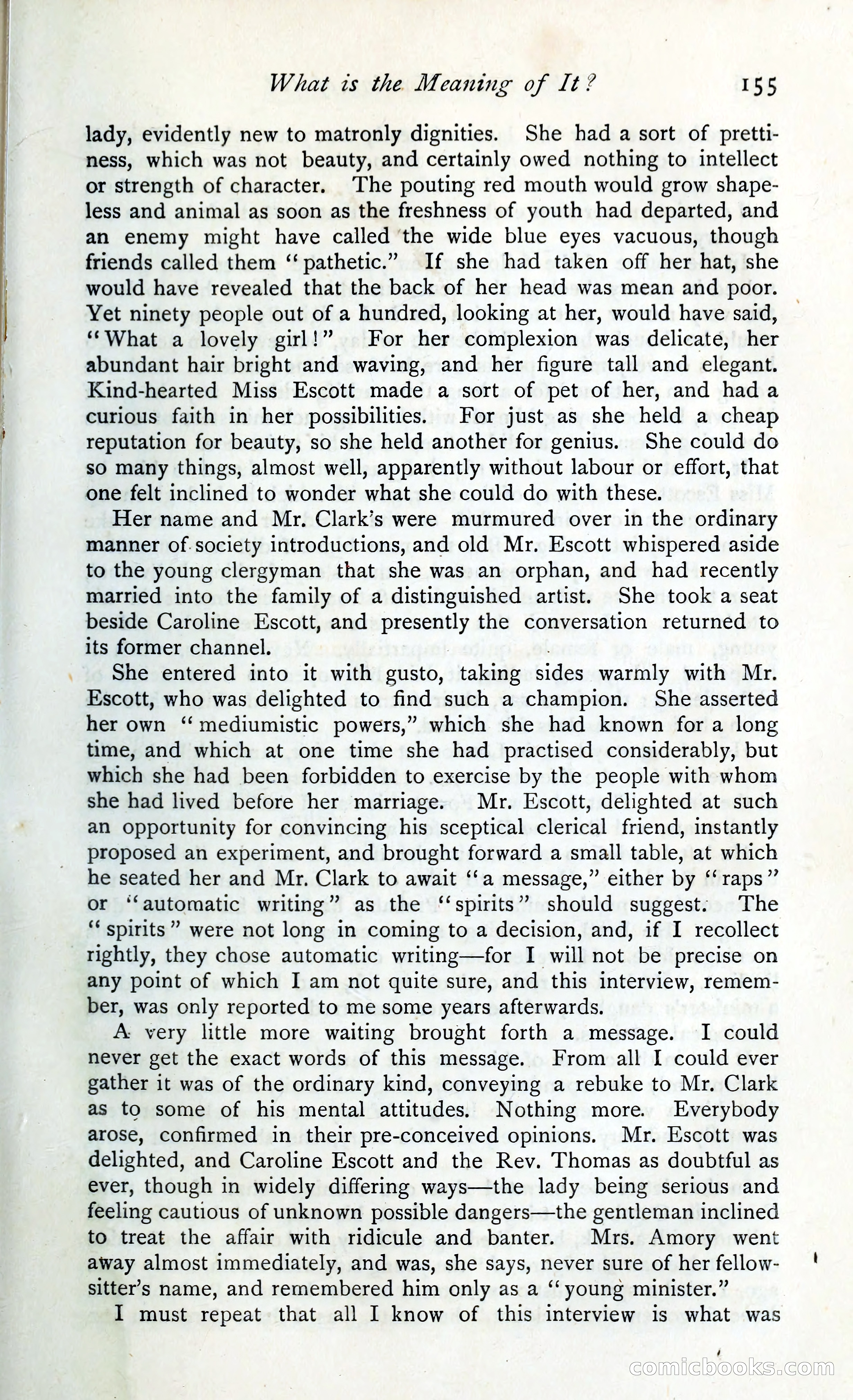
A restored page from Pulp Fiction, 1865. Page through the whole issue in the reader above.
📄 Transcribed text from this page (OCR, searchable)
Machine-transcribed from the original scan — historical spelling and the odd misread are preserved.
What ts the Meaning of Lt? 155 lady, evidently new to matronly dignities. She had a sort of pretti- ness, which was not beauty, and certainly owed nothing to intellect or strength of character. The pouting red mouth would grow shape- less and animal as soon as the freshness of youth had departed, and an enemy might have called the wide blue eyes vacuous, though friends called them ‘‘ pathetic.” If she had taken off her hat, she would have revealed that the back of her head was mean and poor. Yet ninety people out of a hundred, looking at her, would have said, ‘What a lovely girl!” For her complexion was delicate, her abundant hair bright and waving, and her figure tall and elegant. Kind-hearted Miss Escott made a sort of pet of her, and hada curious faith in her possibilities. For just as she held a cheap reputation for beauty, so she held another for genius. She could do sO many things, almost well, apparently without labour or effort, that one felt inclined to wonder what she could do with these. Her name and Mr. Clark’s were murmured over in the ordinary manner of.society introductions, and old Mr. Escott whispered aside to the young clergyman that she was an orphan, and had recently married into the family of a distinguished artist. She took a seat beside Caroline Escott, and presently the conversation returned to its former channel. . , She entered into it with gusto, taking sides warmly with Mr. Escott, who was delighted to find such a champion. She asserted her own ‘“‘ mediumistic powers,” which she had known for a long time, and which at one time she had practised considerably, but which she had been forbidden to exercise by the people with whom she had lived before her marriage. Mr. Escott, delighted at such an opportunity for convincing his sceptical clerical friend, instantly proposed an experiment, and brought forward a small table, at which he seated her and Mr. Clark to await ‘‘a message,” either by ‘‘ raps” or ‘‘automatic writing” as the ‘‘spirits” should suggest: The ‘ spirits” were not long in coming to a decision, and, if I recollect rightly, they chose automatic writing—for I will not be precise on any point of which I am not quite sure, and this interview, remem- ber, was only reported to me some years afterwards. A: very little more waiting brought forth a message. I could never get the exact words of this message. From all I could ever gather it was of the ordinary kind, conveying a rebuke to Mr. Clark as to some of his mental attitudes. Nothing more. Everybody arose, confirmed in their pre-conceived opinions. Mr. Escott was delighted, and Caroline Escott and the Rev. Thomas as doubtful as ever, though in widely differing ways—the lady being serious and feeling cautious of unknown possible dangers—the gentleman inclined to treat the affair with ridicule and banter. Mrs. Amory went away almost immediately, and was, she says, never sure of her fellow- sitter’s name, and remembered him only as a “‘ young minister.” I must repeat that all I know of this interview is what was CoOnniclooolks (CO) am =)