
Pulp Fiction, 1865 · page 167 of 400
The Argosy — page 167: what you’re looking at
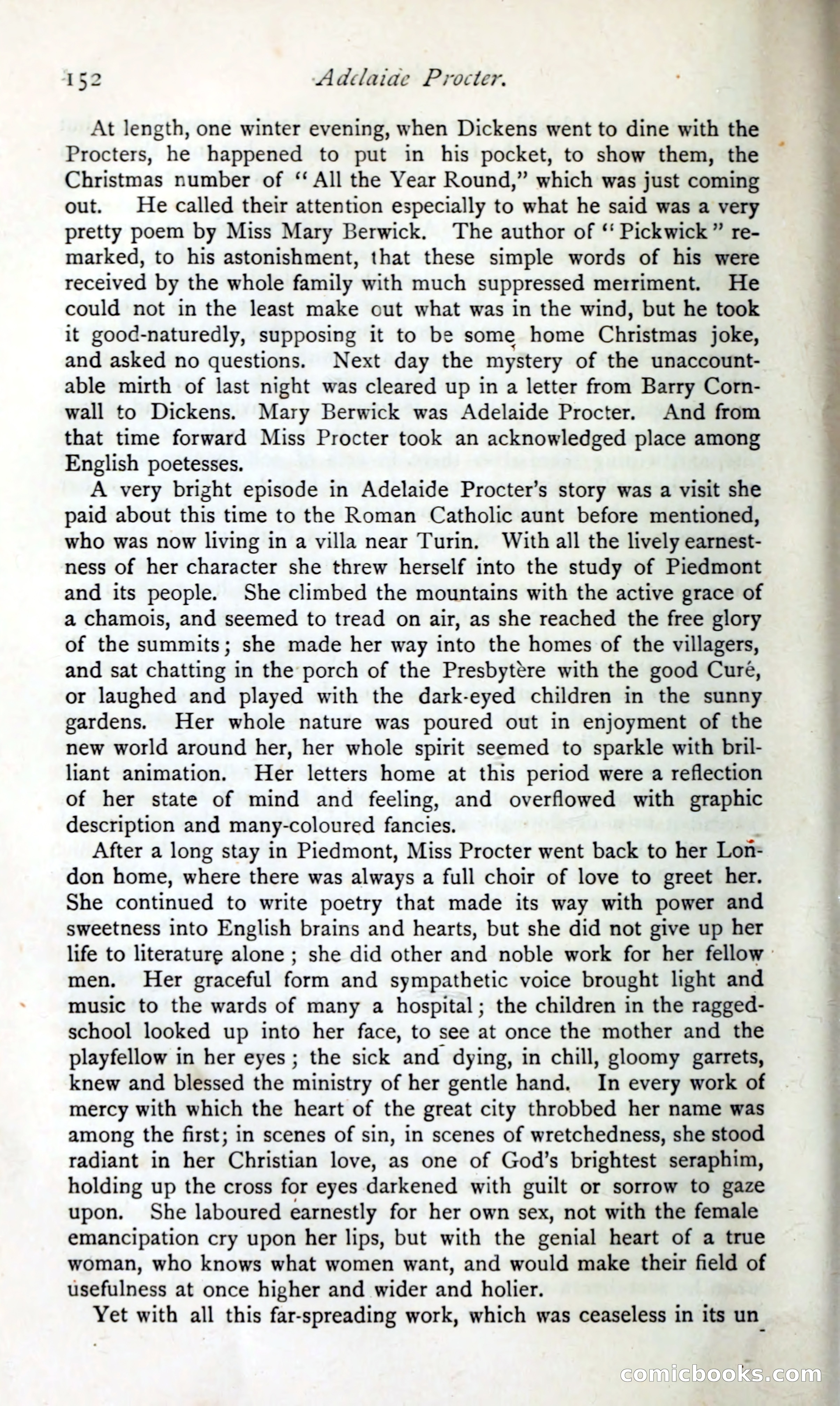
A restored page from Pulp Fiction, 1865. Page through the whole issue in the reader above.
📄 Transcribed text from this page (OCR, searchable)
Machine-transcribed from the original scan — historical spelling and the odd misread are preserved.
152 Adcdaiae Procter. At length, one winter evening, when Dickens went to dine with the Procters, he happened to put in his pocket, to show them, the Christmas number of ‘‘ All the Year Round,” which was just coming out. He called their attention especially to what he said was a very pretty poem by Miss Mary Berwick. The author of ‘‘ Pickwick” re- marked, to his astonishment, that these simple words of his were received by the whole family with much suppressed merriment. He could not in the least make out what was in the wind, but he took it good-naturedly, supposing it to be some home Christmas joke, and asked no questions. Next day the mystery of the unaccount- able mirth of last night was cleared up in a letter from Barry Corn- wall to Dickens. Mary Berwick was Adelaide Procter. And from that time forward Miss Procter took an acknowledged place among English poetesses. A very bright episode in Adelaide Procter’s story was a visit she paid about this time to the Roman Catholic aunt before mentioned, who was now living in a villa near Turin. With all the lively earnest- ness of her character she threw herself into the study of Piedmont and its people. She climbed the mountains with the active grace of a chamois, and seemed to tread on air, as she reached the free glory of the summits; she made her way into the homes of the villagers, and sat chatting in the porch of the Presbyttre with the good Cure, or laughed and played with the dark-eyed children in the sunny gardens. Her whole nature was poured out in enjoyment of the new world around her, her whole spirit seemed to sparkle with bril- liant animation. Her letters home at this period were a reflection of her state of mind and feeling, and overflowed with graphic description and many-coloured fancies. After a long stay in Piedmont, Miss Procter went back to her Lon- don home, where there was always a full choir of love to greet her. She continued to write poetry that made its way with power and sweetness into English brains and hearts, but she did not give up her life to literature alone ; she did other and noble work for her fellow men. Her graceful form and sympathetic voice brought light and music to the wards of many a hospital; the children in the ragged- school looked up into her face, to see at once the mother and the playfellow in her eyes ; the sick and dying, in chill, gloomy garrets, knew and blessed the ministry of her gentle hand. In every work of mercy with which the heart of the great city throbbed her name was among the first; in scenes of sin, in scenes of wretchedness, she stood radiant in her Christian love, as one of God’s brightest seraphim, holding up the cross for eyes darkened with guilt or sorrow to gaze upon. She laboured earnestly for her own sex, not with the female emancipation cry upon her lips, but with the genial heart of a true woman, who knows what women want, and would make their field of usefulness at once higher and wider and holier. Yet with all this far-spreading work, which was ceaseless in its un Comicbooks (E(0) m » 7 5 ‘ ‘ eee ee s