
Pulp Fiction, 1865 · page 166 of 400
The Argosy — page 166: what you’re looking at
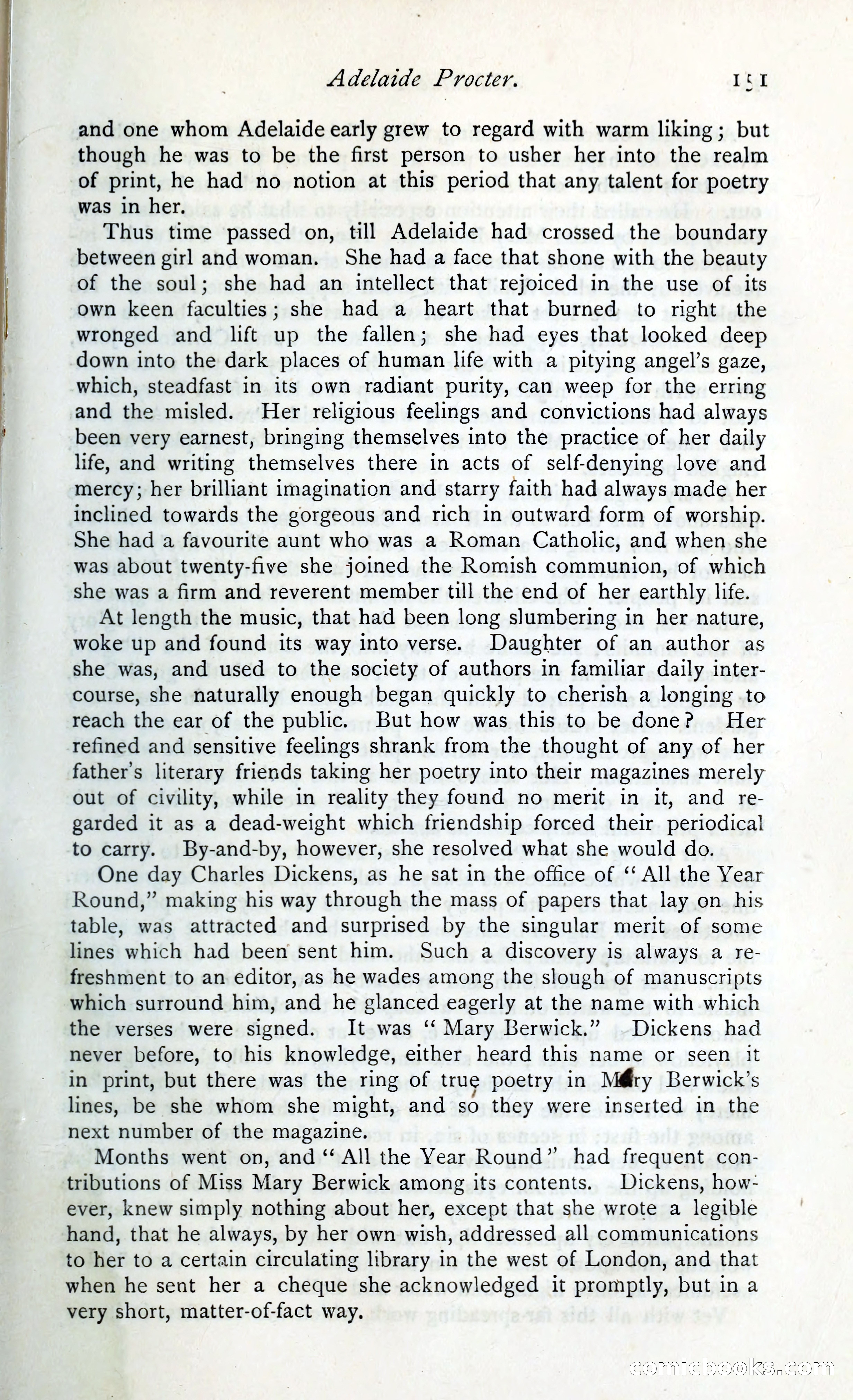
A restored page from Pulp Fiction, 1865. Page through the whole issue in the reader above.
📄 Transcribed text from this page (OCR, searchable)
Machine-transcribed from the original scan — historical spelling and the odd misread are preserved.
Adelaide Procter. Itt and one whom Adelaide early grew to regard with warm liking; but though he was to be the first person to usher her into the realm of print, he had no notion at this period that any talent for poetry was in her. Thus time passed on, till Adelaide had crossed the boundary between girl and woman. She had a face that shone with the beauty of the soul; she had an intellect that rejoiced in the use of its own keen faculties; she had a heart that burned to right the wronged and lift up the fallen; she had eyes that looked deep down into the dark places of human life with a pitying angel’s gaze, which, steadfast in its own radiant purity, can weep for the erring and the misled. Her religious feelings and convictions had always been very earnest, bringing themselves into the practice of her daily life, and writing themselves there in acts of self-denying love and mercy; her brilliant imagination and starry faith had always made her inclined towards the gorgeous and rich in outward form of worship. She had a favourite aunt who was a Roman Catholic, and when she was about twenty-five she joined the Romish communion, of which she was a firm and reverent member till the end of her earthly life. At length the music, that had been long slumbering in her nature, woke up and found its way into verse. Daughter of an author as she was, and used to the society of authors in familiar daily inter- course, she naturally enough began quickly to cherish a longing to reach the ear of the public. But how was this to be done? Her refined and sensitive feelings shrank from the thought of any of her father's literary friends taking her poetry into their magazines merely out of civility, while in reality they found no merit in it, and re- garded it as a dead-weight which friendship forced their periodical to carry. By-and-by, however, she resolved what she would do. One day Charles Dickens, as he sat in the office of ‘‘ All the Year Round,” making his way through the mass of papers that lay en his table, was attracted and surprised by the singular merit of some lines which had been sent him. Such a discovery is always a re- freshment to an editor, as he wades among the slough of manuscripts which surround him, and he glanced eagerly at the name with which the verses were signed. It was ‘‘ Mary Berwick.” Dickens had never before, to his knowledge, either heard this name or seen it in print, but there was the ring of true poetry in Mfry Berwick’s lines, be she whom she might, and so they were inserted in the next number of the magazine. Months went on, and ‘‘ All the Year Round” had frequent con- tributions of Miss Mary Berwick among its contents. Dickens, how- ever, knew simply nothing about her, except that she wrote a legible hand, that he always, by her own wish, addressed all communications to her to a certain circulating library in the west of London, and that when he sent her a cheque she acknowledged it promptly, but in a very short, matter-of-fact way. COnniclooolkks (CO) am =?)