
Pulp Fiction, 1865 · page 169 of 400
The Argosy — page 169: what you’re looking at
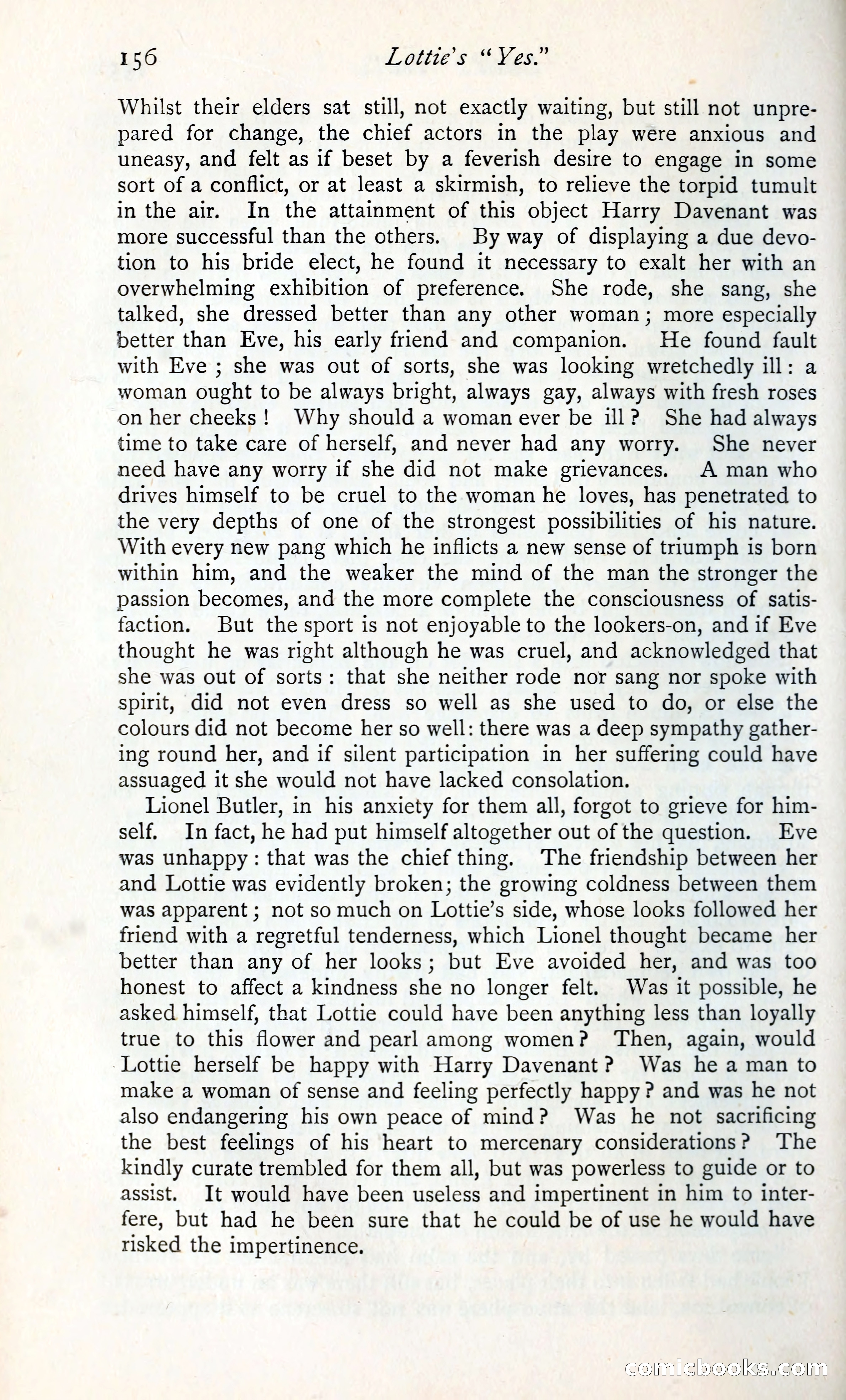
A restored page from Pulp Fiction, 1865. Page through the whole issue in the reader above.
📄 Transcribed text from this page (OCR, searchable)
Machine-transcribed from the original scan — historical spelling and the odd misread are preserved.
156 Lottie’s “Yes.” Whilst their elders sat still, not exactly waiting, but still not unpre- pared for change, the chief actors in the play were anxious and uneasy, and felt as if beset by a feverish desire to engage in some sort of a conflict, or at least a skirmish, to relieve the torpid tumult in the air. In the attainment of this object Harry Davenant was more successful than the others. By way of displaying a due devo- tion to his bride elect, he found it necessary to exalt her with an overwhelming exhibition of preference. She rode, she sang, she talked, she dressed better than any other woman; more especially better than Eve, his early friend and companion. He found fault with Eve ; she was out of sorts, she was looking wretchedly ill: a woman ought to be always bright, always gay, always with fresh roses on her cheeks! Why should a woman ever be ill? She had always time to take care of herself, and never had any worry. She never need have any worry if she did not make grievances. A man who drives himself to be cruel to the woman he loves, has penetrated to the very depths of one of the strongest possibilities of his nature. With every new pang which he inflicts a new sense of triumph is born within him, and the weaker the mind of the man the stronger the passion becomes, and the more complete the consciousness of satis- faction. But the sport is not enjoyable to the lookers-on, and if Eve thought he was right although he was cruel, and acknowledged that she was out of sorts: that she neither rode nor sang nor spoke with spirit, did not even dress so well as she used to do, or else the colours did not become her so well: there was a deep sympathy gather- ing round her, and if silent participation in her suffering could have assuaged it she would not have lacked consolation. Lionel Butler, in his anxiety for them all, forgot to grieve for him- self. In fact, he had put himself altogether out of the question. Eve was unhappy: that was the chief thing. The friendship between her and Lottie was evidently broken; the growing coldness between them was apparent ; not so much on Lottie’s side, whose looks followed her friend with a regretful tenderness, which Lionel thought became her better than any of her looks; but Eve avoided her, and was too honest to affect a kindness she no longer felt. Was it possible, he asked himself, that Lottie could have been anything less than loyally true to this flower and pearlamong women? Then, again, would Lottie herself be happy with Harry Davenant? Was he a man to make a woman of sense and feeling perfectly happy ? and was he not also endangering his own peace of mind? Was he not sacrificing the best feelings of his heart to mercenary considerations? The kindly curate trembled for them all, but was powerless to guide or to assist. It would have been useless and impertinent in him to inter- fere, but had he been sure that he could be of use he would have risked the impertinence. Gomicvdooksscom