
Pulp Fiction, 1865 · page 168 of 400
The Argosy — page 168: what you’re looking at
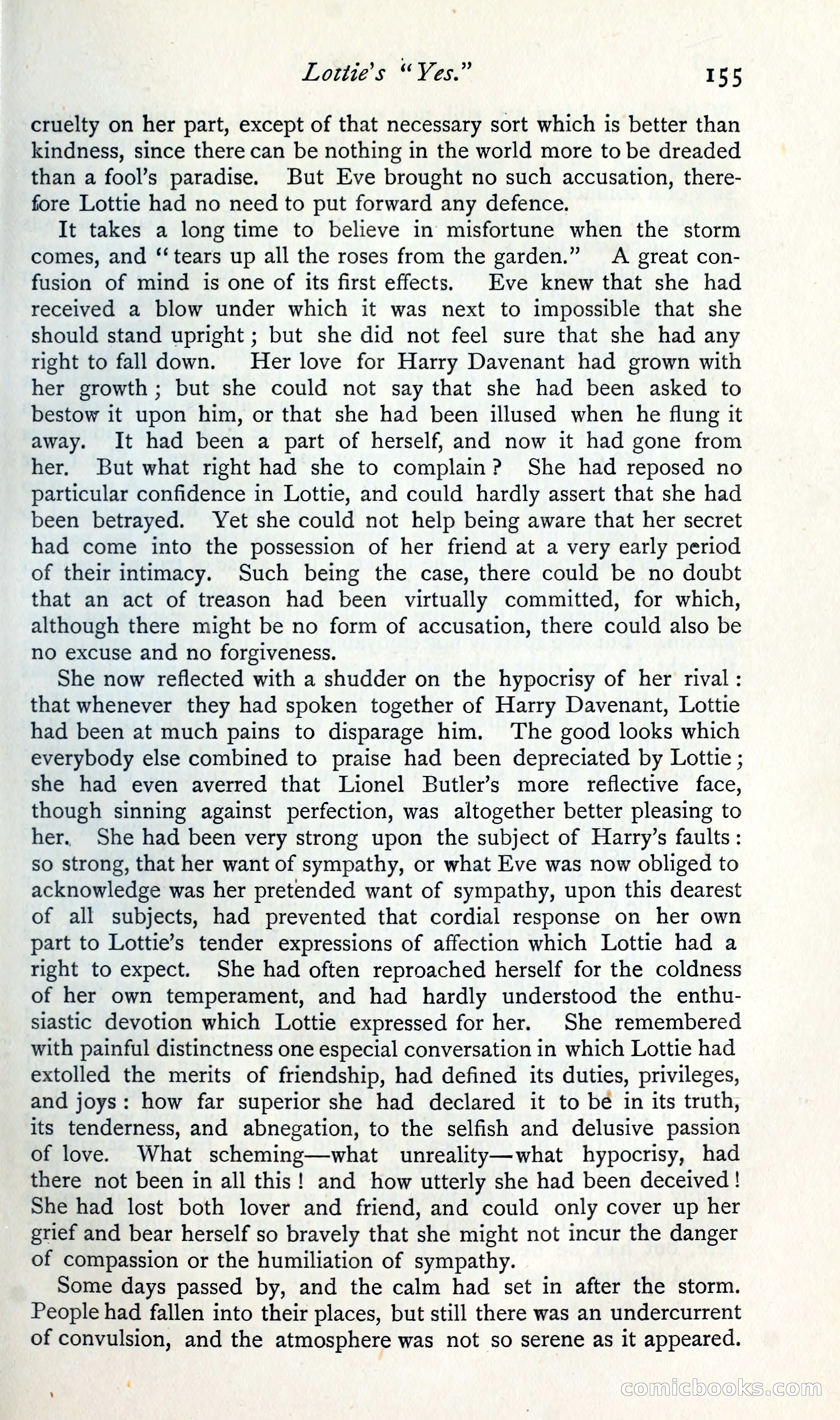
A restored page from Pulp Fiction, 1865. Page through the whole issue in the reader above.
📄 Transcribed text from this page (OCR, searchable)
Machine-transcribed from the original scan — historical spelling and the odd misread are preserved.
Lottie’s “Yes.” 155 cruelty on her part, except of that necessary sort which is better than kindness, since there can be nothing in the world more to be dreaded than a fool’s paradise. But Eve brought no such accusation, there- fore Lottie had no need to put forward any defence. It takes a long time to believe in misfortune when the storm comes, and ‘‘tears up all the roses from the garden.” A great con- fusion of mind is one of its first effects. Eve knew that she had received a blow under which it was next to impossible that she should stand upright ; but she did not feel sure that she had any right to fall down. Her love for Harry Davenant had grown with her growth; but she could not say that she had been asked to bestow it upon him, or that she had been illused when he flung it away. It had been a part of herself, and now it had gone from her. But what right had she to complain? She had reposed no particular confidence in Lottie, and could hardly assert that she had been betrayed. Yet she could not help being aware that her secret had come into the possession of her friend at a very early period of their intimacy. Such being the case, there could be no doubt that an act of treason had been virtually committed, for which, although there might be no form of accusation, there could also be no excuse and no forgiveness. She now reflected with a shudder on the hypocrisy of her rival: that whenever they had spoken together of Harry Davenant, Lottie had been at much pains to disparage him. ‘The good looks which everybody else combined to praise had been depreciated by Lottie ; she had even averred that Lionel Butler’s more reflective face, though sinning against perfection, was altogether better pleasing to her. She had been very strong upon the subject of Harry’s faults: so strong, that her want of sympathy, or what Eve was now obliged to acknowledge was her pretended want of sympathy, upon this dearest of all subjects, had prevented that cordial response on her own part to Lottie’s tender expressions of affection which Lottie had a right to expect. She had often reproached herself for the coldness of her own temperament, and had hardly understood the enthu- siastic devotion which Lottie expressed for her. She remembered with painful distinctness one especial conversation in which Lottie had extolled the merits of friendship, had defined its duties, privileges, and joys: how far superior she had declared it to be in its truth, its tenderness, and abnegation, to the selfish and delusive passion of love. What scheming—what unreality—what hypocrisy, had there not been in all this! and how utterly she had been deceived! She had lost both lover and friend, and could only cover up her grief and bear herself so bravely that she might not incur the danger of compassion or the humiliation of sympathy. Some days passed by, and the calm had set in after the storm. People had fallen into their places, but still there was an undercurrent of convulsion, and the atmosphere was not so serene as it appeared. COMICOOO© SS (S©) im