
Pulp Fiction, 1865 · page 313 of 400
The Argosy — page 313: what you’re looking at
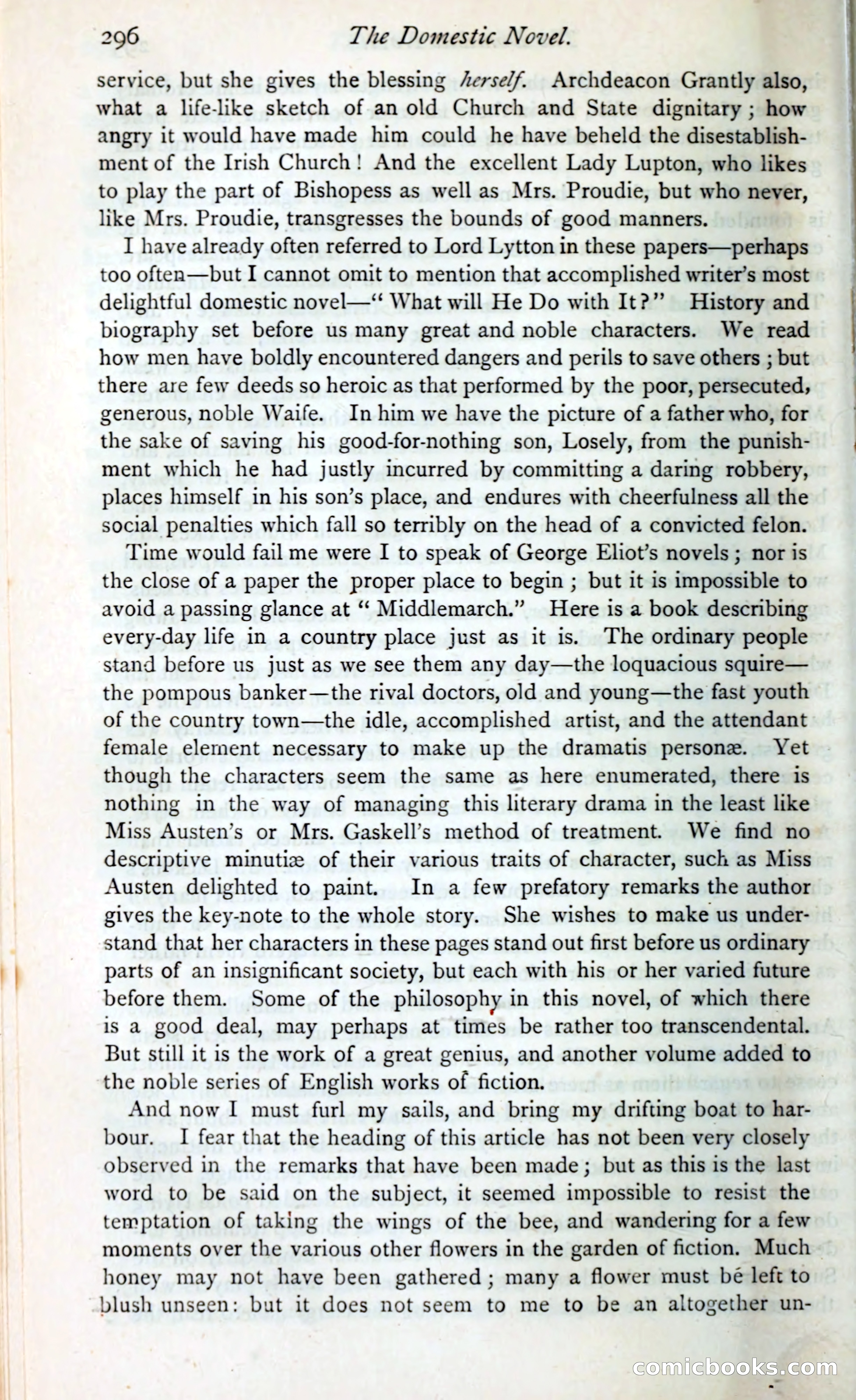
A restored page from Pulp Fiction, 1865. Page through the whole issue in the reader above.
📄 Transcribed text from this page (OCR, searchable)
Machine-transcribed from the original scan — historical spelling and the odd misread are preserved.
296 The Domestic Novel. service, but she gives the blessing /erse/f. Archdeacon Grantly also, what a life-like sketch of an old Church and State dignitary ; how angry it would have made him could he have beheld the disestablish- ment of the Irish Church! And the excellent Lady Lupton, who likes to play the part of Bishopess as well as Mrs. Proudie, but who never, like Mrs. Proudie, transgresses the bounds of good manners. I have already often referred to Lord Lytton in these papers—perhaps too oftea—but I cannot omit to mention that accomplished writer’s most delightful domestic novel— What will He Do with It?” History and biography set before us many great and noble characters. We read how men have boldly encountered dangers and perils to save others ; but there are few deeds so heroic as that performed by the poor, persecuted, generous, noble Waife. In him we have the picture of a father who, for the sake of saving his good-for-nothing son, Losely, from the punish- ment which he had justly incurred by committing a daring robbery, places himself in his son’s place, and endures with cheerfulness all the social penalties which fall so terribly on the head of a convicted felon. Time would fail me were I to speak of George Eliot’s novels; nor is the close of a paper the proper place to begin ; but it is impossible to avoid a passing glance at ‘“ Middlemarch.” Here is a book descnbing every-day life in a country place just as it is. The ordinary people stand before us just as we see them any day—the loquacious squire— the pompous banker—the rival doctors, old and young—the fast youth of the country town—the idle, accomplished artist, and the attendant female element necessary to make up the dramatis persone. Yet though the characters seem the same as here enumerated, there is nothing in the way of managing this literary drama in the least like Miss Austen’s or Mrs. Gaskell’s method of treatment. We find no descriptive minutiz of their various traits of character, such as Miss Austen delighted to paint. In a few prefatory remarks the author gives the key-note to the whole story. She wishes to make us under- stand that her characters in these pages stand out first before us ordinary parts of an insignificant society, but each with his or her varied future before them. Some of the philosophy in this novel, of which there is a good deal, may perhaps at times be rather too transcendental. But still it is the work of a great genius, and another volume added to the noble series of English works of fiction. And now I must furl my sails, and bring my drifting boat to har- bour. I fear that the heading of this article has not been very closely observed in the remarks that have been made; but as this is the last word to be said on the subject, it seemed impossible to resist the temptation of taking the wings of the bee, and wandering for a few moments over the various other flowers in the garden of fiction. Much honey may not have been gathered; many a flower must be left to blush unseen: but it does not seem to me to be an altogether un- Gomicbooks.co m