
Pulp Fiction, 1865 · page 312 of 400
The Argosy — page 312: what you’re looking at
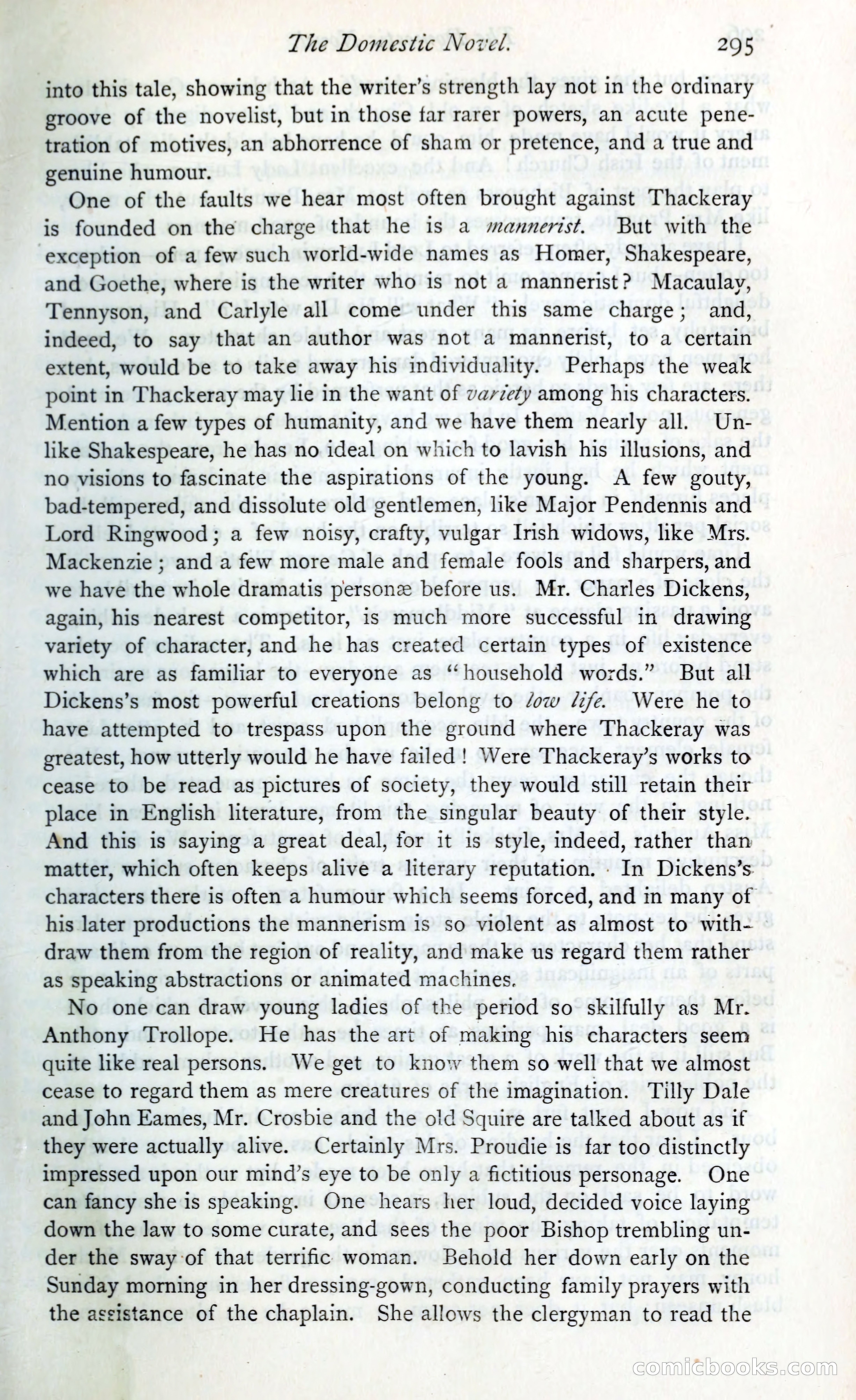
A restored page from Pulp Fiction, 1865. Page through the whole issue in the reader above.
📄 Transcribed text from this page (OCR, searchable)
Machine-transcribed from the original scan — historical spelling and the odd misread are preserved.
The Domestic Novel. 295 into this tale, showing that the writer’s strength lay not in the ordinary groove of the novelist, but in those far rarer powers, an acute pene- tration of motives, an abhorrence of sham or pretence, and a true and genuine humour. One of the faults we hear most often brought against Thackeray is founded on the charge that he is a mannerist. But with the exception of a few such world-wide names as Homer, Shakespeare, and Goethe, where is the writer who is not a mannerist? Macaulay, Tennyson, and Carlyle all come under this same charge; and, indeed, to say that an author was not a mannerist, to a certain extent, would be to take away his individuality. Perhaps the weak point in Thackeray may lie in the want of varzety among his characters. Mention a few types of humanity, and we have them nearly all. Un- like Shakespeare, he has no ideal on which to lavish his illusions, and no visions to fascinate the aspirations of the young. A few gouty, bad-tempered, and dissolute old gentlemen, like Major Pendennis and Lord Ringwood; a few noisy, crafty, vulgar Insh widows, like Mrs. Mackenzie ; and a few more male and female fools and sharpers, and we have the whole dramatis persone before us. Mr. Charles Dickens, again, his nearest competitor, is much more successful in drawing variety of character, and he has created certain types of existence which are as familiar to everyone as ‘‘household words.” But all Dickens’s most powerful creations belong to /ow /zfe. Were he to have attempted to trespass upon the ground where Thackeray was ereatest, how utterly would he have failed! Were Thackeray’s works to cease to be read as pictures of society, they would still retain their place in English literature, from the singular beauty of their style. And this is saying a great deal, for it is style, indeed, rather than matter, which often keeps alive a literary reputation. - In Dickens’s. characters there is often a humour which seems forced, and in many of his later productions the mannerism is so violent as almost to with- draw them from the region of reality, and make us regard them rather as speaking abstractions or animated machines. No one can draw young ladies of the period so skilfully as Mr. Anthony Trollope. He has the art of making his characters seem quite like real persons. We get to know them so well that we almost cease to regard them as mere creatures of the imagination. Tilly Dale and John Eames, Mr. Crosbie and the old Squire are talked about as if they were actually alive. Certainly Mrs. Proudie is far too distinctly impressed upon our mind’s eye to be only a fictitious personage. One can fancy she is speaking. One hears her loud, decided voice laying down the law to some curate, and sees the poor Bishop trembling un- der the sway-of that terrific woman. Behold her down early on the Sunday morning in her dressing-gown, conducting family prayers with the assistance of the chaplain. She allows the clergyman to read the GOMNGIOO SS (SO)