
Pulp Fiction, 1865 · page 314 of 400
The Argosy — page 314: what you’re looking at
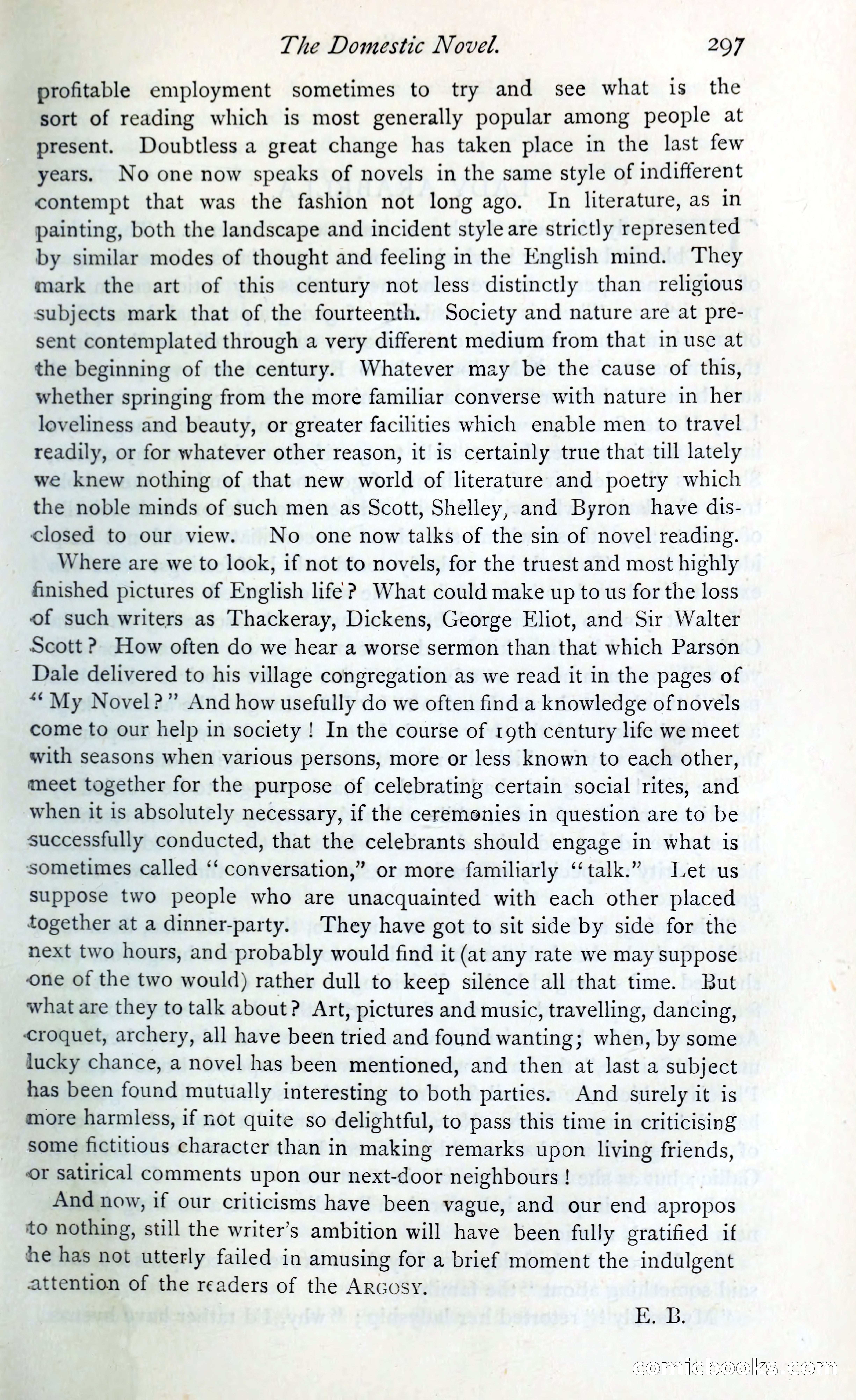
A restored page from Pulp Fiction, 1865. Page through the whole issue in the reader above.
📄 Transcribed text from this page (OCR, searchable)
Machine-transcribed from the original scan — historical spelling and the odd misread are preserved.
The Domestic Novel. 297 profitable employment sometimes to try and see what is the sort of reading which is most generally popular among people at present. Doubtless a great change has taken place in the last few years. No one now speaks of novels in the same style of indifferent contempt that was the fashion not long ago. In literature, as in painting, both the landscape and incident styleare strictly represented by similar modes of thought and feeling in the English mind. They mark the art of this century not less distinctly than religious subjects mark that of the fourteenth. Society and nature are at pre- sent contemplated through a very different medium from that in use at the beginning of the century. Whatever may be the cause of this, whether springing from the more familiar converse with nature in her loveliness and beauty, or greater facilities which enable men to travel readily, or for whatever other reason, it is certainly true that till lately we knew nothing of that new world of literature and poetry which the noble minds of such men as Scott, Shelley, and Byron have dis- closed to our view. No one now talks of the sin of novel reading. Where are we to look, if not to novels, for the truest and most highly finished pictures of English life? What could make up to us for the loss of such writers as Thackeray, Dickens, George Eliot, and Sir Walter Scott ? How often do we hear a worse sermon than that which Parson Dale delivered to his village congregation as we read it in the pages of *“ My Novel?” And how usefully do we often find a knowledge of novels come to our help in society ! In the course of roth century life we meet with seasons when various persons, more or less known to each other, meet together for the purpose of celebrating certain social rites, and when it is absolutely necessary, if the ceremonies in question are to be successfully conducted, that the celebrants should engage in what is sometimes called ‘‘ conversation,” or more familiarly “talk.” Let us Suppose two people who are unacquainted with each other placed together at a dinner-party. They have got to sit side by side for the next two hours, and probably would find it (at any rate we may suppose one of the two would) rather dull to keep silence all that time. But what are they to talk about? Art, pictures and music, travelling, dancing, croquet, archery, all have been tried and found wanting; when, by some lucky chance, a novel has been mentioned, and then at last a subject has been found mutually interesting to both parties. And surely it is more harmless, if not quite so delightful, to pass this time in criticising some fictitious character than in making remarks upon living friends, or satirical comments upon our next-door neighbours ! And now, if our criticisms have been vague, and our end apropos to nothing, still the writer’s ambition will have been fully gratified if he has not utterly failed in amusing for a brief moment the indulgent attention of the readers of the Arcosy. E. B. CONnniiclooo SS (S©)