
Pulp Fiction, 1865 · page 311 of 400
The Argosy — page 311: what you’re looking at
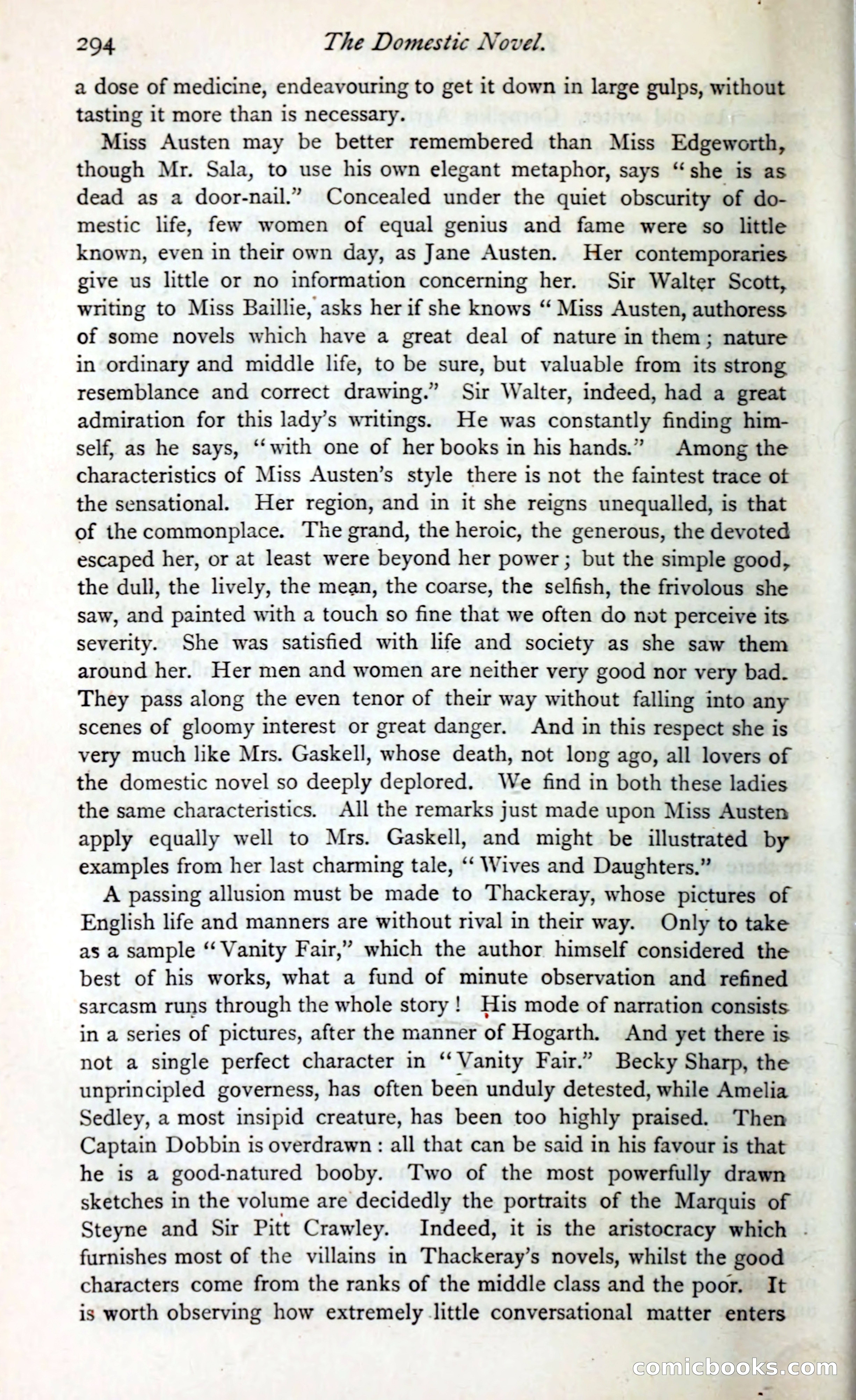
A restored page from Pulp Fiction, 1865. Page through the whole issue in the reader above.
📄 Transcribed text from this page (OCR, searchable)
Machine-transcribed from the original scan — historical spelling and the odd misread are preserved.
294 The Domestic Novel. a dose of medicine, endeavouring to get it down in large gulps, without tasting it more than Is necessary. | Miss Austen may be better remembered than Miss Edgeworth, ‘ though Mr. Sala, to use his own elegant metaphor, says “she is as dead as a door-nail.” Concealed under the quiet obscurity of do- mestic life, few women of equal genius and fame were so little known, even in their own day, as Jane Austen. Her contemporaries give us little or no information concerning her. Sir Walter Scott, writing to Miss Baillie, asks her if she knows “ Miss Austen, authoress of some novels which have a great deal of nature in them; nature in ordinary and middle life, to be sure, but valuable from its strong resemblance and correct drawing.” Sir Walter, indeed, had a great admiration for this lady’s writings. He was constantly finding him- self, as he says, “‘with one of her books in his hands.” Among the characteristics of Miss Austen’s style there is not the faintest trace ot the sensational. Her region, and in it she reigns unequalled, is that of the commonplace. The grand, the heroic, the generous, the devoted escaped her, or at least were beyond her power ; but the simple good, the dull, the lively, the mean, the coarse, the selfish, the frivolous she saw, and painted with a touch so fine that we often do not perceive its severity. She was satisfied with life and society as she saw them around her. Her men and women are neither very good nor very bad. They pass along the even tenor of their way without falling into any scenes of gloomy interest or great danger. And in this respect she is very much like Mrs. Gaskell, whose death, not long ago, all lovers of the domestic novel so deeply deplored. We find in both these ladies | the same characteristics. All the remarks just made upon Miss Austen | apply equally well to Mrs. Gaskell, and might be illustrated by | examples from her last charming tale, ‘‘ Wives and Daughters.” | A passing allusion must be made to Thackeray, whose pictures of English life and manners are without rival in their way. Only to take as a sample ‘‘ Vanity Fair,” which the author himself considered the best of his works, what a fund of minute observation and refined sarcasm runs through the whole story! His mode of narration consists in a series of pictures, after the manner of Hogarth. And yet there is not a single perfect character in ‘‘ Vanity Fair.” Becky Sharp, the unprincipled governess, has often been unduly detested, while Amelia Sedley, a most insipid creature, has been too highly praised. Then Captain Dobbin is overdrawn: all that can be said in his favour is that he is a good- natured booby. Two of the most powerfully drawn sketches in the volume are decidedly the portraits of the Marquis of Steyne and Sir Pitt Crawley. Indeed, it is the aristocracy which . furnishes most of the villains in Thackeray’s novels, whilst the good characters come from the ranks of the middle class and the poor. It is worth observing how extremely little conversational matter enters Gomilcbooks.co