
Pulp Fiction, 1865 · page 310 of 400
The Argosy — page 310: what you’re looking at
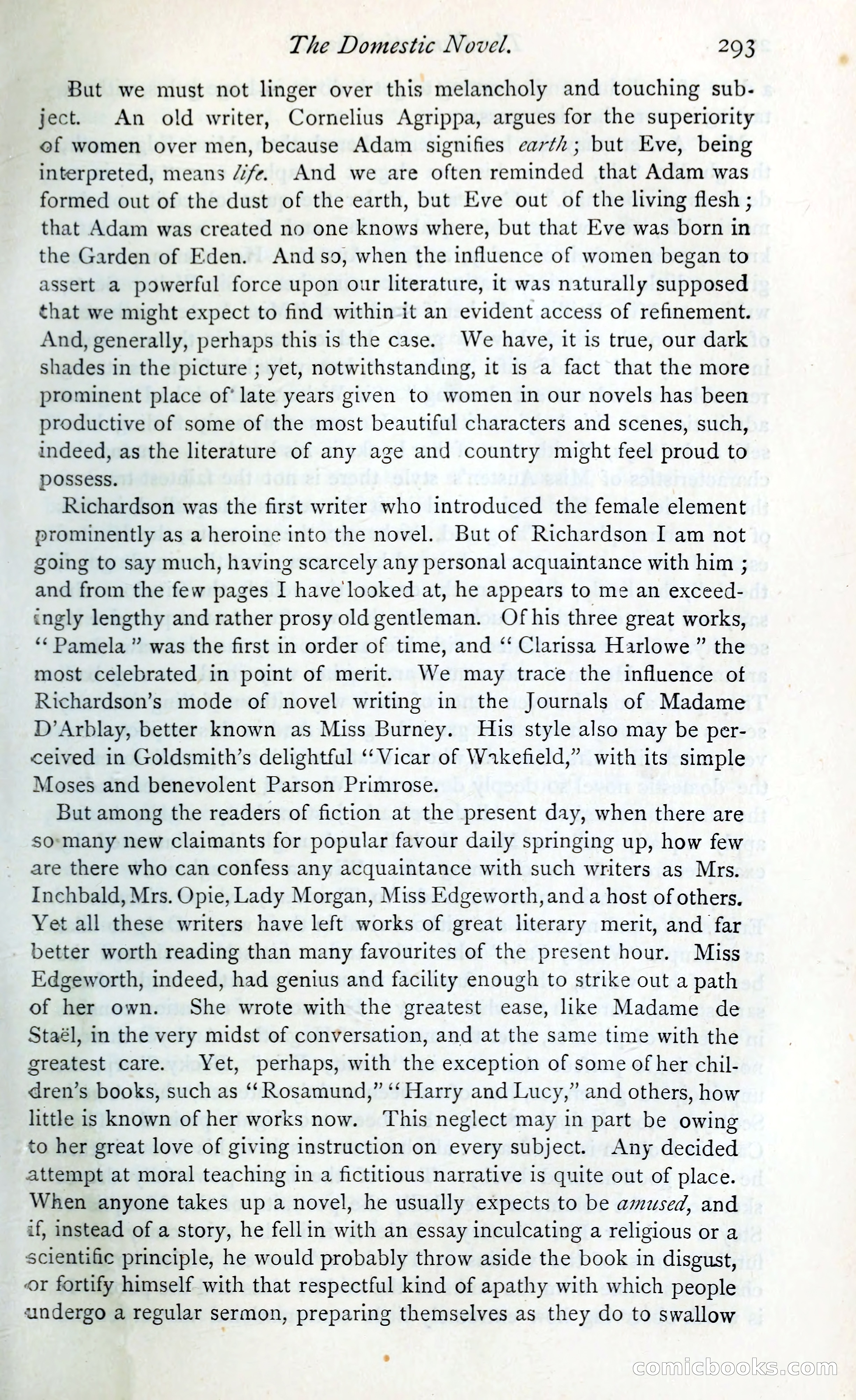
A restored page from Pulp Fiction, 1865. Page through the whole issue in the reader above.
📄 Transcribed text from this page (OCR, searchable)
Machine-transcribed from the original scan — historical spelling and the odd misread are preserved.
The Domestic Novel. 293 But we must not linger over this melancholy and touching sub- ject. An old writer, Cornelius Agrippa, argues for the superiority of women over men, because Adam signifies carth; but Eve, being interpreted, means 7%. And we are often reminded that Adam was formed out of the dust of the earth, but Eve out of the living flesh ; that Adam was created no one knows where, but that Eve was born in the Garden of Eden. Andso, when the influence of women began to assert a powerful force upon our literature, it was naturally supposed that we might expect to find within it an evident access of refinement. And, generally, perhaps this is the case. We have, it is true, our dark shades in the picture ; yet, notwithstanding, it 1s a fact that the more prominent place of’ late years given to women in our novels has been productive of some of the most beautiful characters and scenes, such, indeed, as the literature of any age and country might feel proud to possess. Richardson was the first writer who introduced the female element prominently as a heroine into the novel. But of Richardson I am not going to say much, having scarcely any personal acquaintance with him ; and from the few pages I have looked at, he appears to me an exceed- ingly lengthy and rather prosy old gentleman. Of his three great works, ‘‘ Pamela ” was the first in order of time, and ‘‘ Clarissa Harlowe ” the most celebrated in point of merit. We may trace the influence of Richardson’s mode of novel writing in the Journals of Madame D’Arblay, better known as Miss Burney. His style also may be per- ceived in Goldsmith’s delightful ‘‘ Vicar of Wrkefield,” with its simple Moses and benevolent Parson Primrose. But among the readers of fiction at the present day, when there are so*many new claimants for popular favour daily springing up, how few are there who can confess any acquaintance with such writers as Mrs. Inchbald, Mrs. Opie, Lady Morgan, Miss Edgeworth, and a host of others, Yet all these writers have left works of great literary merit, and far better worth reading than many favourites of the present hour. Miss Edgeworth, indeed, had genius and facility enough to strike out a path of her own. She wrote with the greatest ease, hike Madame de Staél, in the very midst of conversation, and at the same time with the greatest care. Yet, perhaps, with the exception of some of her chil- dren’s books, such as ‘‘ Rosamund,” ‘‘ Harry and Lucy,” and others, how little is known of her works now. This neglect may in part be owing to her great love of giving instruction on every subject. Any decided attempt at moral teaching in a fictitious narrative is quite out of place. When anyone takes up a novel, he usually expects to be amused, and if, instead of a story, he fellin with an essay inculcating a religious or a scientific principle, he would probably throw aside the book in disgust, or fortify himself with that respectful kind of apathy with which people undergo a regular sermon, preparing themselves as they do to swallow . connicboo SS (CO)