
Pulp Fiction, 1865 · page 309 of 400
The Argosy — page 309: what you’re looking at
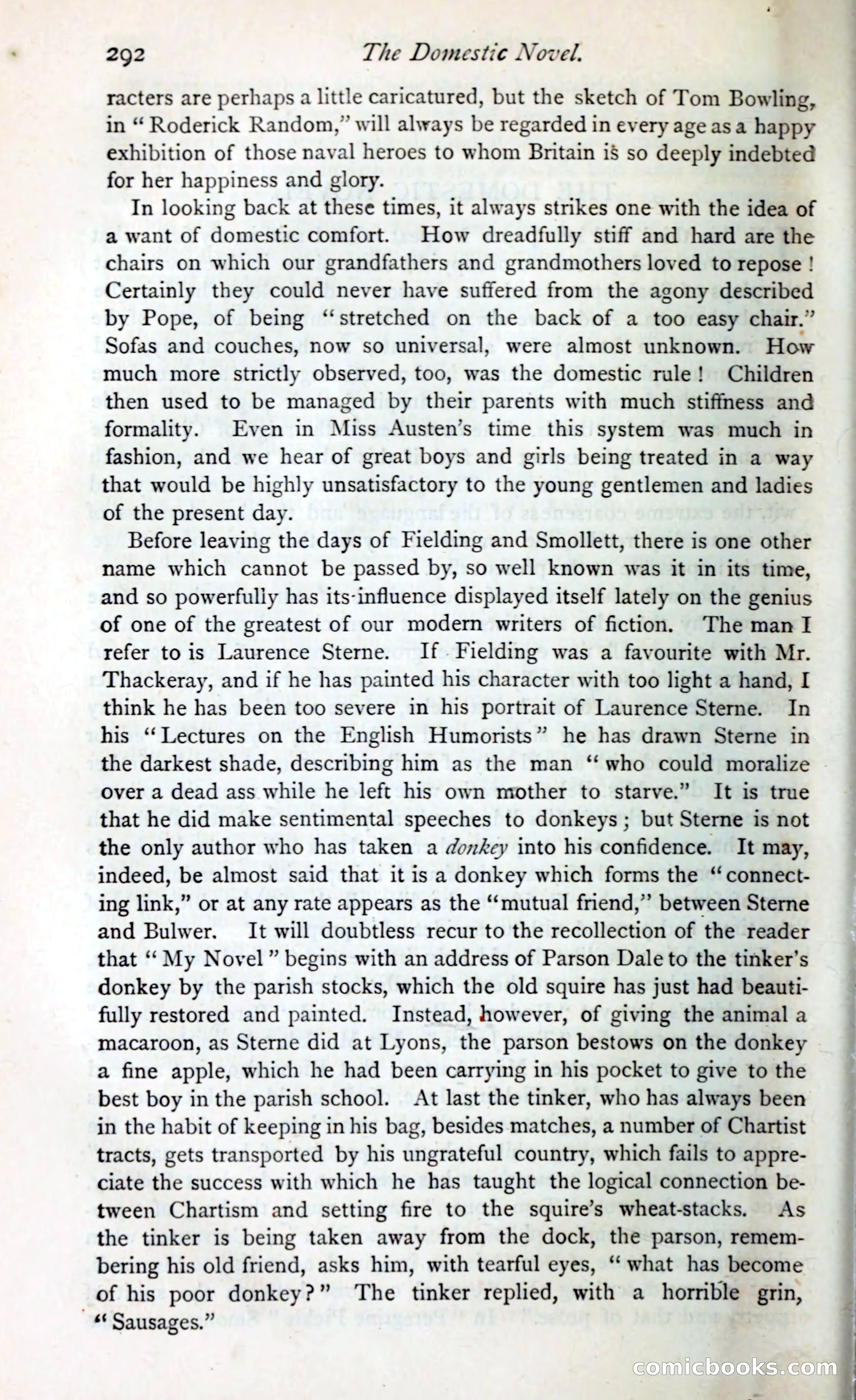
A restored page from Pulp Fiction, 1865. Page through the whole issue in the reader above.
📄 Transcribed text from this page (OCR, searchable)
Machine-transcribed from the original scan — historical spelling and the odd misread are preserved.
292 The Domestie Novel. racters are perhaps a little caricatured, but the sketch of Tom Bowling, in “ Roderick Random,” will always be regarded in every age asa happy exhibition of those naval heroes to whom Britain i so deeply indebted for her happiness and glory. In looking back at these times, it always strikes one with the idea of a want of domestic comfort. How dreadfully stiff and hard are the chairs on which our grandfathers and grandmothers loved to repose ! Certainly they could never have suffered from the agony described by Pope, of being “stretched on the back of a too easy chair.” Sofas and couches, now so universal, were almost unknown. How much more strictly observed, too, was the domestic rule! Children then used to be managed by their parents with much stiffness and formality. Even in Miss Austen’s time this system was much in fashion, and we hear of great boys and girls being treated in a way that would be highly unsatisfactory to the young gentlemen and ladies of the present day. Before leaving the days of Fielding and Smollett, there is one other name which cannot be passed by, so well known was it in its time, and so powerfully has its-influence displayed itself lately on the genius of one of the greatest of our modern writers of fiction. The man I refer to is Laurence Sterne. If. Fielding was a favourite with Mr. Thackeray, and if he has painted his character with too light a hand, I think he has been too severe in his portrait of Laurence Sterne. In his ‘‘ Lectures on the English Humorists” he has drawn Sterne in the darkest shade, describing him as the man ‘‘ who could moralize over a dead ass while he left his own mother to starve.” It is true that he did make sentimental speeches to donkeys; but Sterne is not the only author who has taken a donkey into his confidence. It may, indeed, be almost said that it is a donkey which forms the “connect- ing link,” or at any rate appears as the “‘mutual friend,” between Sterne and Bulwer. It will doubtless recur to the recollection of the reader that ‘‘ My Novel” begins with an address of Parson Dale to the tinker’s donkey by the parish stocks, which the old squire has just had beauti- fully restored and painted. Instead, however, of giving the animal a macaroon, as Sterne did at Lyons, the parson bestows on the donkey a fine apple, which he had been carrying in his pocket to give to the best boy in the parish school. At last the tinker, who has always been in the habit of keeping in his bag, besides matches, a number of Chartist tracts, gets transported by his ungrateful country, which fails to appre- ciate the success with which he has taught the logical connection be- tween Chartism and setting fire to the squire’s wheat-stacks. As the tinker is being taken away from the dock, the parson, remem- bering his old friend, asks him, with tearful eyes, “what has become of his poor donkey?” The tinker replied, with a horrible grin, _ * Sausages.” Gomicbooks.Gco f