
Pulp Fiction, 1865 · page 26 of 400
The Argosy — page 26: what you’re looking at
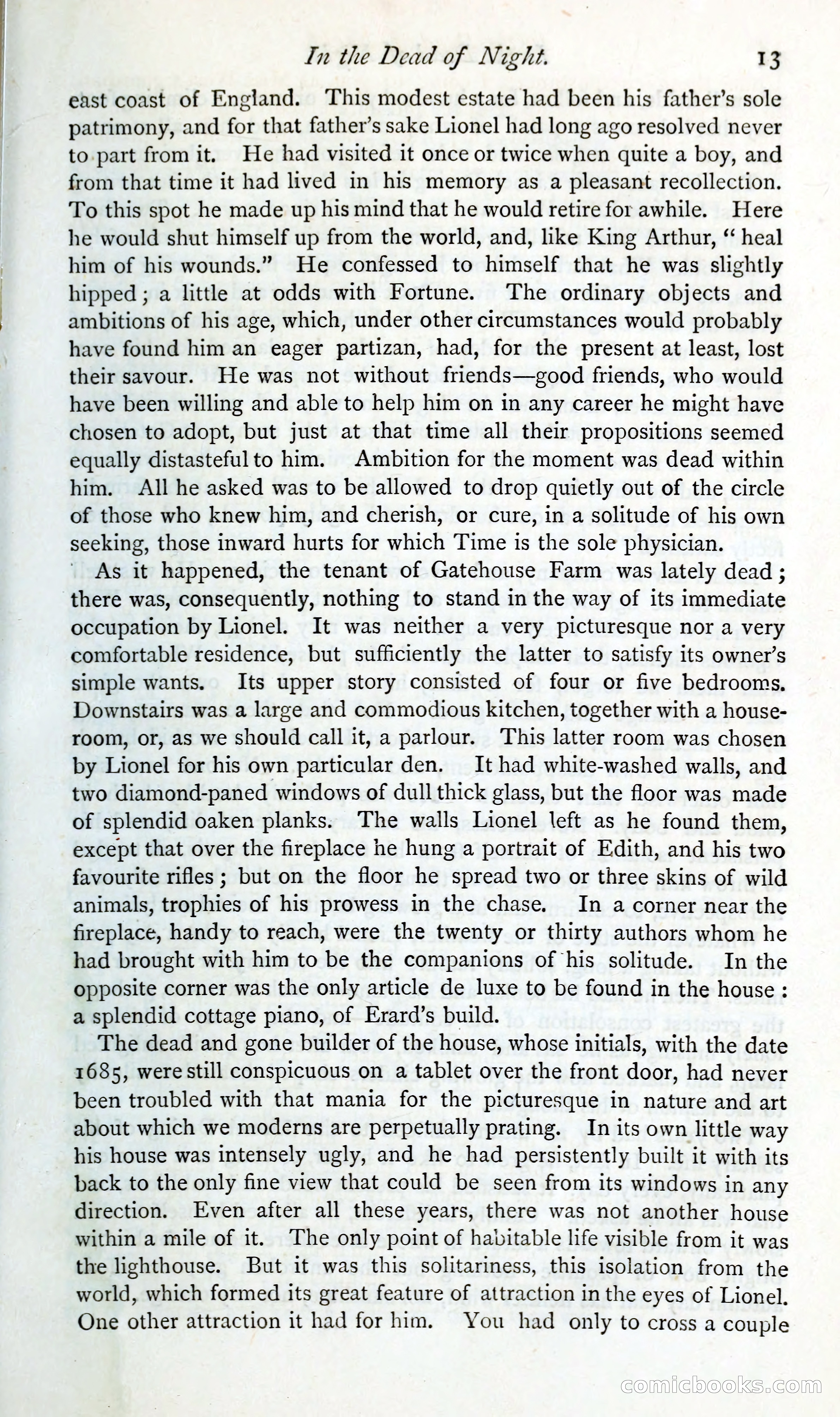
A restored page from Pulp Fiction, 1865. Page through the whole issue in the reader above.
📄 Transcribed text from this page (OCR, searchable)
Machine-transcribed from the original scan — historical spelling and the odd misread are preserved.
In the Dead of Night. 13 east coast of England. ‘This modest estate had been his father’s sole patrimony, and for that father’s sake Lionel had long ago resolved never to part from it. He had visited it once or twice when quite a boy, and from that time it had lived in his memory as a pleasant recollection. To this spot he made up his mind that he would retire for awhile. Here he would shut himself up from the world, and, like King Arthur, ‘ heal him of his wounds.” He confessed to himself that he was slightly hipped ; a little at odds with Fortune. The ordinary objects and ambitions of his age, which, under other circumstances would probably have found him an eager partizan, had, for the present at least, lost their savour. He was not without friends—good friends, who would have been willing and able to help him on in any career he might have chosen to adopt, but just at that time all their propositions seemed equally distastefulto him. Ambition for the moment was dead within him. All he asked was to be allowed to drop quietly out of the circle of those who knew him, and cherish, or cure, in a solitude of his own seeking, those inward hurts for which Time is the sole physician. As it happened, the tenant of Gatehouse Farm was lately dead ; there was, consequently, nothing to stand in the way of its immediate occupation by Lionel. It was neither a very picturesque nor a very comfortable residence, but sufficiently the latter to satisfy its owner’s simple wants. Its upper story consisted of four or five bedrooms. Downstairs was a large and commodious kitchen, together with a house- room, or, as we should call it, a parlour. This latter room was chosen by Lionel for his own particular den. It had white-washed walls, and two diamond-paned windows of dull thick glass, but the floor was made of splendid oaken planks. The walls Lionel left as he found them, except that over the fireplace he hung a portrait of Edith, and his two favourite rifles ; but on the floor he spread two or three skins of wild animals, trophies of his prowess in the chase. In a corner near the fireplace, handy to reach, were the twenty or thirty authors whom he had brought with him to be the companions of his solitude. In the Opposite corner was the only article de luxe to be found in the house: a splendid cottage piano, of Erard’s build. The dead and gone builder of the house, whose initials, with the date 1685, were still conspicuous on a tablet over the front door, had never been troubled with that mania for the picturesque in nature and art about which we moderns are perpetually prating. In its own little way his house was intensely ugly, and he had persistently built it with its back to the only fine view that could be seen from its windows in any direction. Even after all these years, there was not another house within a mile of it. The only point of habitable life visible from it was the lighthouse. But it was this solitariness, this isolation from the world, which formed its great feature of attraction in the eyes of Lionel. One other attraction it had for him. You had only to cross a couple COMICOOOlKS.EO