
Pulp Fiction, 1865 · page 27 of 400
The Argosy — page 27: what you’re looking at
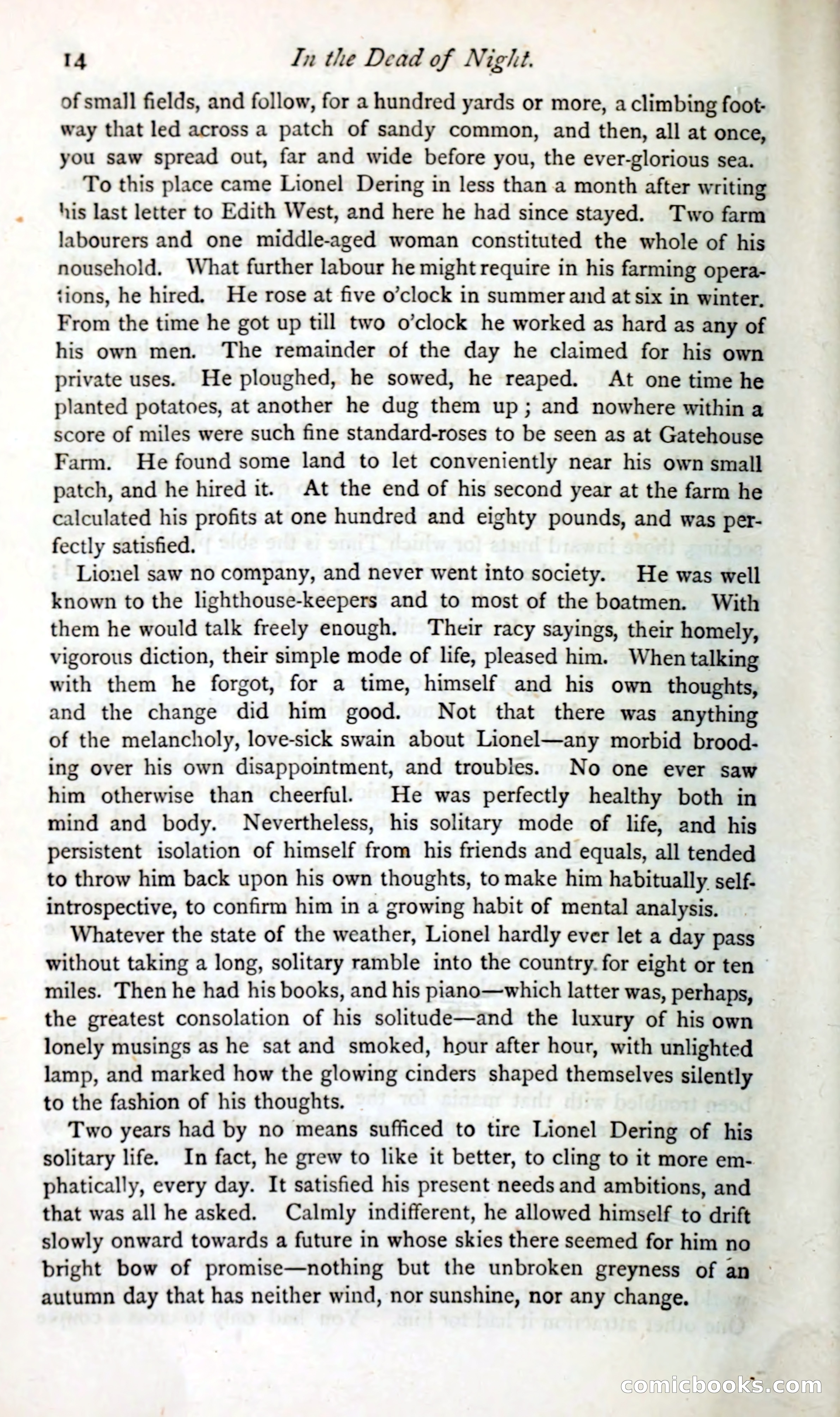
A restored page from Pulp Fiction, 1865. Page through the whole issue in the reader above.
📄 Transcribed text from this page (OCR, searchable)
Machine-transcribed from the original scan — historical spelling and the odd misread are preserved.
14 In the Dead of Night. of small fields, and follow, for a hundred yards or more, a climbing foot- way that led across a patch of sandy common, and then, all at once, you saw spread out, far and wide before you, the ever-glorious sea. To this place came Lionel Dering in less than a month after writing his last letter to Edith West, and here he had since stayed. Two farm labourers and one middle-aged woman constituted the whole of his nousehold. What further labour he might require in his farming opera- tions, he hired. He rose at five o’clock in summer and at six in winter. From the time he got up till two o’clock he worked as hard as any of his own men. The remainder of the day he claimed for his own private uses. He ploughed, he sowed, he reaped. At one time he planted potatoes, at another he dug them up; and nowhere within a score of miles were such fine standard-roses to be seen as at Gatehouse Farm. He found some land to let conveniently near his own small patch, and he hired it. At the end of his second year at the farm he calculated his profits at one hundred and eighty pounds, and was per- fectly satisfied. Lionel saw no company, and never went into society. He was well known to the lighthouse-keepers and to most of the boatmen. With them he would talk freely enough. Their racy sayings, their homely, vigorous diction, their simple mode of life, pleased him. When talking with them he forgot, for a time, himself and his own thoughts, and the change did him good. Not that there was anything of the melancholy, love-sick swain about Lionel—any morbid brood- ing over his own disappointment, and troubles. No one ever saw him otherwise than cheerful. He was perfectly healthy both in mind and body. Nevertheless, his solitary mode of life, and his persistent isolation of himself from his friends and equals, all tended to throw him back upon his own thoughts, to make him habitually self- introspective, to confirm him in a growing habit of mental analysis. Whatever the state of the weather, Lionel hardly ever let a day pass without taking a long, solitary ramble into the country. for eight or ten miles. Then he had his books, and his piano—which latter was, perhaps, the greatest consolation of his solitude—and the luxury of his own lonely musings as he sat and smoked, hour after hour, with unlighted lamp, and marked how the glowing cinders shaped area silently to the fashion of his thoughts. Two years had by no means sufficed to tire Lionel Dering of his solitary life. In fact, he grew to like it better, to cling to it more em- phatically, every day. It satisfied his present needs and ambitions, and that was all he asked. Calmly indifferent, he allowed himself to drift slowly onward towards a future in whose skies there seemed for him no bright bow of promise—nothing but the unbroken greyness of an © autumn day that has neither wind, nor sunshine, nor any change. comicbooks (E(0) m