
Pulp Fiction, 1865 · page 25 of 400
The Argosy — page 25: what you’re looking at
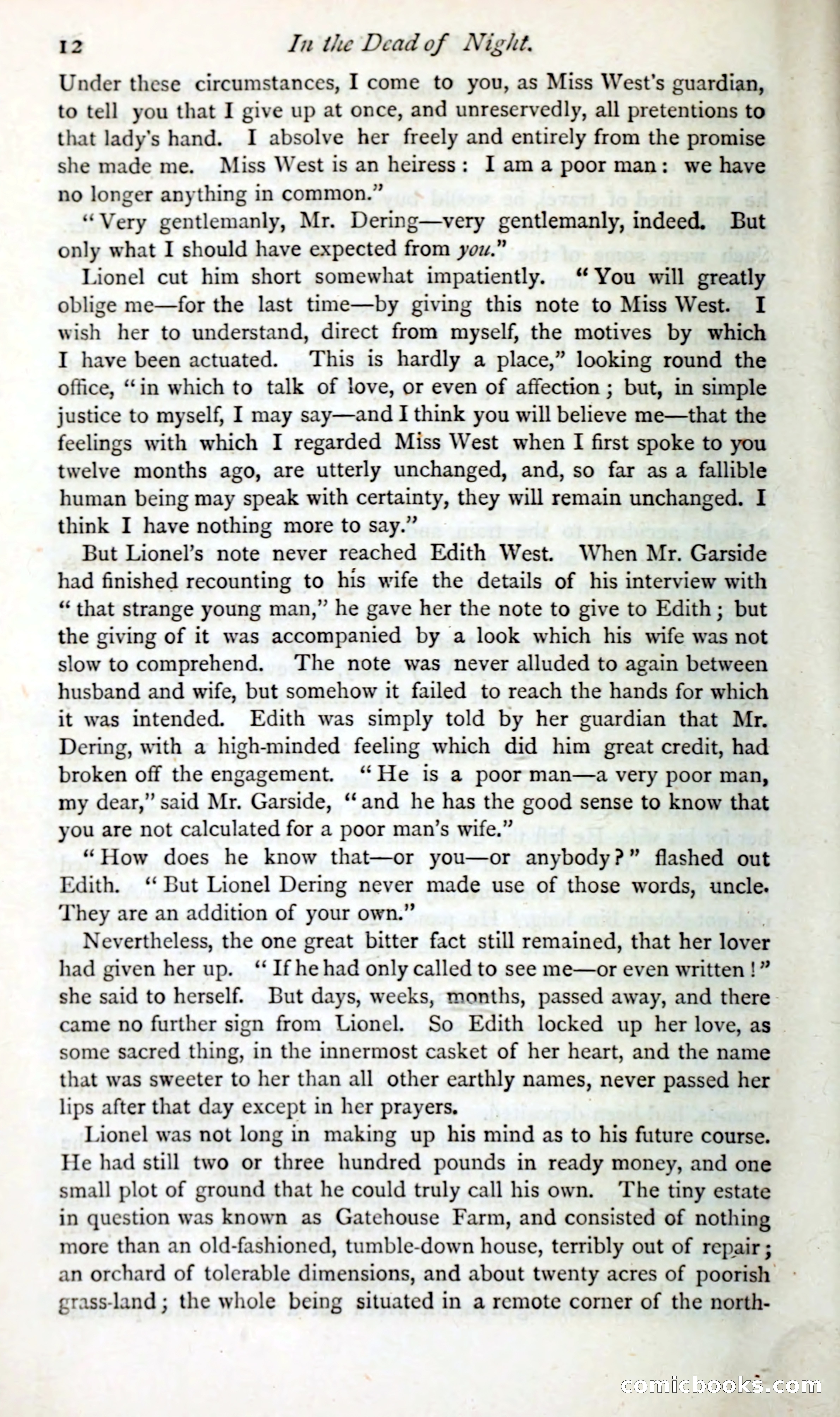
A restored page from Pulp Fiction, 1865. Page through the whole issue in the reader above.
📄 Transcribed text from this page (OCR, searchable)
Machine-transcribed from the original scan — historical spelling and the odd misread are preserved.
12 In the Dead of Night. Under these circumstances, I come to you, as Miss West's guardian, to tell you that I give up at once, and unreservedly, all pretentions to that lady's hand. I absolve her freely and entirely from the promise she made me. Miss West is > heiress: I am a poor man: we have no longer anything in common.’ “Very gentlemanly, Mr. Dering—very gentlemanly, indeed. But only what I should have expected from you.” Lionel cut him short somewhat impatiently. ‘“ You will greatly oblige me—for the last time—by giving this note to Miss West. I wish her to understand, direct from myself, the motives by which I have been actuated. This is hardly a place,” looking round the office, ‘in which to talk of love, or even of affection ; but, in simple justice to myself, I may say—and I think you will believe me—that the feelings with which I regarded Miss West when I first spoke to you twelve months ago, are utterly unchanged, and, so far as a fallible human being may speak with certainty, they will remain unchanged. I think I have nothing more to say.” But Lionel’s note never reached Edith West. When Mr. Garside had finished recounting to his wife the details of his interview with “ that strange young man,” he gave her the note to give to Edith; but the giving of it was accompanied by a look which his wife was not slow to comprehend. The note was never alluded to again between husband and wife, but somehow it failed to reach the hands for which it was intended. Edith was simply told by her guardian that Mr. Dering, with a high-minded feeling which did him great credit, had broken off the engagement. “He is a poor man—a very poor man, my dear,” said Mr. Garside, “‘and he has the good sense to know that you are not calculated for a poor man’s wife.” “How does he know that—or you—or anybody?” flashed out Edith. ‘ But Lionel Dering never made use of those words, Em They are an addition of your own.’ Nevertheless, the one great bitter fact still remained, that her lover had given her up. ‘If hehad only called to see me—or even written !” she said to herself. But days, weeks, months, passed away, and there. came no further sign from Lionel. So Edith locked up her love, as some sacred thing, in the innermost casket of her heart, and the name that was sweeter to her than all other earthly names, never passed her lips after that day except in her prayers, Lionel was not long in making up his mind as to his future course. He had still two or three hundred pounds in ready money, and one small plot of ground that he could truly call his own. ‘The tiny estate in question was known as Gatehouse Farm, and consisted of nothing more than an old-fashioned, tumble-down house, terribly out of repair; an orchard of tolerable dimensions, and about twenty acres of poorish grass-land ; the whole being situated in a remote corner of the north- GOmicbooks (E(0) m