
Pulp Fiction, 1875 · page 219 of 400
The Argosy — page 219: what you’re looking at
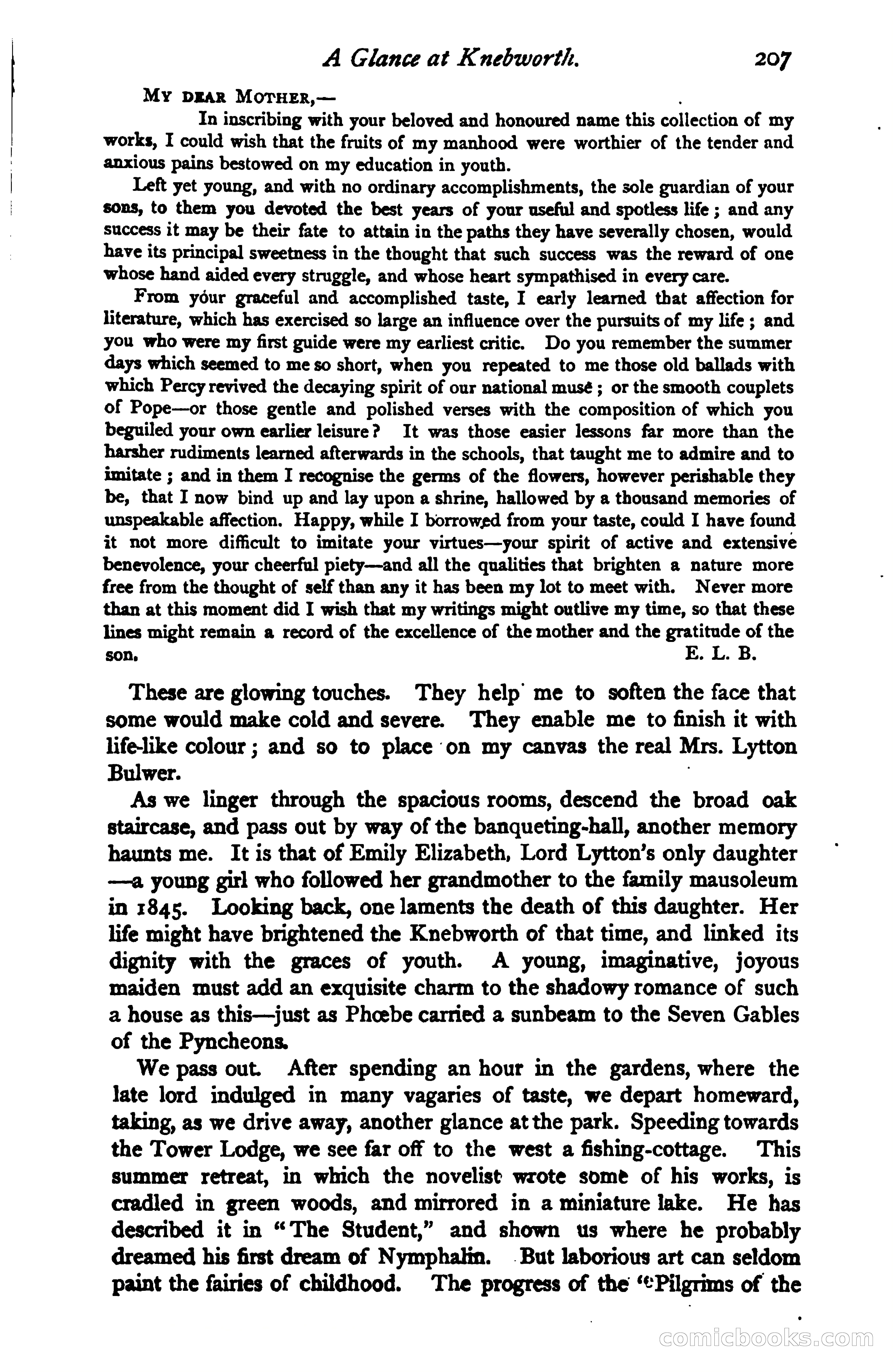
A restored page from Pulp Fiction, 1875. Page through the whole issue in the reader above.
📄 Transcribed text from this page (OCR, searchable)
Machine-transcribed from the original scan — historical spelling and the odd misread are preserved.
A Glance at Knebworth. 207 My DEAR MOTHER,— In inscribing with your beloved and honoured name this collection of my works, I could wish that the fruits of my manhood were worthier of the tender and anxious pains bestowed on my education in youth. Left yet young, and with no ordinary accomplishments, the sole guardian of your sons, to them you devoted the best years of your useful and spotless life ; and any success it may be their fate to attain in the paths they have severally chosen, would have its principal sweetness in the thought that such success was the reward of one whose hand aided every struggle, and whose heart sympathised in every care. From your graceful and accomplished taste, I early learned that affection for literature, which has exercised so large an influence over the pursuits of my life; and you who were my first guide were my earliest critic. Do you remember the summer days which seemed to me so short, when you repeated to me those old ballads with which Percy revived the decaying spirit of our national musé ; or the smooth couplets of Pope—or those gentle and polished verses with the composition of which you beguiled your own earlier leisure? It was those easier lessons far more than the harsher rudiments learned afterwards in the schools, that taught me to admire and to imitate ; and in them I recognise the germs of the flowers, however perishable they be, that I now bind up and lay upon a shrine, hallowed by a thousand memories of unspeakable affection. Happy, while I borrowed from your taste, could I have found it not more difficult to imitate your virtues—your spirit of active and extensive benevolence, your cheerful piety—and all the qualities that brighten a nature more free from the thought of self than any it has been my lot to meet with. Never more than at this moment did I wish that my writings might outlive my time, so that these lines might remain a record of the excellence of the mother and the gratitude of the son, E. L. B. These are glowing touches. They help me to soften the face that some would make cold and severe. They enable me to finish it with life-like colour ; and so to place on my canvas the real Mrs. Lytton Bulwer. : As we linger through the spacious rooms, descend the broad oak staircase, and pass out by way of the banqueting-hall, another memory haunts me. It is that of Emily Elizabeth, Lord Lytton’s only daughter —a young girl who followed her grandmother to the family mausoleum in 1845. Looking back, one laments the death of this daughter. Her life might have brightened the Knebworth of that time, and linked its dignity with the graces of youth. A young, imaginative, joyous maiden must add an exquisite charm to the shadowy romance of such a house as this—just as Phoebe carried a sunbeam to the Seven Gables of the Pyncheons. We pass out. After spending an hour in the gardens, where the late lord indulged in many vagaries of taste, we depart homeward, taking, as we drive away, another glance atthe park. Speeding towards the Tower Lodge, we see far off to the west a fishing-cottage. This summer retreat, in which the novelist wrote some of his works, is cradled in green woods, and mirrored in a miniature lake. He has described it in “The Student,” and shown wus where he probably dreamed his first dream of Nymphalin. But laborious art can seldom paint the fairies of childhood. The progress of the ‘¢Pilgrims of the ecomniclooolkks (CO)