
Pulp Fiction, 1875 · page 220 of 400
The Argosy — page 220: what you’re looking at
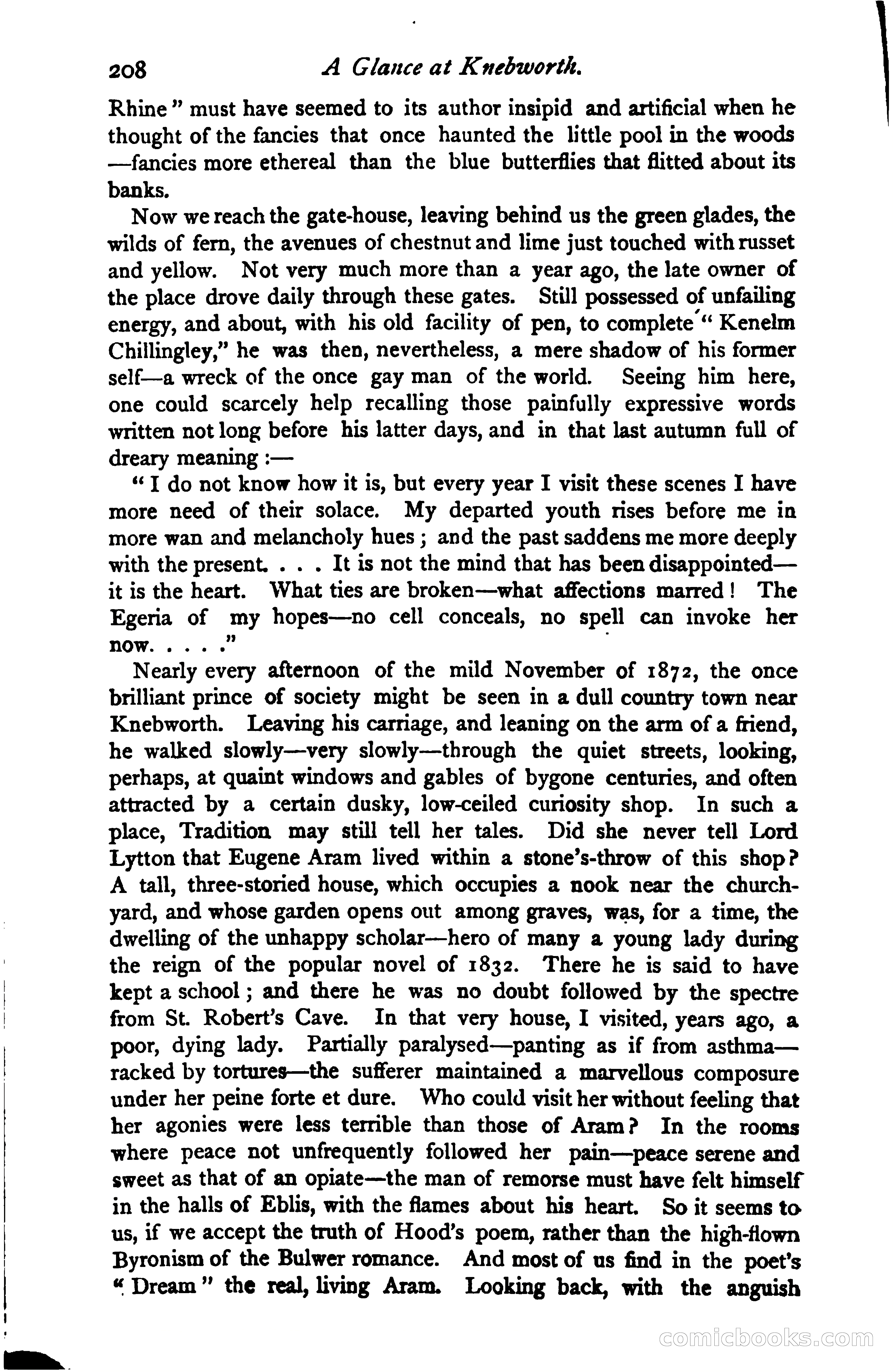
A restored page from Pulp Fiction, 1875. Page through the whole issue in the reader above.
📄 Transcribed text from this page (OCR, searchable)
Machine-transcribed from the original scan — historical spelling and the odd misread are preserved.
208 A Glance at Knebworth. Rhine ” must have seemed to its author insipid and artificial when he thought of the fancies that once haunted the little pool in the woods —fancies more ethereal than the blue butterflies that flitted about its banks. Now we reach the gate-house, leaving behind us the green glades, the wilds of fern, the avenues of chestnut and lime just touched with russet and yellow. Not very much more than a year ago, the late owner of the place drove daily through these gates. Still possessed of unfailing energy, and about, with his old facility of pen, to complete “ Kenelm Chillingley,” he was then, nevertheless, a mere shadow of his former self—a wreck of the once gay man of the world. Seeing him here, one could scarcely help recalling those painfully expressive words written not long before his latter days, and in that last autumn full of dreary meaning :— ‘I do not know how it is, but every year I visit these scenes I have more need of their solace. My departed youth rises before me in more wan and melancholy hues ; and the past saddens me more deeply with the present. . . . It is not the mind that has been disappointed— it is the heart. What ties are broken—what affections marred! The Egeria of my hopes—no cell conceals, no spell can invoke her Nearly every afternoon of the mild November of 1872, the once brilliant prince of society might be seen in a dull country town near Knebworth. Leaving his carriage, and leaning on the arm of a friend, he walked slowly—very slowly—through the quiet streets, looking, perhaps, at quaint windows and gables of bygone centuries, and often attracted by a certain dusky, low-ceiled curiosity shop. In such a place, Tradition may still tell her tales. Did she never tell Lord Lytton that Eugene Aram lived within a stone’s-throw of this shop? A tall, three-storied house, which occupies a nook near the church- yard, and whose garden opens out among graves, was, for a time, the dwelling of the unhappy scholar—hero of many a young lady during the reign of the popular novel of 1832. There he is said to have ! kept a school ; and there he was no doubt followed by the spectre | from St. Robert’s Cave. In that very house, I visited, years ago, a | poor, dying lady. Partially paralysed—panting as if from asthma— | racked by tortures—the sufferer maintained a marvellous composure under her peine forte et dure. Who could visit her without feeling that her agonies were less termble than those of Aram? In the rooms where peace not unfrequently followed her pain—peace serene and sweet as that of an oplate—the man of remorse must have felt himself in the halls of Eblis, with the flames about his heart. So it seems to | us, if we accept the truth of Hood’s poem, rather than the high-flown ! Byronism of the Bulwer romance. And most of us find in the poet's : “Dream” the real, living Aram. Looking back, with the anguish | COMIC OOOKS.COn _