
Pulp Fiction, 1875 · page 217 of 400
The Argosy — page 217: what you’re looking at
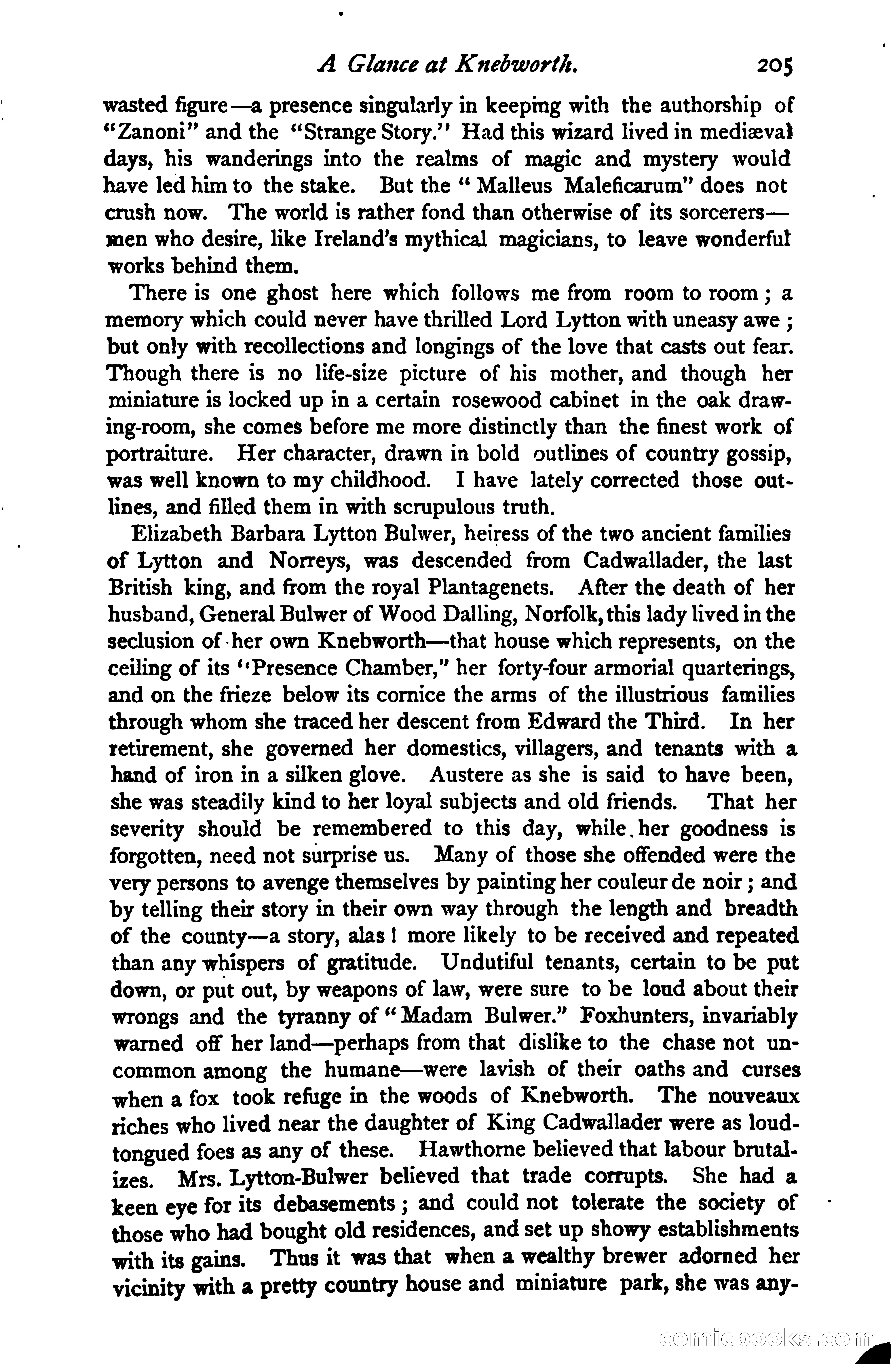
A restored page from Pulp Fiction, 1875. Page through the whole issue in the reader above.
📄 Transcribed text from this page (OCR, searchable)
Machine-transcribed from the original scan — historical spelling and the odd misread are preserved.
A Glance at Knebworth. 205 wasted figure —a presence singularly in keepmg with the authorship of ‘‘Zanoni’”’ and the “Strange Story.’’ Had this wizard lived in medizvak days, his wanderings into the realms of magic and mystery would have led him to the stake. But the “ Malleus Maleficarum” does not crush now. The world is rather fond than otherwise of its sorcerers— men who desire, like Ireland’s mythical magicians, to leave wonderful works behind them. There is one ghost here which follows me from room to room; a memory which could never have thnlled Lord Lytton with uneasy awe ; but only with recollections and longings of the love that casts out fear. Though there is no life-size picture of his mother, and though her miniature 1s locked up in a certain rosewood cabinet in the oak draw- ing-room, she comes before me more distinctly than the finest work of portraiture. Her character, drawn in bold outlines of country gossip, was well known to my childhood. I have lately corrected those out- lines, and filled them in with scrupulous truth. Elizabeth Barbara Lytton Bulwer, heiress of the two ancient families of Lytton and Norreys, was descended from Cadwallader, the last British king, and from the royal Plantagenets. After the death of her husband, General Bulwer of Wood Dalling, Norfolk, this lady lived in the seclusion of -her own Knebworth—that house which represents, on the ceiling of its ‘*Presence Chamber,” her forty-four armorial quarterings, and on the frieze below its cornice the arms of the illustrious families through whom she traced her descent from Edward the Third. In her retirement, she governed her domestics, villagers, and tenants with a hand of iron in a silken glove. Austere as she is said to have been, she was steadily kind to her loyal subjects and old friends. That her severity should be remembered to this day, while. her goodness is forgotten, need not surprise us. Many of those she offended were the very persons to avenge themselves by painting her couleur de noir ; and by telling their story in their own way through the length and breadth of the county—a story, alas! more likely to be received and repeated than any whispers of gratitude. Undutiful tenants, certain to be put down, or put out, by weapons of law, were sure to be loud about their wrongs and the tyranny of “ Madam Bulwer.” Foxhunters, invariably warned off her land—perhaps from that dislike to the chase not un- common among the humane—were lavish of their oaths and curses when 2 fox took refuge in the woods of Knebworth. The nouveaux riches who lived near the daughter of King Cadwallader were as loud- tongued foes as any of these. Hawthorne believed that labour brutal- izes. Mrs. Lytton-Bulwer believed that trade corrupts. She had a keen eye for its debasements ; and could not tolerate the society of those who had bought old residences, and set up showy establishments with its gains. Thus it was that when a wealthy brewer adorned her vicinity with a pretty country house and miniature park, she was any- COMIC OOOKS.EO _