
Pulp Fiction, 1875 · page 216 of 400
The Argosy — page 216: what you’re looking at
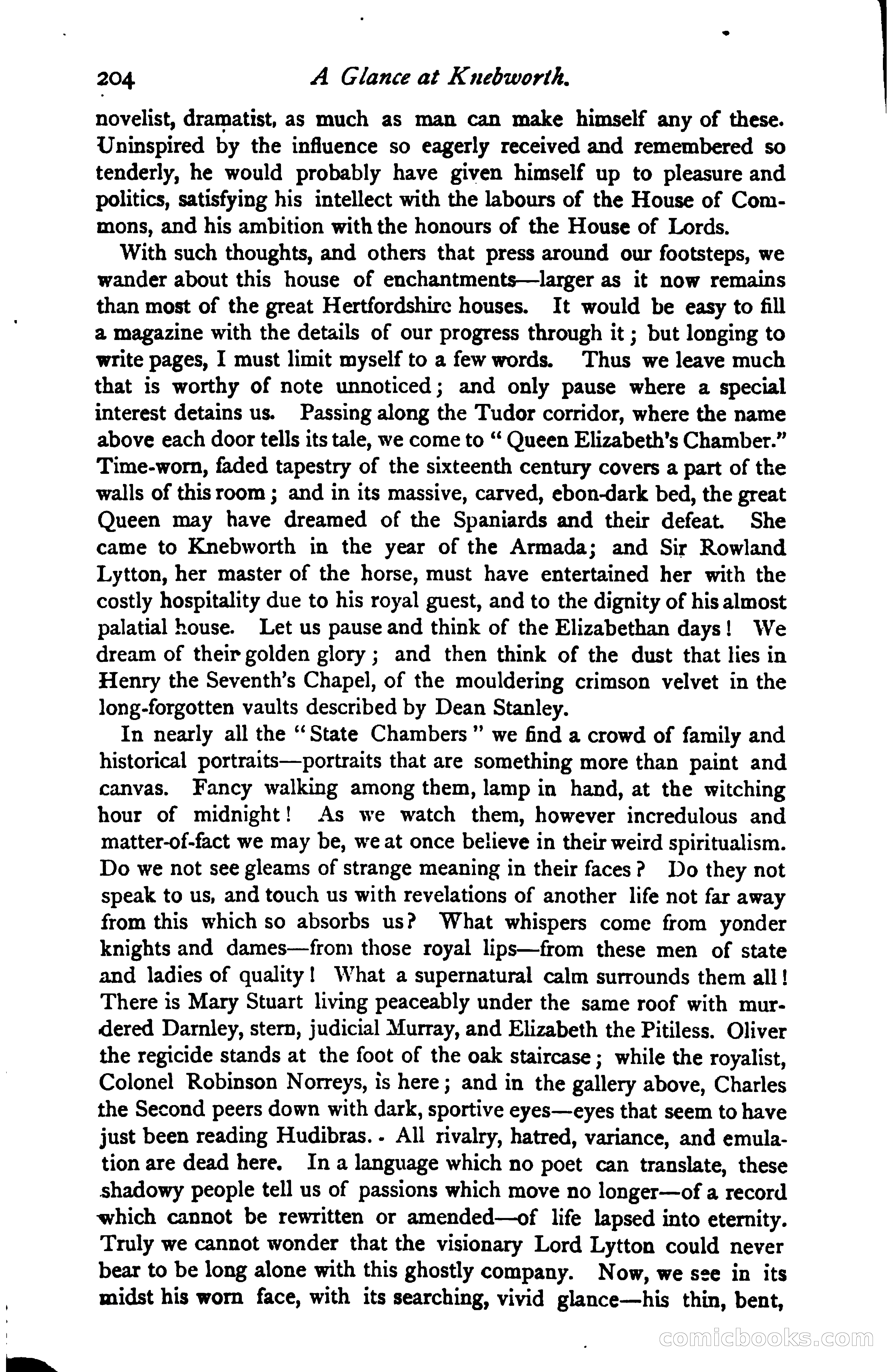
A restored page from Pulp Fiction, 1875. Page through the whole issue in the reader above.
📄 Transcribed text from this page (OCR, searchable)
Machine-transcribed from the original scan — historical spelling and the odd misread are preserved.
204 A Glance at Knebworth. novelist, dramatist, as much as man can make himself any of these. Uninspired by the influence so eagerly received and remembered so tenderly, he would probably have given himself up to pleasure and politics, satisfying his intellect with the labours of the House of Com- mons, and his ambition with the honours of the House of Lords. With such thoughts, and others that press around our footsteps, we wander about this house of enchantments—larger as it now remains than most of the great Hertfordshire houses. It would be easy to fill a magazine with the details of our progress through it ; but longing to write pages, I must limit myself to a few words. Thus we leave much that is worthy of note unnoticed; and only pause where a special interest detains us. Passing along the Tudor corridor, where the name above each door tells its tale, we come to “ Queen Elizabeth's Chamber.” Time-worn, faded tapestry of the sixteenth century covers a part of the walls of thisroom ; and in its massive, carved, ebon-dark bed, the great Queen may have dreamed of the Spaniards and their defeat. She came to Knebworth in the year of the Armada; and Sir Rowland Lytton, her master of the horse, must have entertained her with the costly hospitality due to his royal guest, and to the dignity of his almost palatial house. Let us pause and think of the Elizabethan days! We dream of their golden glory ; and then think of the dust that lies in Henry the Seventh’s Chapel, of the mouldering crimson velvet in the long-forgotten vaults described by Dean Stanley. In nearly all the “State Chambers” we find a crowd of family and historical portraits—portraits that are something more than paint and canvas. Fancy walking among them, lamp in hand, at the witching hour of midnight! As we watch them, however incredulous and matter-of-fact we may be, we at once believe in their weird spiritualism. Do we not see gleams of strange meaning in their faces? Do they not speak to us, and touch us with revelations of another life not far away from this which so absorbs us? What whispers come from yonder knights and dames—from those royal lips—from these men of state and ladies of quality! What a supernatural calm surrounds them all! There is Mary Stuart living peaceably under the same roof with mur- dered Darnley, stern, judicial Murray, and Elizabeth the Pitiless. Oliver the regicide stands at the foot of the oak staircase; while the royalist, Colonel Robinson Norreys, is here; and in the gallery above, Charles the Second peers down with dark, sportive eyes—eyes that seem to have just been reading Hudibras.- All rivalry, hatred, variance, and emula- tion are dead here. In a language which no poet can translate, these shadowy people tell us of passions which move no longer—of a record which cannot be rewritten or amended—of life lapsed into eternity. Truly we cannot wonder that the visionary Lord Lytton could never bear to be long alone with this ghostly company. Now, we see in its midst his worn face, with its searching, vivid glance—his thin, bent, ECOMnniiElooe _ SS (CO)