
Pulp Fiction, 1875 · page 215 of 400
The Argosy — page 215: what you’re looking at
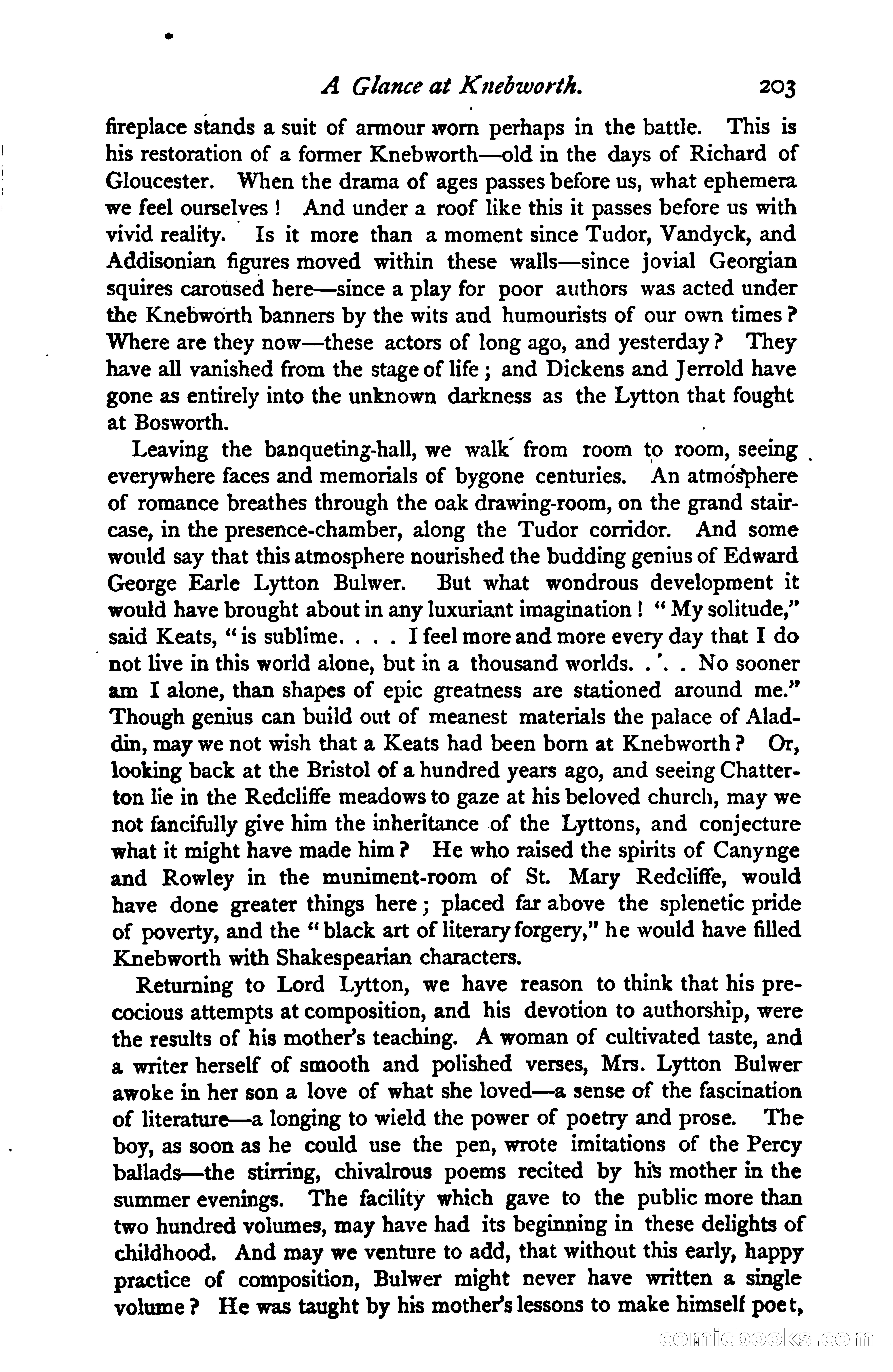
A restored page from Pulp Fiction, 1875. Page through the whole issue in the reader above.
📄 Transcribed text from this page (OCR, searchable)
Machine-transcribed from the original scan — historical spelling and the odd misread are preserved.
A Glance at Knebworth. 203 fireplace stands a suit of armour worn perhaps in the battle. This is his restoration of a former Knebworth—old in the days of Richard of Gloucester. When the drama of ages passes before us, what ephemera we feel ourselves! And under a roof like this it passes before us with vivid reality. Is it more than a moment since Tudor, Vandyck, and Addisonian figures moved within these walls—since jovial Georgian squires caroused here—since a play for poor authors was acted under the Knebworth banners by the wits and humourists of our own times ? Where are they now—these actors of long ago, and yesterday? They have all vanished from the stage of life ; and Dickens and Jerrold have gone as entirely into the unknown darkness as the Lytton that fought at Bosworth. Leaving the banqueting-hall, we walk from room to room, seeing _ everywhere faces and memorials of bygone centuries. An atmosphere of romance breathes through the oak drawing-room, on the grand stair- case, in the presence-chamber, along the Tudor corndor. And some would say that this atmosphere nourished the budding genius of Edward George Earle Lytton Bulwer. But what wondrous development it would have brought about in any luxuriant imagination ! “‘ My solitude,” said Keats, “is sublime. . . . I feel more and more every day that I do not live in this world alone, but in a thousand worlds. .°. . No sooner am I alone, than shapes of epic greatness are stationed around me.” Though genius can build out of meanest materials the palace of Alad- din, may we not wish that 2 Keats had been born at Knebworth? Or, looking back at the Bristol of a hundred years ago, and seeing Chatter- ton lie in the Redcliffe meadows to gaze at his beloved church, may we not fancifully give him the inheritance of the Lyttons, and conjecture what it might have made him? He who raised the spirits of Canynge and Rowley in the muniment-room of St. Mary Redcliffe, would have done greater things here; placed far above the splenetic pride of poverty, and the “ black art of literary forgery,” he would have filled Knebworth with Shakespearian characters. Returning to Lord Lytton, we have reason to think that his pre- cocious attempts at composition, and his devotion to authorship, were the results of his mother’s teaching. A woman of cultivated taste, and a writer herself of smooth and polished verses, Mrs. Lytton Bulwer awoke in her son a love of what she loved—a sense of the fascination of literature—a longing to wield the power of poetry and prose. The boy, as soon as he could use the pen, wrote imitations of the Percy ballads—the stirring, chivalrous poems recited by his mother in the summer evenings. The facility which gave to the public more than two hundred volumes, may have had its beginning in these delights of childhood. And may we venture to add, that without this early, happy practice of composition, Bulwer might never have written a single volume? He was taught by his mother’s lessons to make himself poet, GORMIGOOOKS _ (CO)