
Pulp Fiction, 1875 · page 214 of 400
The Argosy — page 214: what you’re looking at
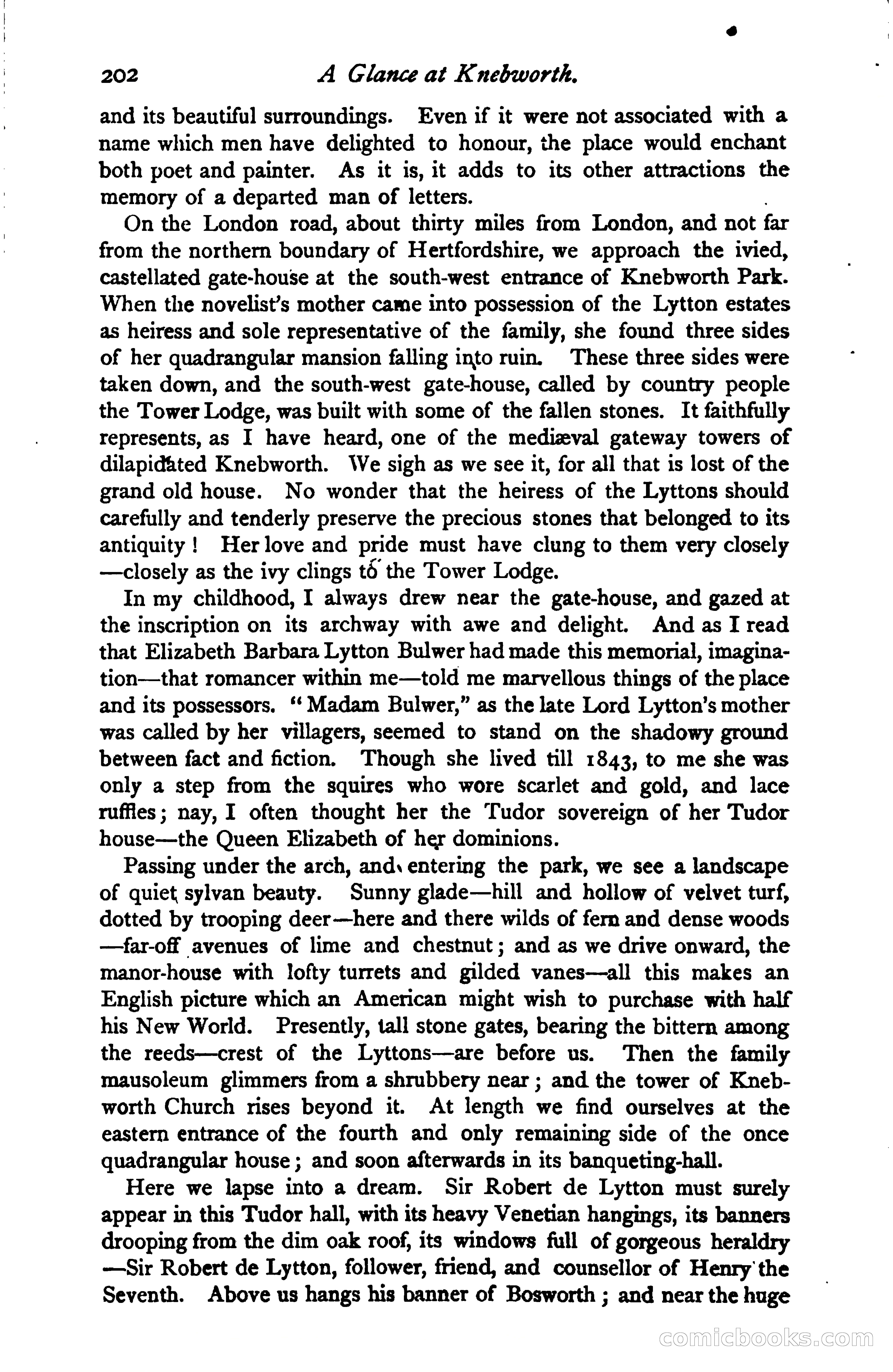
A restored page from Pulp Fiction, 1875. Page through the whole issue in the reader above.
📄 Transcribed text from this page (OCR, searchable)
Machine-transcribed from the original scan — historical spelling and the odd misread are preserved.
202 A Glance at Knebworth. and its beautiful surroundings. Even if it were not associated with a name which men have delighted to honour, the place would enchant both poet and painter. As it is, it adds to its other attractions the memory of a departed man of letters. On the London road, about thirty miles from London, and not far from the northern boundary of Hertfordshire, we approach the ivied, castellated gate-house at the south-west entrance of Knebworth Park. When the novelist’s mother came into possession of the Lytton estates as heiress and sole representative of the family, she found three sides of her quadrangular mansion falling into ruin. These three sides were taken down, and the south-west gate-house, called by country people the Tower Lodge, was built with some of the fallen stones. It faithfully represents, as I have heard, one of the medizval gateway towers of dilapidated Knebworth. We sigh as we see it, for all that 1s lost of the grand old house. No wonder that the heiress of the Lyttons should carefully and tenderly preserve the precious stones that belonged to its antiquity ! Herlove and pride must have clung to them very closely —closely as the ivy clings t6 the Tower Lodge. In my childhood, I always drew near the gate-house, and gazed at the inscription on its archway with awe and delight. And as I read that Elizabeth Barbara Lytton Bulwer had made this memorial, imagina- tion—that romancer within me—told me marvellous things of the place and its possessors. ‘‘ Madam Bulwer,” as the late Lord Lytton’s mother was called by her villagers, seemed to stand on the shadowy ground between fact and fiction. Though she lived till 1843, to me she was only a step from the squires who wore Scarlet and gold, and lace ruffies; nay, I often thought her the Tudor sovereign of her Tudor house—the Queen Elizabeth of her dominions. Passing under the arch, and. entering the park, we see a landscape of quiet sylvan beauty. Sunny glade—hill and hollow of velvet turf, dotted by trooping deer—here and there wilds of fern and dense woods —far-off avenues of lime and chestnut; and as we drive onward, the manor-house with lofty turrets and gilded vanes—all this makes an English picture which an American might wish to purchase with half his New World. Presently, tall stone gates, bearing the bittern among the reeds—crest of the Lyttons—are before us. Then the family mausoleum glimmers from a shrubbery near ; and the tower of Kneb- worth Church rises beyond it. At length we find ourselves at the eastern entrance of the fourth and only remaining side of the once quadrangular house ; and soon afterwards in its banqueting-hall. Here we lapse into a dream. Sir Robert de Lytton must surely appear in this Tudor hall, with its heavy Venetian hangings, its banners drooping from the dim oak roof, its windows full of gorgeous heraldry —Sir Robert de Lytton, follower, friend, and counsellor of Henry the Seventh. Above us hangs his banner of Bosworth ; and near the huge ecomniclooolkks _ (CO)