
Pulp Fiction, 1865 · page 372 of 399
The Argosy — page 372: what you’re looking at
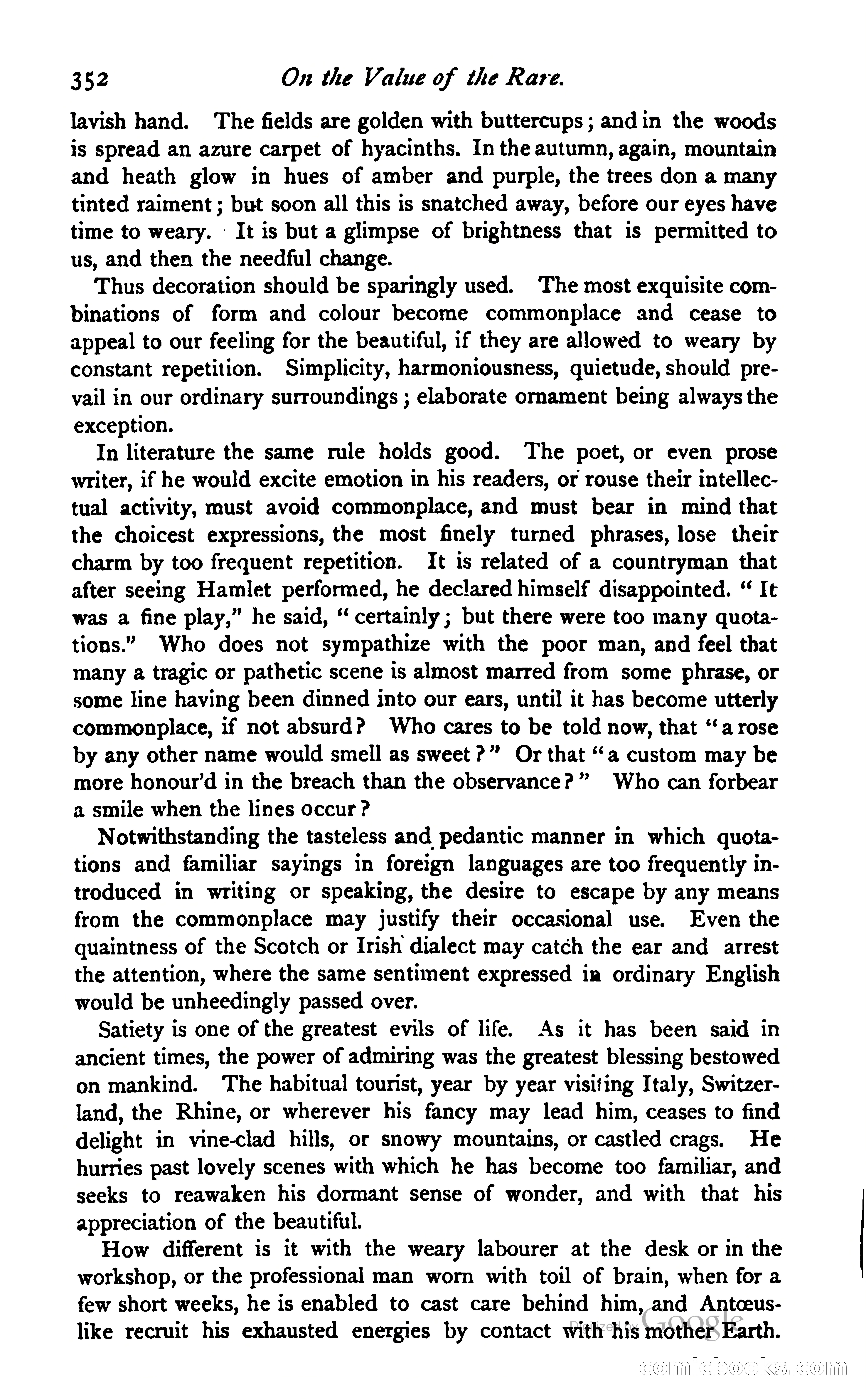
A restored page from Pulp Fiction, 1865. Page through the whole issue in the reader above.
📄 Transcribed text from this page (OCR, searchable)
Machine-transcribed from the original scan — historical spelling and the odd misread are preserved.
352 On the Value of the Rare. lavish hand. The fields are golden with buttercups ; andin the woods is spread an azure carpet of hyacinths. In the autumn, again, mountain and heath glow in hues of amber and purple, the trees don a many tinted raiment; but soon all this is snatched away, before our eyes have time to weary. It is but a glimpse of bnghtness that is permitted to us, and then the needful change. Thus decoration should be sparingly used. The most exquisite com- binations of form and colour become commonplace and cease to appeal to our feeling for the beautiful, 1f they are allowed to weary by constant repetition. Simplicity, harmoniousness, quietude, should pre- vail in our ordinary surroundings ; elaborate ornament being always the exception. In literature the same rule holds good. The poet, or even prose writer, if he would excite emotion in his readers, or rouse their intellec- tual activity, must avoid commonplace, and must bear in mind that the choicest expressions, the most finely turned phrases, lose their charm by too frequent repetition. It is related of a countryman that after seeing Hamlet performed, he declared himself disappointed. “ It was a fine play,” he said, “ certainly ; but there were too many quota- tions.” Who does not sympathize with the poor man, and feel that many a tragic or pathetic scene is almost marred from some phrase, or some line having been dinned into our ears, until it has become utterly commonplace, if not absurd? Who cares to be told now, that “‘a rose by any other name would smell as sweet ?” Or that ‘‘a custom may be more honour’d in the breach than the observance?” Who can forbear a smile when the lines occur ? Notwithstanding the tasteless and pedantic manner in which quota- tions and familiar sayings in foreign languages are too frequently in- troduced in writing or speaking, the desire to escape by any means from the commonplace may justify their occasional use. Even the quaintness of the Scotch or Irish dialect may catch the ear and arrest the attention, where the same sentiment expressed ia ordinary English would be unheedingly passed over. Satiety is one of the greatest evils of life. As it has been said in ancient times, the power of admiring was the greatest blessing bestowed on mankind. The habitual tounst, year by year visiting Italy, Switzer- land, the Rhine, or wherever his fancy may lead him, ceases to find delight in vine-clad hills, or snowy mountains, or castled crags. He hurries past lovely scenes with which he has become too familiar, and seeks to reawaken his dormant sense of wonder, and with that his appreciation of the beautiful. How different is it with the weary labourer at the desk or in the workshop, or the professional man worn with toil of brain, when for a few short weeks, he is enabled to cast care behind him, and Antceus- like recruit his exhausted energies by contact with ‘his mother Earth. ECoOMmicloooks (C(O)