
Pulp Fiction, 1865 · page 371 of 399
The Argosy — page 371: what you’re looking at
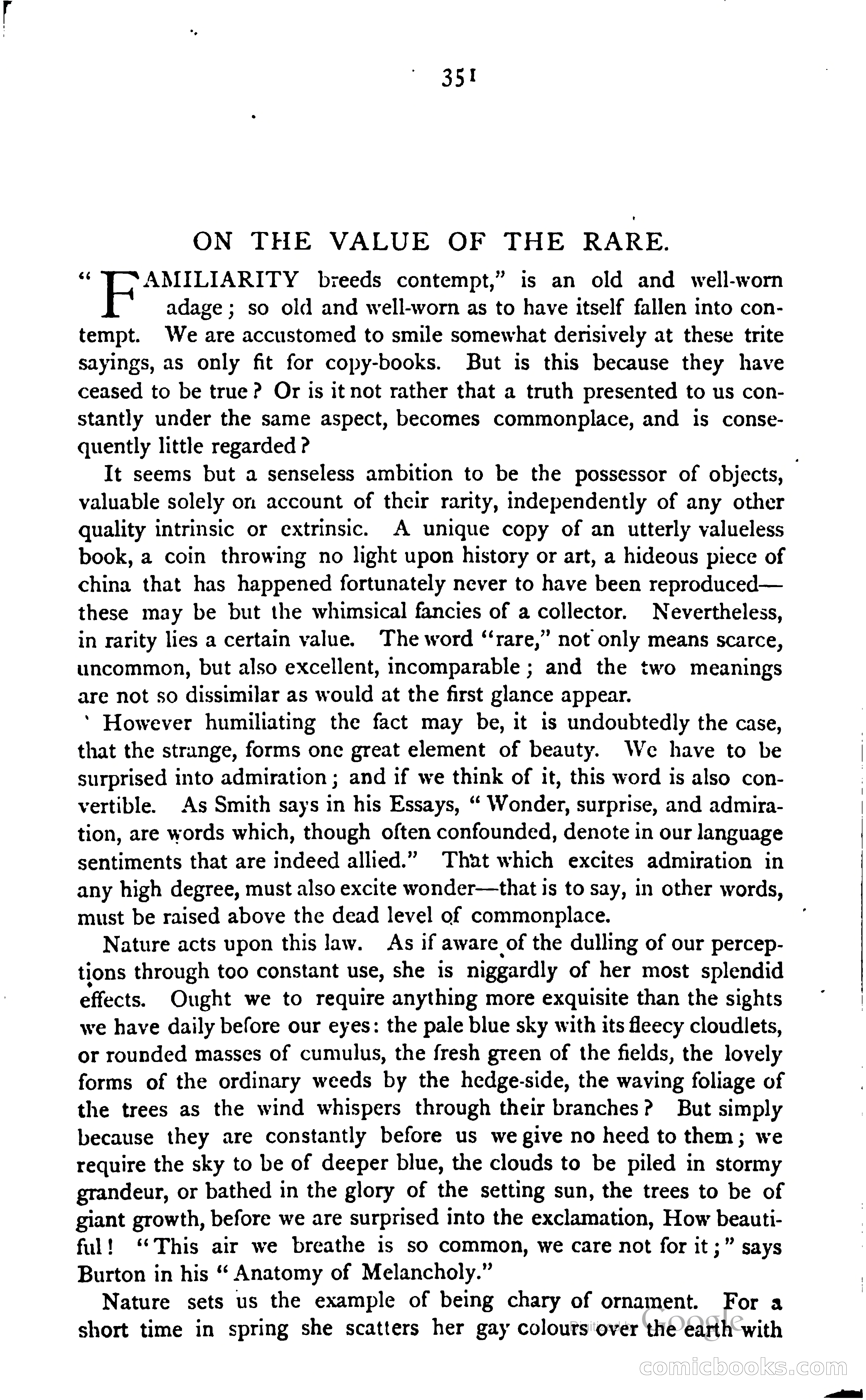
A restored page from Pulp Fiction, 1865. Page through the whole issue in the reader above.
📄 Transcribed text from this page (OCR, searchable)
Machine-transcribed from the original scan — historical spelling and the odd misread are preserved.
35! ON THE VALUE OF THE RARE. “¢ AMILIARITY breeds contempt,” is an old and well-worn 5) adage; so old and well-worn as to have itself fallen into con- tempt. We are accustomed to smile somewhat derisively at these trite sayings, as only fit for copy-books. But is this because they have ceased to be true? Or is it not rather that a truth presented to us con- stantly under the same aspect, becomes commonplace, and is conse- quently little regarded It seems but a senseless ambition to be the possessor of objects, — valuable solely on account of their rarity, independently of any other quality intrinsic or extrinsic. A unique copy of an utterly valueless book, a coin throwing no light upon history or art, a hideous piece of china that has happened fortunately never to have been reproduced— these may be but the whimsical fancies of a collector. Nevertheless, in rarity lies a certain value. The word “rare,” not only means scarce, uncommon, but also excellent, incomparable ; and the two meanings are not so dissimilar as would at the first glance appear. ‘ However humiliating the fact may be, it 1s undoubtedly the case, that the strange, forms one great element of beauty. We have to be surprised into admiration ; and if we think of it, this word is also con- vertible. As Smith says in his Essays, “ Wonder, surprise, and admira- tion, are words which, though often confounded, denote in our language sentiments that are indeed allied.” That which excites admiration in any high degree, must also excite wonder—that Is to say, in other words, must be raised above the dead level of commonplace. Nature acts upon this law. As if aware of the dulling of our percep- tions through too constant use, she is niggardly of her most splendid effects. Ought we to require anything more exquisite than the sights we have daily before our eyes: the pale blue sky with its fleecy cloudlets, or rounded masses of cumulus, the fresh green of the fields, the lovely forms of the ordinary weeds by the hedge-side, the waving foliage of the trees as the wind whispers through their branches? But simply because they are constantly before us we give no heed to them; we require the sky to be of deeper blue, the clouds to be piled in stormy grandeur, or bathed in the glory of the setting sun, the trees to be of giant growth, before we are surprised into the exclamation, How beauti- ful! ‘*This air we breathe is so common, we care not for it ;” says Burton in his “ Anatomy of Melancholy.” Nature sets us the example of being chary of ornament. For a short time in spring she scatters her gay colours'over the earth with ECoOMmicloooks (CO)