
Pulp Fiction, 1865 · page 373 of 399
The Argosy — page 373: what you’re looking at
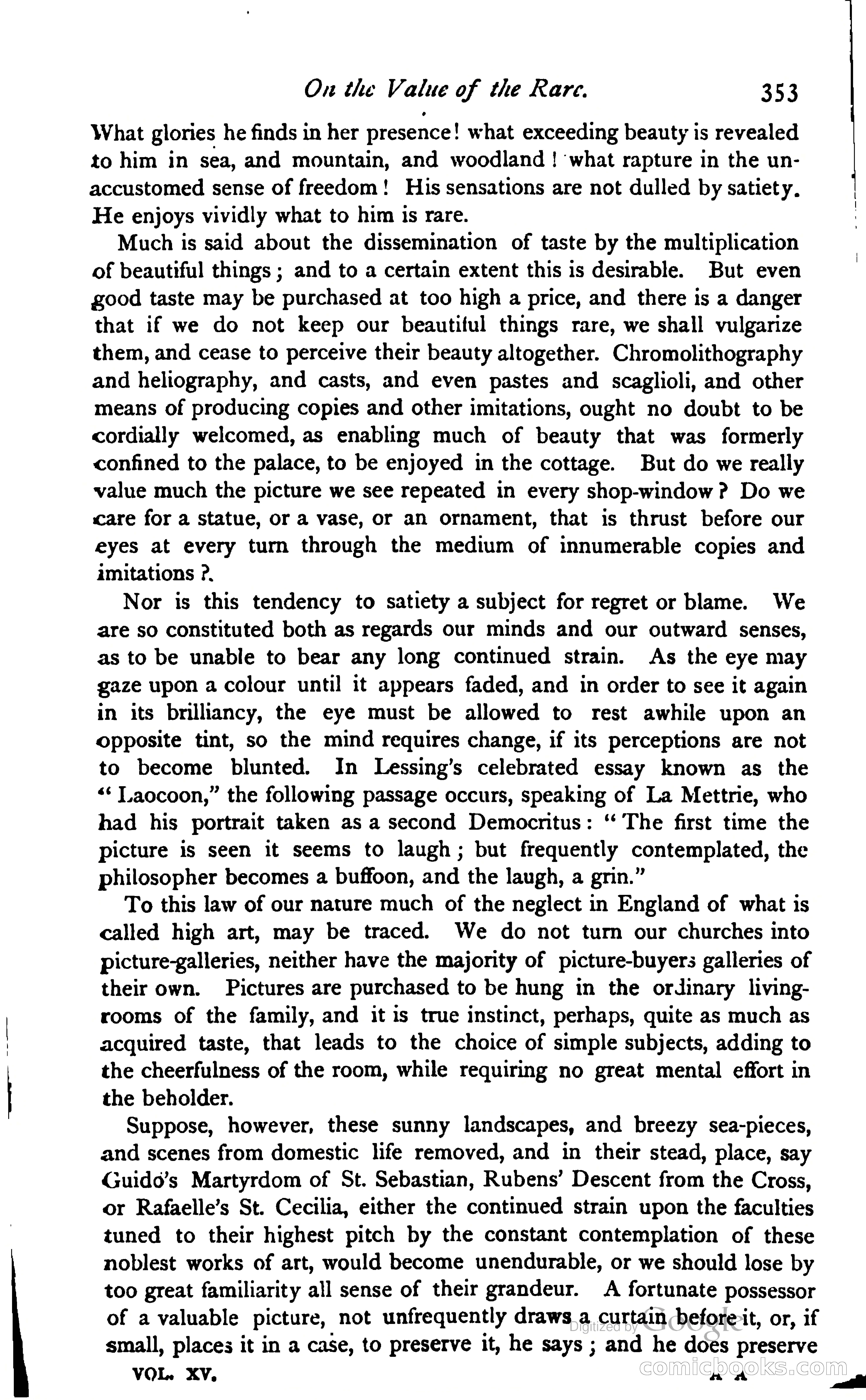
A restored page from Pulp Fiction, 1865. Page through the whole issue in the reader above.
📄 Transcribed text from this page (OCR, searchable)
Machine-transcribed from the original scan — historical spelling and the odd misread are preserved.
On the Value of the Rare. 353 What glories he finds in her presence! what exceeding beauty is revealed to him in sea, and mountain, and woodland ! what rapture in the un- accustomed sense of freedom! His sensations are not dulled by satiety. He enjoys vividly what to him 1s rare. Much is said about the dissemination of taste by the multiplication of beautiful things ; and to a certain extent this is desirable. But even good taste may be purchased at too high a price, and there is a danger that if we do not keep our beautiful things rare, we shall vulgarize them, and cease to perceive their beauty altogether. Chromolithography and heliography, and casts, and even pastes and scaglioli, and other means of producing copies and other imitations, ought no doubt to be cordially welcomed, as enabling much of beauty that was formerly confined to the palace, to be enjoyed in the cottage. But do we really value much the picture we see repeated in every shop-window P Do we care for a statue, or a vase, or an ornament, that is thrust before our eyes at every turn through the medium of innumerable copies and imitations ?. Nor is this tendency to satiety a subject for regret or blame. We are so constituted both as regards our minds and our outward senses, as to be unable to bear any long continued strain. As the eye may gaze upon a colour until it appears faded, and in order to see it again in its brilliancy, the eye must be allowed to rest awhile upon an opposite tint, so the mind requires change, if its perceptions are not to become blunted. In Lessing’s celebrated essay known as the ‘«¢ Taocoon,” the following passage occurs, speaking of La Mettrie, who had his portrait taken as a second Democntus: ‘ The first time the picture is seen it seems to laugh; but frequently contemplated, the philosopher becomes a buffoon, and the laugh, a grin.” To this law of our nature much of the neglect in England of what is called high art, may be traced. We do not turn our churches into picture-galleries, neither have the majority of picture-buyers galleries of their own. Pictures are purchased to be hung in the ordinary living- | rooms of the family, and it is true instinct, perhaps, quite as much as acquired taste, that leads to the choice of simple subjects, adding to the cheerfulness of the room, while requiring no great mental effort in the beholder. Suppose, however, these sunny landscapes, and breezy sea-pieces, and scenes from domestic life removed, and in their stead, place, say Guido’s Martyrdom of St. Sebastian, Rubens’ Descent from the Cross, or Rafaelle’s St. Cecilia, either the continued strain upon the faculties tuned to their highest pitch by the constant contemplation of these noblest works of art, would become unendurable, or we should lose by too great familiarity all sense of their grandeur. <A fortunate possessor of a valuable picture, not unfrequently draws.a curtain before:it, or, if small, places it in a case, to preserve it, he says ; and he does preserve VOL. XV. COMMIGIOOKSAeEonn