
Pulp Fiction, 1887 · page 355 of 399
The Argosy — page 355: what you’re looking at
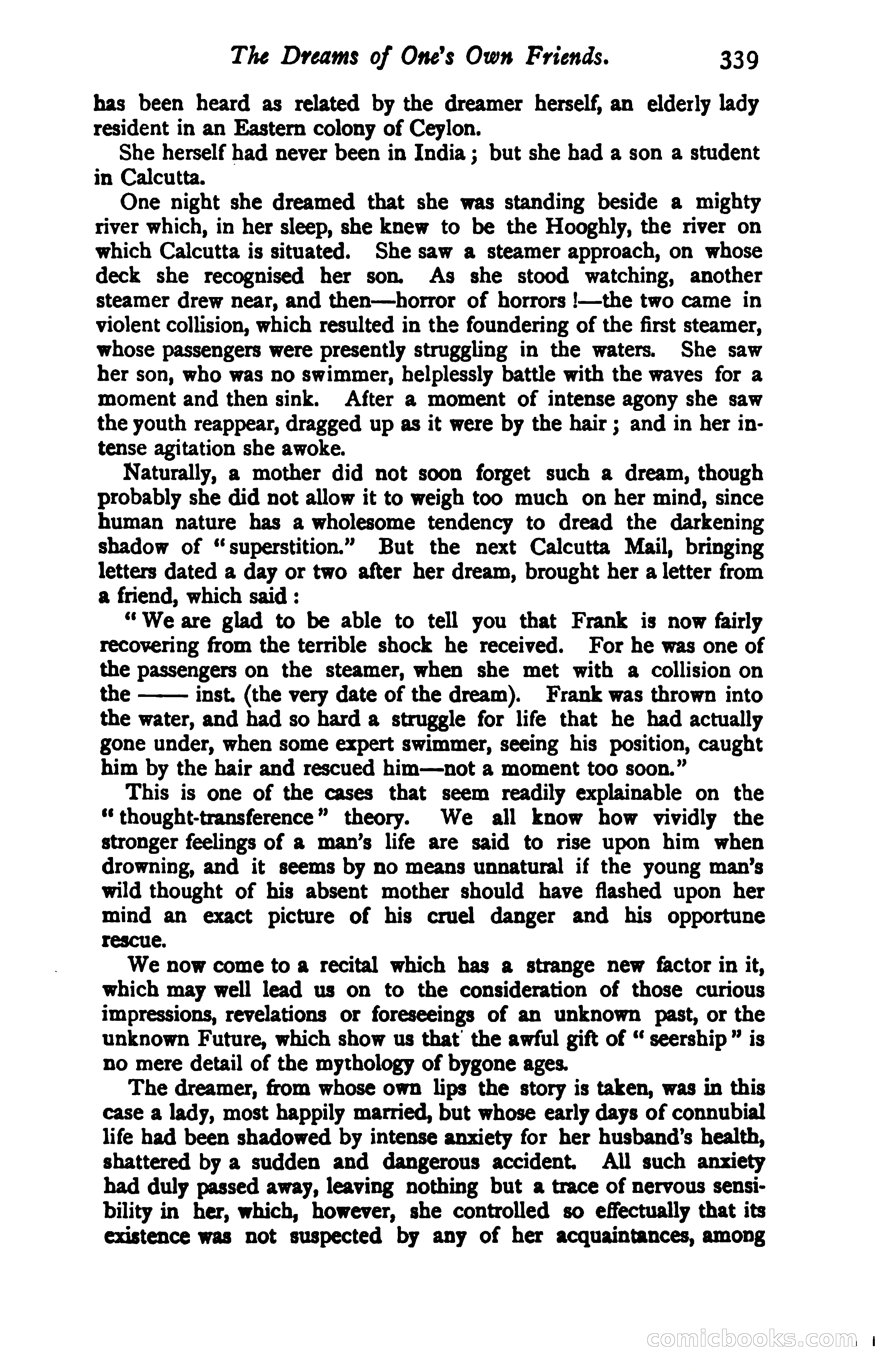
A restored page from Pulp Fiction, 1887. Page through the whole issue in the reader above.
📄 Transcribed text from this page (OCR, searchable)
Machine-transcribed from the original scan — historical spelling and the odd misread are preserved.
The Dreams of One’s Own Friends. 339 has been heard as related by the dreamer herself, an elderly lady resident in an Eastern colony of Ceylon. She herself had never been in India; but she had a son a student in Calcutta. One night she dreamed that she was standing beside a mighty river which, in her sleep, she knew to be the Hooghly, the river on which Calcutta is situated. She saw a steamer approach, on whose deck she recognised her son. As she stood watching, another steamer drew near, and then—horror of horrors !—the two came in violent collision, which resulted in the foundering of the first steamer, whose passengers were presently struggling in the waters. She saw her son, who was no swimmer, helplessly battle with the waves for a moment and then sink. After a moment of intense agony she saw the youth reappear, dragged up as it were by the hair ; and in her in- tense agitation she awoke. Naturally, a mother did not soon forget such a dream, though probably she did not allow it to weigh too much on her mind, since human nature has a wholesome tendency to dread the darkening shadow of “superstition.” But the next Calcutta Mail, bringing letters dated a day or two after her dream, brought her a letter from a friend, which said : ‘“‘'We are glad to be able to tell you that Frank is now fairly recovering from the terrible shock he received. For he was one of the passengers on the steamer, when she met with a collision on the inst. (the very date of the dream). Frank was thrown into the water, and had so hard a struggle for life that he had actually gone under, when some expert swimmer, seeing his position, caught him by the hair and rescued him—not a moment too soon.” This is one of the cases that seem readily explainable on the *‘ thought-transference” theory. We all know how vividly the stronger feelings of a man’s life are said to rise upon him when drowning, and it seems by no means unnatural if the young man’s wild thought of his absent mother should have flashed upon her mind an exact picture of his cruel danger and his opportune rescue. We now come to a recital which has a strange new factor in it, which may well lead us on to the consideration of those curious impressions, revelations or foreseeings of an unknown past, or the unknown Future, which show us that the awful gift of “ seership ” is no mere detail of the mythology of bygone ages. The dreamer, from whose own lips the story is taken, was in this case a lady, most happily married, but whose early days of connubial life had been shadowed by intense anxiety for her husband’s health, shattered by a sudden and dangerous accident. All such anxiety had duly passed away, leaving nothing but a trace of nervous sensi- bility in her, which, however, she controlled so effectually that its existence was not suspected by any of her acquaintances, among EOMRRIC OOO SS (GO) mn