
Pulp Fiction, 1901 · page 91 of 400
The Argosy — page 91: what you’re looking at
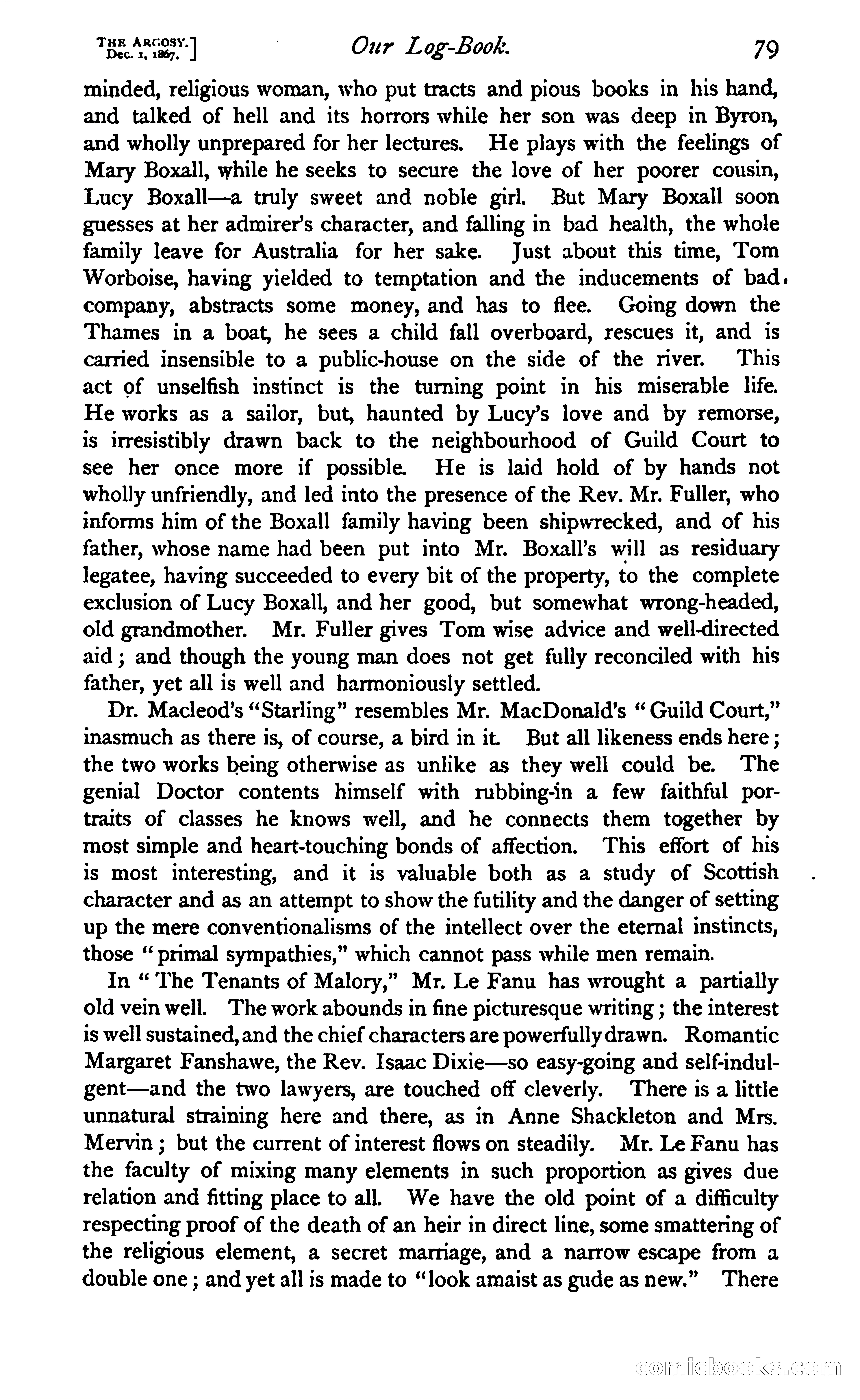
A restored page from Pulp Fiction, 1901. Page through the whole issue in the reader above.
📄 Transcribed text from this page (OCR, searchable)
Machine-transcribed from the original scan — historical spelling and the odd misread are preserved.
"Bee. 11887. | | Our Log-Book. 79 minded, religious woman, who put tracts and pious books in his hand, and talked of hell and its horrors while her son was deep in Byron, and wholly unprepared for her lectures. He plays with the feelings of Mary Boxall, while he seeks to secure the love of her poorer cousin, Lucy Boxall—a truly sweet and noble girl. But Mary Boxall soon guesses at her admirer’s character, and falling in bad health, the whole family leave for Australia for her sake. Just about this time, Tom Worboise, having yielded to temptation and the inducements of bad. company, abstracts some money, and has to flee. Going down the Thames in a boat, he sees a child fall overboard, rescues it, and 1s carried insensible to a public-house on the side of the river. This act of unselfish instinct is the turning point in his miserable life. He works as a sailor, but, haunted by Lucy’s love and by remorse, is irresistibly drawn back to the neighbourhood of Guild Court to see her once more if possible. He is laid hold of by hands not wholly unfriendly, and led into the presence of the Rev. Mr. Fuller, who informs him of the Boxall family having been shipwrecked, and of his father, whose name had been put into Mr. Boxall’s will as residuary legatee, having succeeded to every bit of the property, to the complete exclusion of Lucy Boxall, and her good, but somewhat wrong-headed, old grandmother. Mr. Fuller gives Tom wise advice and well-directed aid ; and though the young man does not get fully reconciled with his father, yet all is well and harmoniously settled. Dr. Macleod’s “Starling” resembles Mr. MacDonald’s “ Guild Court,” inasmuch as there is, of course, a bird in it. But all likeness ends here ; the two works being otherwise as unlike as they well could be. The genial Doctor contents himself with rubbing-in a few faithful por- traits of classes he knows well, and he connects them together by most simple and heart-touching bonds of affection. This effort of his is most interesting, and it is valuable both as a study of Scottish character and as an attempt to show the futility and the danger of setting up the mere conventionalisms of the intellect over the eternal instincts, those “ primal sympathies,” which cannot pass while men remain. In “ The Tenants of Malory,” Mr. Le Fanu has wrought a partially old vein well. The work abounds in fine picturesque writing ; the interest is well sustained, and the chief characters are powerfullydrawn. Romantic Margaret Fanshawe, the Rev. Isaac Dixie—so easy-going and self-indul- gent—and the two lawyers, are touched off cleverly. There 1s a little unnatural straining here and there, as in Anne Shackleton and Mrs. Mervin ; but the current of interest flows on steadily. Mr. Le Fanu has the faculty of mixing many elements in such proportion as gives due relation and fitting place to all. We have the old point of a difficulty respecting proof of the death of an heir in direct line, some smattering of the religious element, a secret marriage, and a narrow escape from a double one ; and yet all is made to “look amaist as gude as new.” There comicaocks (GO)