
Pulp Fiction, 1901 · page 90 of 400
The Argosy — page 90: what you’re looking at
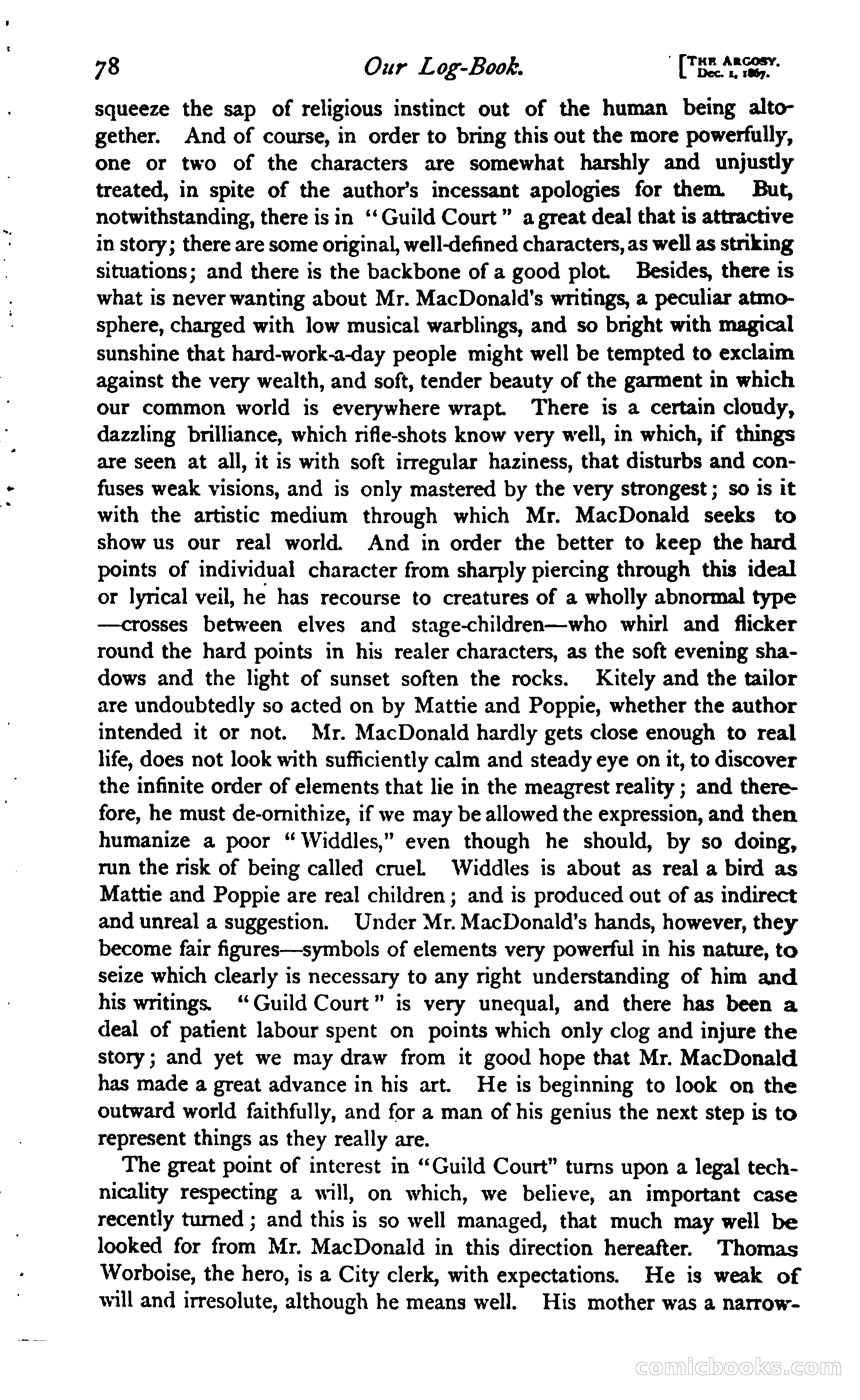
A restored page from Pulp Fiction, 1901. Page through the whole issue in the reader above.
📄 Transcribed text from this page (OCR, searchable)
Machine-transcribed from the original scan — historical spelling and the odd misread are preserved.
78 Our Log-Book. [TBE Ancoee. squeeze the sap of religious instinct out of the human being alto- gether. And of course, in order to bring this out the more powerfully, one or two of the characters are somewhat harshly and unjustly treated, in spite of the author’s incessant apologies for them. But, notwithstanding, there isin ‘‘Guild Court” a great deal that is attractive in story; there are some original, well-defined characters, as well as striking situations; and there is the backbone of a good plot. Besides, there is what is never wanting about Mr. MacDonald's writings, a peculiar atmo- sphere, charged with low musical warblings, and so bright with magical sunshine that hard-work-a-day people might well be tempted to exclaim against the very wealth, and soft, tender beauty of the garment in which our common world is everywhere wrapt. There is a certain cloudy, dazzling brilliance, which rifie-shots know very well, in which, if things are seen at all, it is with soft irregular haziness, that disturbs and con- fuses weak visions, and is only mastered by the very strongest ; so is it with the artistic medium through which Mr. MacDonald seeks to show us our real world. And in order the better to keep the hard points of individual character from sharply piercing through this ideal or lyrical veil, he has recourse to creatures of a wholly abnormal type —crosses between elves and stage-children—who whirl and flicker round the hard points in his realer characters, as the soft evening sha- dows and the light of sunset soften the rocks. Kitely and the tailor are undoubtedly so acted on by Mattie and Poppie, whether the author intended it or not. Mr. MacDonald hardly gets close enough to real life, does not look with sufficiently calm and steady eye on it, to discover the infinite order of elements that lie in the meagrest reality ; and there- fore, he must de-ornithize, if we may be allowed the expression, and then humanize a poor “ Widdles,” even though he should, by so doing, run the risk of being called cruel. Widdles is about as real a bird as Mattie and Poppie are real children; and is produced out of as indirect and unreal a suggestion. Under Mr. MacDonald’s hands, however, they become fair figures—symbols of elements very powerful in his nature, to seize which clearly is necessary to any right understanding of him and his writings. ‘Guild Court” is very unequal, and there has been a deal of patient labour spent on points which only clog and injure the story; and yet we may draw from it good hope that Mr. MacDonald has made a great advance in his art. He is beginning to look on the outward world faithfully, and for a man of his genius the next step is to represent things as they really are. The great point of interest in “Guild Court” turns upon a legal tech- nicality respecting a will, on which, we believe, an important case recently turned ; and this is so well managed, that much may well be looked for from Mr. MacDonald in this direction hereafter. Thomas Worboise, the hero, is a City clerk, with expectations. He is weak of will and irresolute, although he means well. His mother was a narrow- COIN @ lDOOl|KS .CO©