
Pulp Fiction, 1901 · page 92 of 400
The Argosy — page 92: what you’re looking at
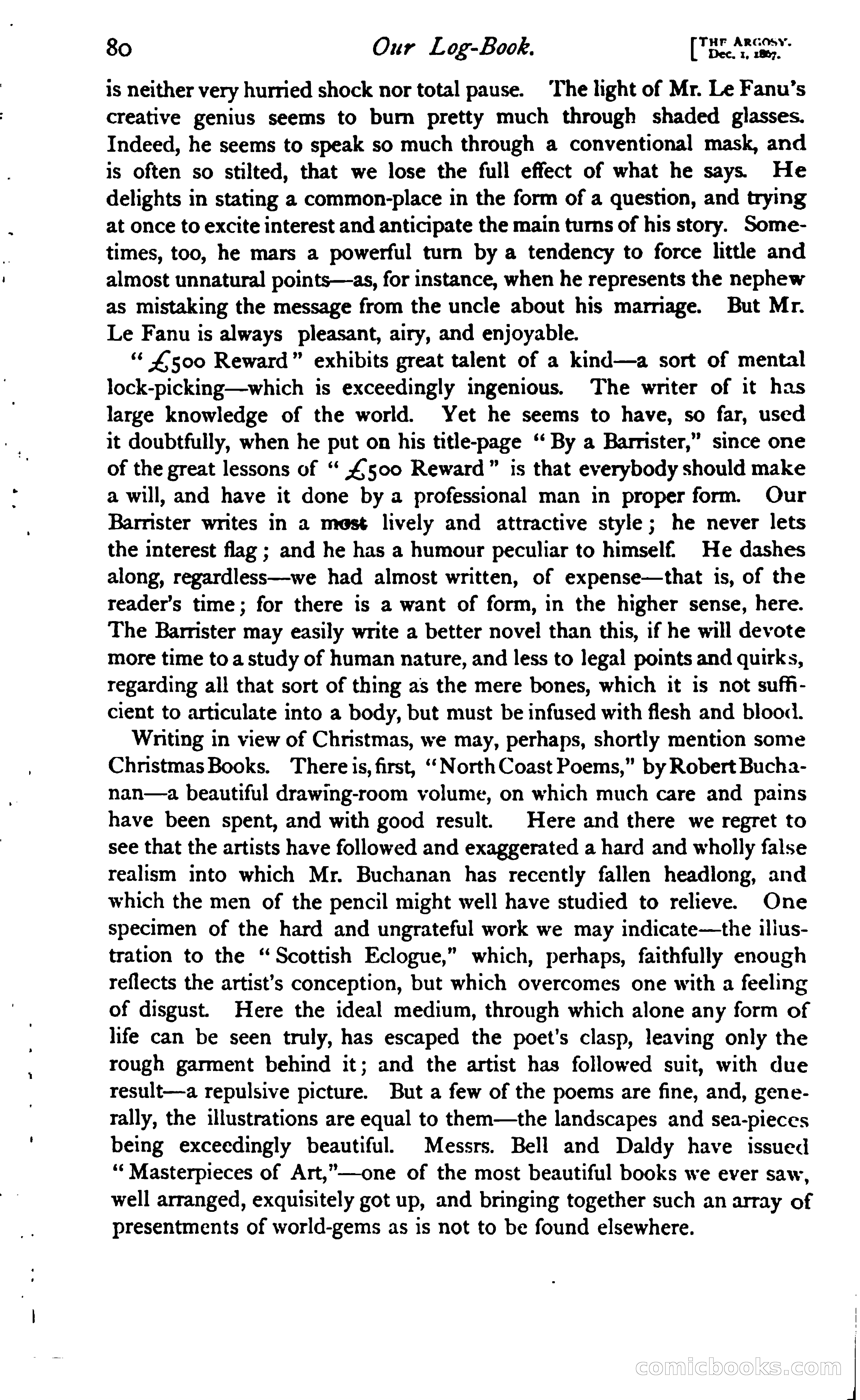
A restored page from Pulp Fiction, 1901. Page through the whole issue in the reader above.
📄 Transcribed text from this page (OCR, searchable)
Machine-transcribed from the original scan — historical spelling and the odd misread are preserved.
80 Our Log-Book. [tae Aware. is neither very hurried shock nor total pause. The hght of Mr. Le Fanu’s creative genius seems to bum pretty much through shaded glasses. Indeed, he seems to speak so much through a conventional mask, and is often so stilted, that we lose the full effect of what he says. He delights in stating a common-place in the form of a question, and trying at once to excite interest and anticipate the main turns of his story. Some- times, too, he mars a powerful turn by a tendency to force little and almost unnatural points—as, for instance, when he represents the nephew as mistaking the message from the uncle about his marriage. But Mr. Le Fanu is always pleasant, airy, and enjoyable. “* £500 Reward” exhibits great talent of a kind—a sort of mental lock-picking—which is exceedingly ingenious. The writer of it has large knowledge of the world. Yet he seems to have, so far, used it doubtfully, when he put on his title-page ‘‘ By a Barmister,” since one of the great lessons of “ 4500 Reward” is that everybody should make a will, and have it done by a professional man in proper form. Our Barnster writes In a mest lively and attractive style; he never lets the interest flag ; and he has a humour peculiar to himself. He dashes along, regardless—we had almost written, of expense—that 1s, of the reader's time; for there 1s a want of form, in the higher sense, here. The Barrister may easily write a better novel than this, if he will devote more time to a study of human nature, and less to legal points and quirks, regarding all that sort of thing as the mere bones, which it 1s not sufh- cient to articulate into a body, but must be infused with flesh and blood. Wntting in view of Christmas, we may, perhaps, shortly mention some Christmas Books. Thereis, first, ‘“‘North Coast Poems,” by Robert Bucha- nan—a beautiful drawing-room volume, on which much care and pains have been spent, and with good result. Here and there we regret to see that the artists have followed and exaggerated a hard and wholly false realism into which Mr. Buchanan has recently fallen headlong, and which the men of the pencil might well have studied to relieve. One specimen of the hard and ungrateful work we may indicate—the ilius- tration to the “Scottish Eclogue,” which, perhaps, faithfully enough reflects the artist’s conception, but which overcomes one with a feeling of disgust. Here the ideal medium, through which alone any form of life can be seen truly, has escaped the poet's clasp, leaving only the rough garment behind it; and the artist has followed suit, with due result—a repulsive picture. But a few of the poems are fine, and, gene- rally, the illustrations are equal to them—the landscapes and sea-pieces being exceedingly beautiful. Messrs. Bell and Daldy have issued ‘* Masterpieces of Art,”—one of the most beautiful books we ever saw, well arranged, exquisitely got up, and bringing together such an array of presentments of world-gems as 1s not to be found elsewhere. COIN @ lDOOl|KS .CO©