
Pulp Fiction, 1901 · page 81 of 400
The Argosy — page 81: what you’re looking at
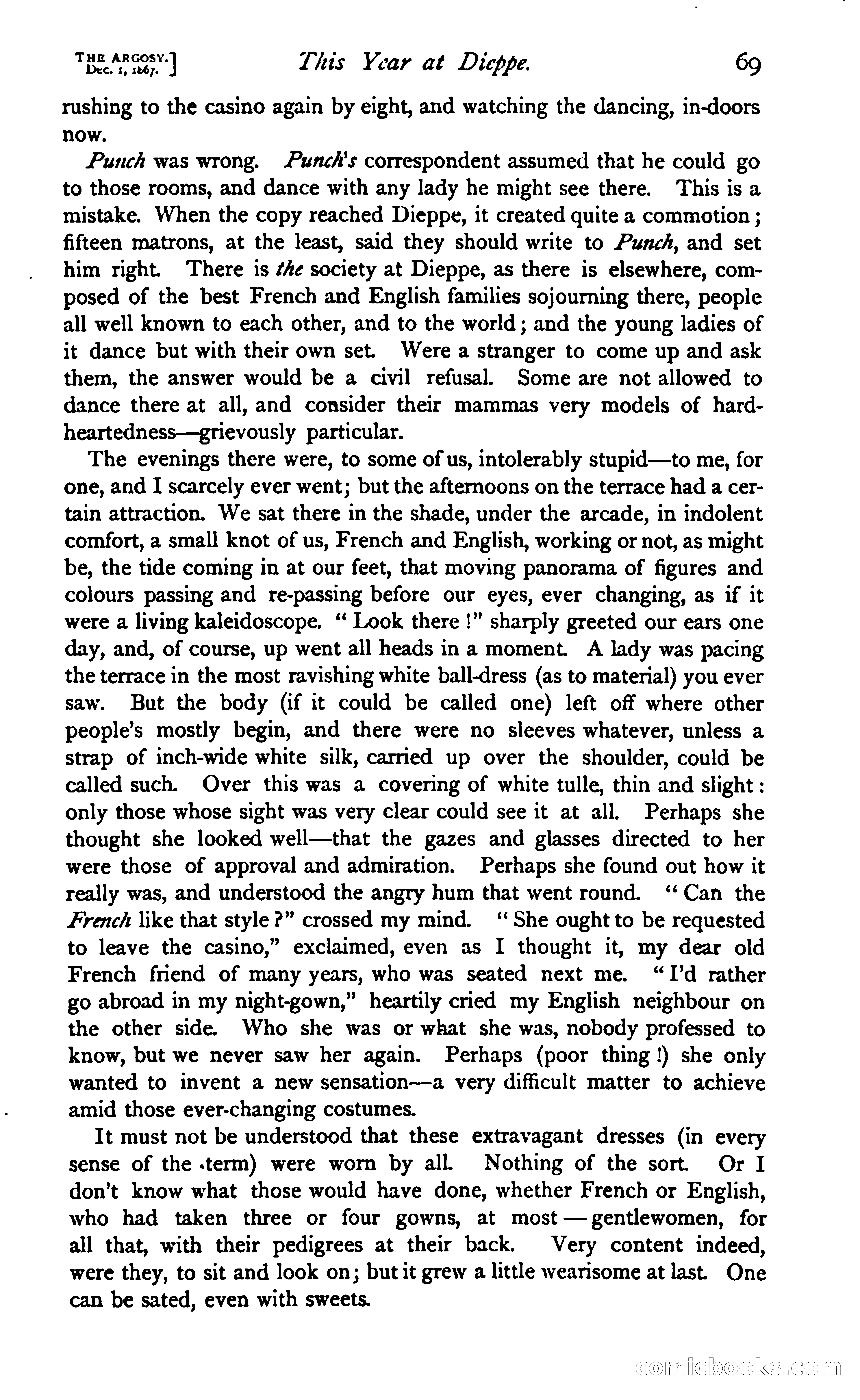
A restored page from Pulp Fiction, 1901. Page through the whole issue in the reader above.
📄 Transcribed text from this page (OCR, searchable)
Machine-transcribed from the original scan — historical spelling and the odd misread are preserved.
Tye Ancesy. Lhis Year at Dieppe. 69 rushing to the casino again by eight, and watching the dancing, in-doors now. Punch was wrong. Punch’s correspondent assumed that he could go to those rooms, and dance with any lady he might see there. This isa mistake. When the copy reached Dieppe, it created quite a commotion ; fifteen matrons, at the least, said they should write to Punch, and set him right. There is “Ae society at Dieppe, as there is elsewhere, com- posed of the best French and English families sojourning there, people all well known to each other, and to the world ; and the young ladies of it dance but with their own set. Were a stranger to come up and ask them, the answer would be a civil refusal. Some are not allowed to dance there at all, and consider their mammas very models of hard- heartedness—grievously particular. The evenings there were, to some of us, intolerably stupid—to me, for one, and I scarcely ever went; but the afternoons on the terrace had a cer- tain attraction. We sat there in the shade, under the arcade, in indolent comfort, a small knot of us, French and English, working or not, as might be, the tide coming in at our feet, that moving panorama of figures and colours passing and re-passing before our eyes, ever changing, as if it were a living kaleidoscope. ‘‘ Look there !” sharply greeted our ears one day, and, of course, up went all heads ina moment. A lady was pacing the terrace in the most ravishing white ball-dress (as to material) you ever saw. But the body (if it could be called one) left off where other people’s mostly begin, and there were no sleeves whatever, unless a strap of inch-wide white silk, carried up over the shoulder, could be called such. Over this was a covering of white tulle, thin and slight : only those whose sight was very clear could see it at all. Perhaps she thought she looked well—that the gazes and glasses directed to her were those of approval and admiration. Perhaps she found out how it really was, and understood the angry hum that went round. ‘‘ Can the French like that style ?” crossed my mind. ‘She ought to be requested - to leave the casino,” exclaimed, even as I thought it, my dear old French fnend of many years, who was seated next me. “I'd rather go abroad in my night-gown,” heartily cned my English neighbour on the other side. Who she was or what she was, nobody professed to know, but we never saw her again. Perhaps (poor thing !) she only wanted to invent a new sensation—a very difficult matter to achieve amid those ever-changing costumes. It must not be understood that these extravagant dresses (in every sense of the .term) were worn by all. Nothing of the sort. Or I don’t know what those would have done, whether French or English, who had taken three or four gowns, at most —gentlewomen, for all that, with their pedigrees at their back. Very content indeed, were they, to sit and look on; but it grew a little wearisome at last. One can be sated, even with sweets. comicaocks (GO)