
Pulp Fiction, 1901 · page 80 of 400
The Argosy — page 80: what you’re looking at
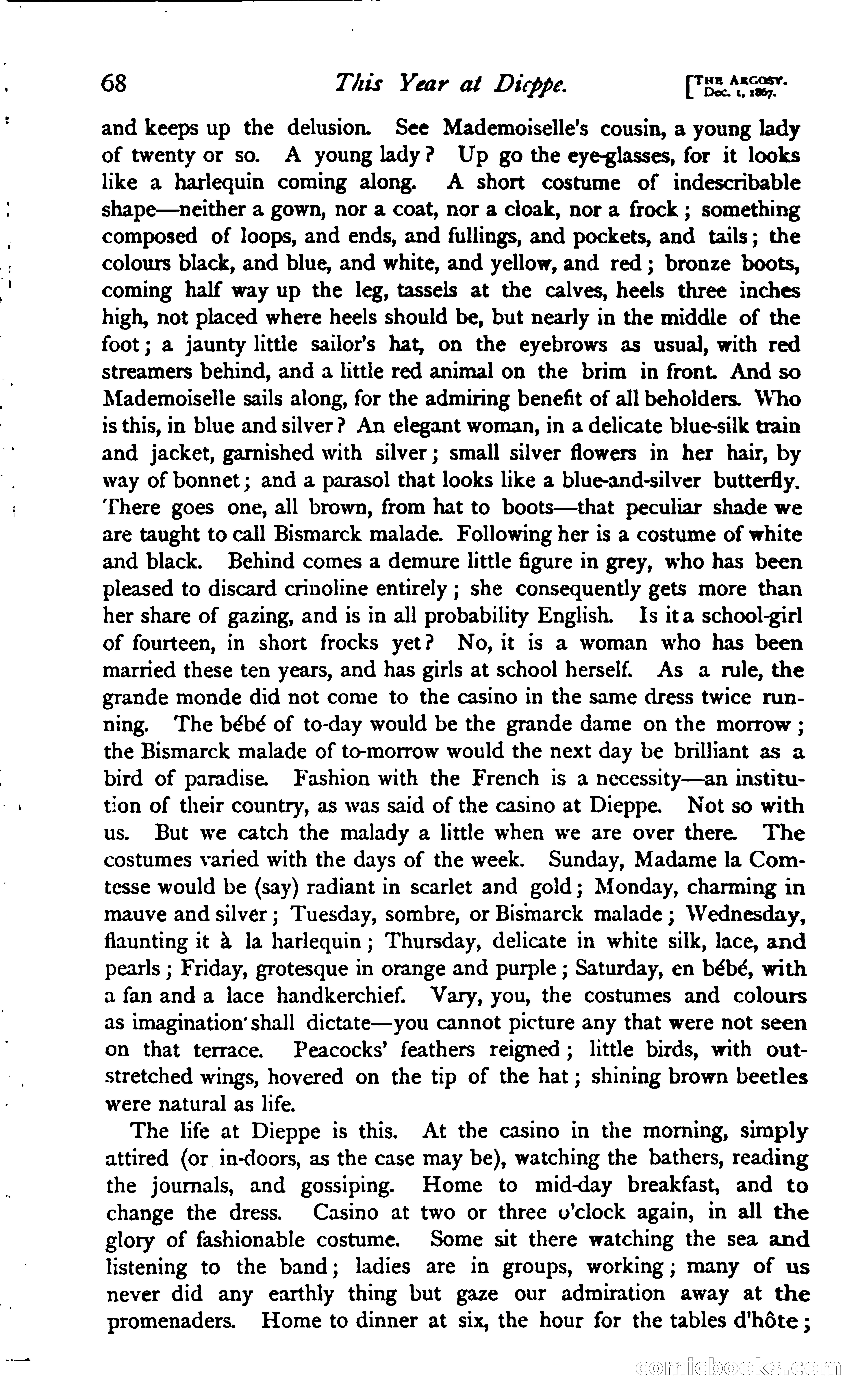
A restored page from Pulp Fiction, 1901. Page through the whole issue in the reader above.
📄 Transcribed text from this page (OCR, searchable)
Machine-transcribed from the original scan — historical spelling and the odd misread are preserved.
68 This Year at Dichpe. [THE ARcosy. 2867 and keeps up the delusion. See Mademoiselle’s cousin, a young lady of twenty or so. A young lady? Up go the eye-glasses, for it looks like a harlequin coming along. A short costume of indescribable shape—neither a gown, nor a coat, nor a cloak, nor a frock ; something composed of loops, and ends, and fullings, and pockets, and tails; the colours black, and blue, and white, and yellow, and red; bronze boots, coming half way up the leg, tassels at the calves, heels three inches high, not placed where heels should be, but nearly in the middle of the foot ; a jaunty little sailor's hat, on the eyebrows as usual, with red streamers behind, and a little red animal on the brim in front. And so Mademoiselle sails along, for the admiring benefit of all beholders. Who is this, in blue and silver? An elegant woman, in a delicate blue-silk train and jacket, garnished with silver; small silver flowers in her hair, by way of bonnet; and a parasol that looks like a blue-and-silver butterfly. There goes one, all brown, from hat to boots—that peculiar shade we are taught to call Bismarck malade. Following her is a costume of white and black. Behind comes a demure little figure in grey, who has been pleased to discard cnnoline entirely ; she consequently gets more than her share of gazing, and is in all probability Enghsh. Is ita school-girl of fourteen, in short frocks yet? No, it 1s a woman who has been married these ten years, and has girls at school herself. As a rule, the grande monde did not come to the casino in the same dress twice run- ning. The bébé of to-day would be the grande dame on the morrow ; the Bismarck malade of to-morrow would the next day be bmilliant as a bird of paradise. Fashion with the French is a necessity—an institu- tion of their country, as was said of the casino at Dieppe. Not so with us. But we catch the malady a little when we are over there. The costumes varied with the days of the week. Sunday, Madame la Com- tesse would be (say) radiant in scarlet and gold; Monday, charming in mauve and silver ; Tuesday, sombre, or Bismarck malade ; Wednesday, flaunting it 4 la harlequin; Thursday, delicate in white silk, lace, and pearls ; Friday, grotesque in orange and purple ; Saturday, en bébé, with a fan anda lace handkerchief. Vary, you, the costumes and colours as imagination’ shall dictate—you cannot picture any that were not seen on that terrace. Peacocks’ feathers reigned; little birds, with out- stretched wings, hovered on the tip of the hat; shining brown beetles were natural as life. The life at Dieppe is this. At the casino in the morning, simply attired (or in-doors, as the case may be), watching the bathers, reading the journals, and gossiping. Home to mid-day breakfast, and to change the dress. Casino at two or three vu’clock again, in all the glory of fashionable costume. Some sit there watching the sea and listening to the band; ladies are in groups, working; many of us never did any earthly thing but gaze our admiration away at the promenaders. Home to dinner at six, the hour for the tables d’hote ; ECOMiIcoOolkxs.cO©