
Pulp Fiction, 1901 · page 82 of 400
The Argosy — page 82: what you’re looking at
A restored page from Pulp Fiction, 1901. Page through the whole issue in the reader above.
📄 Transcribed text from this page (OCR, searchable)
Machine-transcribed from the original scan — historical spelling and the odd misread are preserved.
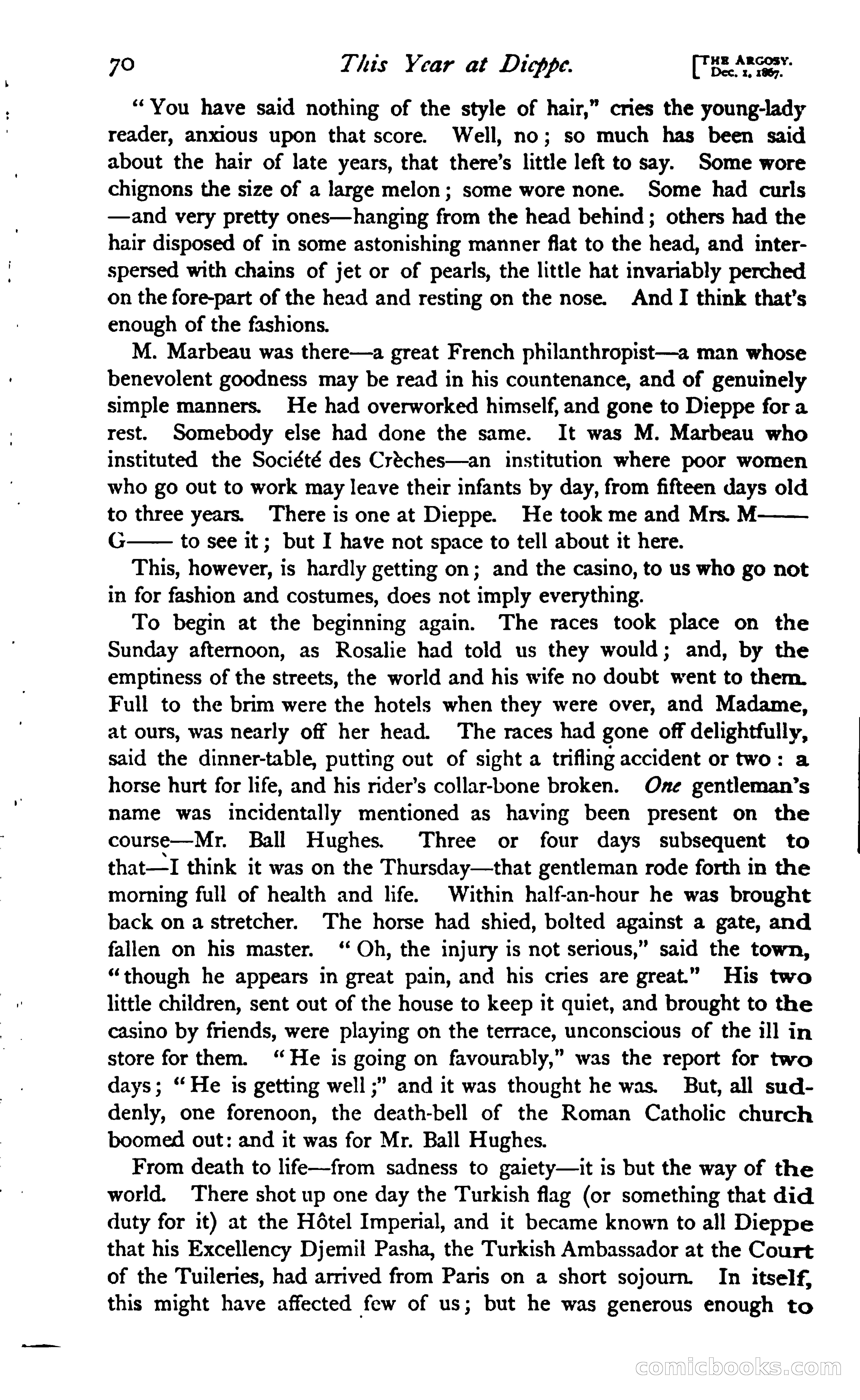
70 This Year at Dichpe. [eee “You have said nothing of the style of hair,” cnes the young-lady reader, anxious upon that score. Well, no; so much has been said about the hair of late years, that there’s little left to say. Some wore chignons the size of a large melon; some wore none. Some had curls —and very pretty ones—hanging from the head behind; others had the hair disposed of in some astonishing manner flat to the head, and inter- spersed with chains of jet or of pearls, the little hat invariably perched on the fore-part of the head and resting on the nose. And I think that’s enough of the fashions. M. Marbeau was there—a great French philanthropist—a man whose benevolent goodness may be read in his countenance, and of genuinely simple manners. He had overworked himself, and gone to Dieppe for a rest. Somebody else had done the same. It was M. Marbeau who instituted the Société des Créches—an institution where poor women who go out to work may leave their infants by day, from fifteen days old to three years. There is one at Dieppe. He took me and Mrs. M G to see it; but I have not space to tell about it here. This, however, is hardly getting on; and the casino, to us who go not in for fashion and costumes, does not imply everything. To begin at the beginning again. The races took place on the Sunday afternoon, as Rosalie had told us they would; and, by the emptiness of the streets, the world and his wife no doubt went to them. Full to the brim were the hotels when they were over, and Madame, at ours, was nearly off her head. The races had gone off delightfully, said the dinner-table, putting out of sight a trifling accident or two: a horse hurt for life, and his nder’s collar-bone broken. Oze gentleman’s name was incidentally mentioned as having been present on the course—Mr. Ball Hughes. Three or four days subsequent to that—I think it was on the Thursday—that gentleman rode forth in the morning full of health and hfe. Within half-an-hour he was brought back on a stretcher. The horse had shied, bolted against a gate, and fallen on his master. ‘Oh, the injury is not serious,” said the town, “though he appears in great pain, and his cries are great.” His two little children, sent out of the house to keep it quiet, and brought to the casino by fnends, were playing on the terrace, unconscious of the 111 in store for them. “He is going on favourably,” was the report for two days; “ He is getting well ;” and it was thought he was. But, all sud- denly, one forenoon, the death-bell of the Roman Catholic church boomed out: and it was for Mr. Ball Hughes. From death to life—from sadness to gaiety—it is but the way of the world. There shot up one day the Turkish flag (or something that did duty for 1t) at the Hétel Imperial, and it became known to all Dieppe that his Excellency Djemil Pasha, the Turkish Ambassador at the Court of the Tuileries, had arrived from Paris on a short sojourn. In itself, this might have affected few of us; but he was generous enough to ECOMiIcoOolxs.cO©