
Pulp Fiction, 1901 · page 65 of 400
The Argosy — page 65: what you’re looking at
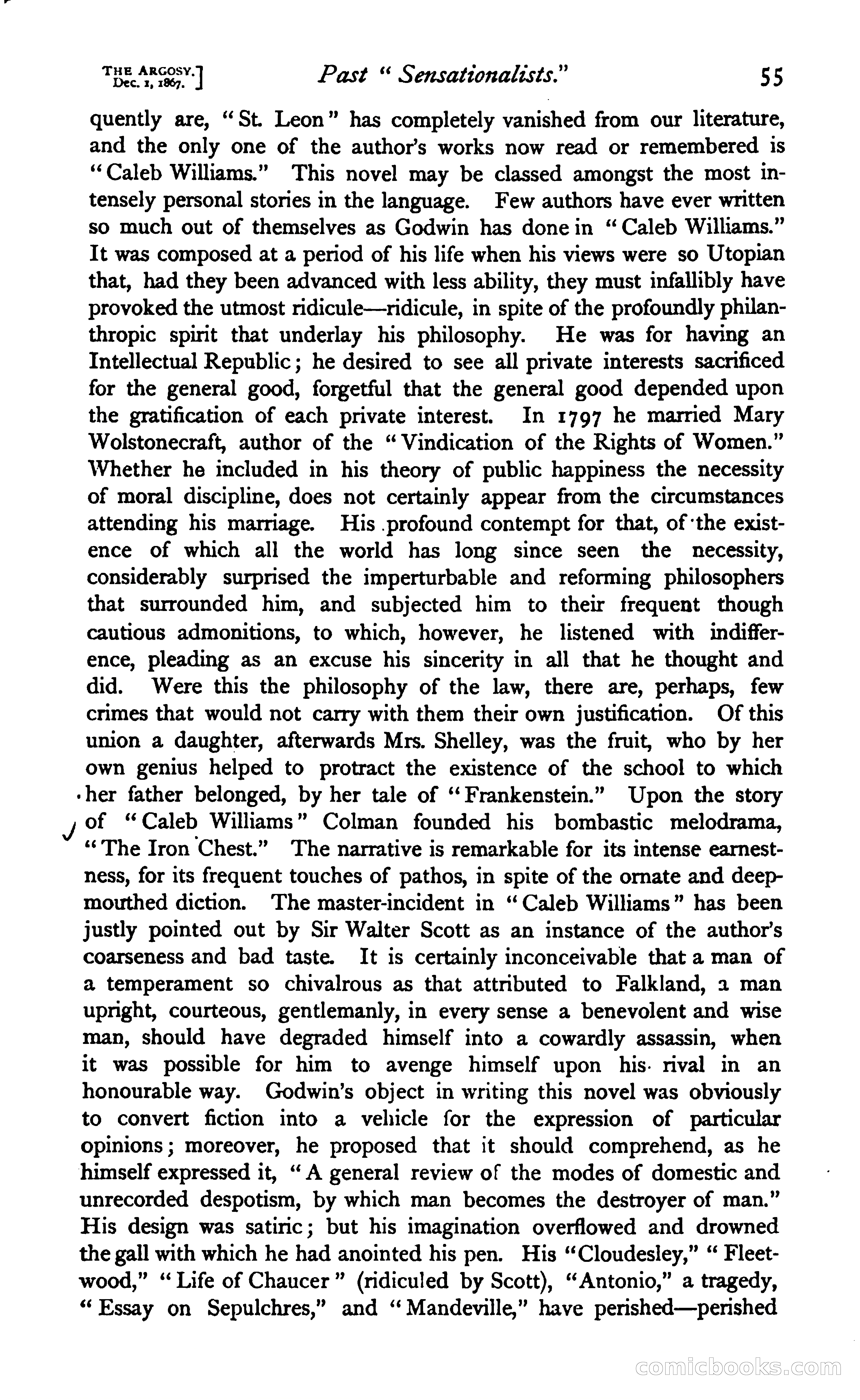
A restored page from Pulp Fiction, 1901. Page through the whole issue in the reader above.
📄 Transcribed text from this page (OCR, searchable)
Machine-transcribed from the original scan — historical spelling and the odd misread are preserved.
THE ARGOSY.] Past “ Sensationalists.” 55 quently are, “St. Leon” has completely vanished from our literature, and the only one of the authors works now read or remembered is “Caleb Williams.” This novel may be classed amongst the most in- tensely personal stories in the language. Few authors have ever wnitten sO much out of themselves as Godwin has donein “Caleb Williams.” It was composed at a period of his life when his views were so Utopian that, had they been advanced with less ability, they must infallibly have provoked the utmost ridicule—ridicule, in spite of the profoundly philan- thropic spirit that underlay his philosophy. He was for having an Intellectual Republic; he desired to see all private interests sacnficed for the general good, forgetful that the general good depended upon the gratification of each private interest. In 1797 he married Mary Wolstonecraft, author of the “ Vindication of the Rights of Women.” Whether he included in his theory of public happiness the necessity of moral discipline, does not certainly appear from the circumstances attending his marriage. His .profound contempt for that, of ‘the exist- ence of which all the world has long since seen the necessity, considerably surprised the imperturbable and reforming philosophers that surrounded him, and subjected him to their frequent though cautious admonitions, to which, however, he listened with indiffer- ence, pleading as an excuse his sincerity in all that he thought and did. Were this the philosophy of the law, there are, perhaps, few crimes that would not carry with them their own justification. Of this union a daughter, afterwards Mrs. Shelley, was the fruit, who by her own genius helped to protract the existence of the school to which -her father belonged, by her tale of ‘‘ Frankenstein.” Upon the story of “Caleb Williams” Colman founded his bombastic melodrama, “The Iron Chest.” The narrative is remarkable for its intense earnest- ness, for its frequent touches of pathos, in spite of the ornate and deep- mouthed diction. The master-incident in “Caleb Williams” has been justly pointed out by Sir Walter Scott as an instance of the author's coarseness and bad taste. It is certainly inconceivable that a man of a temperament so chivalrous as that attnbuted to Falkland, 2 man upnght, courteous, gentlemanly, in every sense a benevolent and wise man, should have degraded himself into a cowardly assassin, when it was possible for him to avenge himself upon his. rival in an honourable way. Godwin’s object in writing this novel was obviously to convert fiction into a velicle for the expression of particular opinions ; moreover, he proposed that it should comprehend, as he himself expressed it, “A general review of the modes of domestic and unrecorded despotism, by which man becomes the destroyer of man.” His design was satiric; but his imagination overflowed and drowned the gall with which he had anointed his pen. His “Cloudesley,” “ Fleet- wood,” “ Life of Chaucer ” (ridiculed by Scott), “Antonio,” a tragedy, ‘Essay on Sepulchres,” and “ Mandeville,” have perished—penshed comicaocks (GO)