
Pulp Fiction, 1901 · page 64 of 400
The Argosy — page 64: what you’re looking at
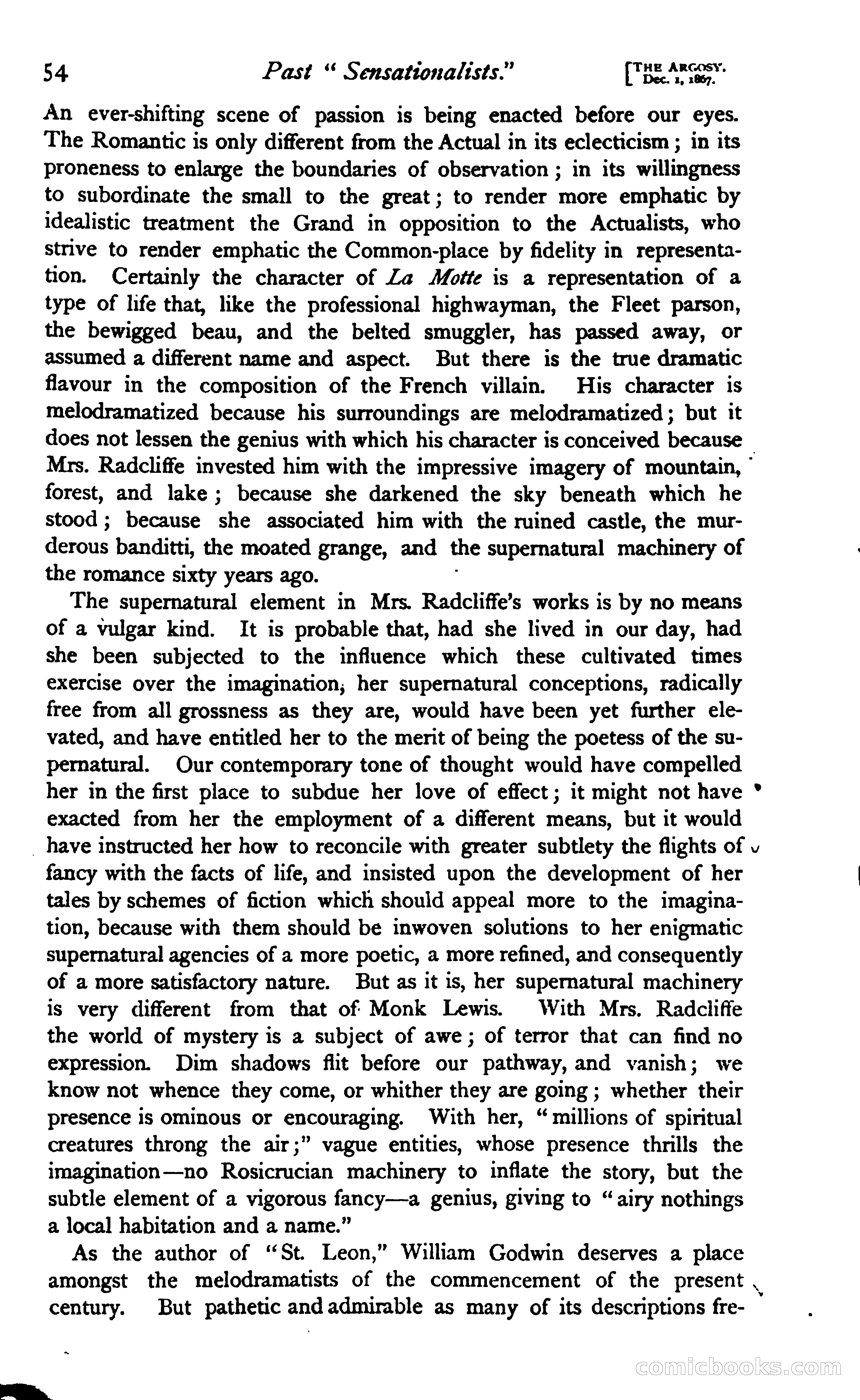
A restored page from Pulp Fiction, 1901. Page through the whole issue in the reader above.
📄 Transcribed text from this page (OCR, searchable)
Machine-transcribed from the original scan — historical spelling and the odd misread are preserved.
54 Past “ Sensattonalists.” bh lala z, 3867. An ever-shifting scene of passion is being enacted before our eyes. The Romantic is only different from the Actual in its eclecticism ; in its proneness to enlarge the boundaries of observation ; in its willingness to subordinate the small to the great; to render more emphatic by idealistic treatment the Grand in opposition to the Actualists, who Strive to render emphatic the Common-place by fidelity in representa- tion. Certainly the character of Za Motte is a representation of a type of life that, hke the professional highwayman, the Fleet parson, the bewigged beau, and the belted smuggler, has passed away, or assumed a different name and aspect. But there is the true dramatic flavour in the composition of the French villain. His character is melodramatized because his surroundings are melodramatized; but it does not lessen the genius with which his character is conceived because | Mrs. Radcliffe invested him with the impressive imagery of mountain, © forest, and lake; because she darkened the sky beneath which he stood ; because she associated him with the ruined castle, the mur- derous banditti, the moated grange, and the supernatural machinery of the romance sixty years ago. The supernatural element in Mrs. Radcliffe’s works is by no means of a vulgar kind. It is probable that, had she lived in our day, had she been subjected to the influence which these cultivated times exercise over the imagination; her supernatural conceptions, radically free from all grossness as they are, would have been yet further ele- vated, and have entitled her to the merit of being the poetess of the su- pernatural. Our contemporary tone of thought would have compelled her im the first place to subdue her love of effect; it might not have exacted from her the employment of a different means, but it would _ have instructed her how to reconcile with greater subtlety the flights of fancy with the facts of life, and insisted upon the development of her tales by schemes of fiction which should appeal more to the imagina- tion, because with them should be inwoven solutions to her enigmatic supernatural agencies of a more poetic, a more refined, and consequently of a more satisfactory nature. But as it is, her supematural machinery is very different from that of Monk Lewis. With Mrs. Radcliffe the world of mystery is a subject of awe; of terror that can find no expression. Dim shadows flit before our pathway, and vanish; we know not whence they come, or whither they are going ; whether their presence Is Ominous or encouraging. With her, “millions of spiritual creatures throng the air;” vague entities, whose presence thrills the imagination—no Rosicrucian machinery to inflate the story, but the subtle element of a vigorous fancy—a genius, giving to “airy nothings a local habitation and a name.” As the author of “St. Leon,” William Godwin deserves a place amongst the melodramatists of the commencement of the present century. But pathetic andadmirable as many of its descriptions fre- C COIN G OOO) <S (CO)