
Pulp Fiction, 1901 · page 49 of 400
The Argosy — page 49: what you’re looking at
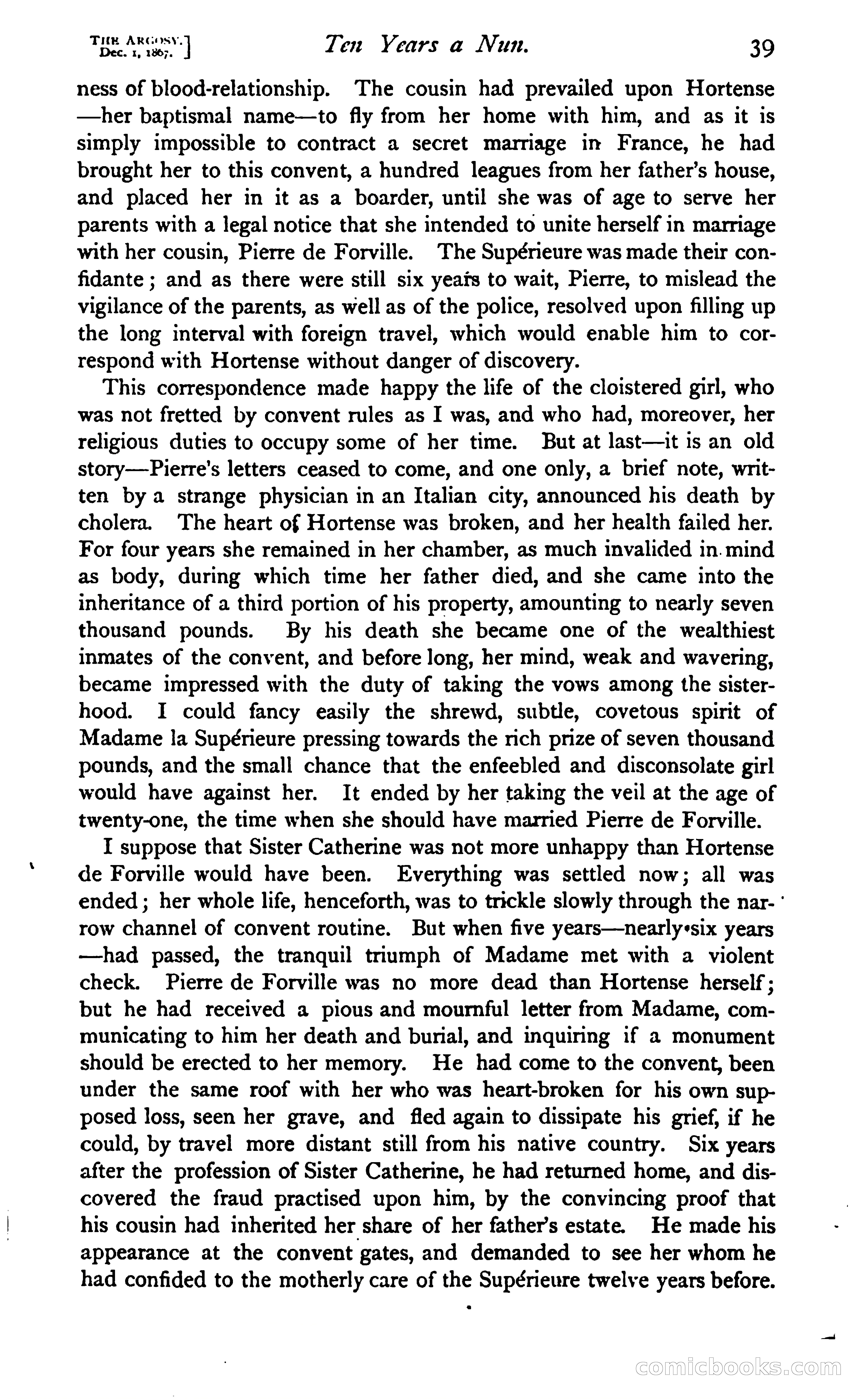
A restored page from Pulp Fiction, 1901. Page through the whole issue in the reader above.
📄 Transcribed text from this page (OCR, searchable)
Machine-transcribed from the original scan — historical spelling and the odd misread are preserved.
a pee. teen | Ten Years a Nun. 39 ness of blood-relationship. The cousin had prevailed upon Hortense —her baptismal name—to fly from her home with him, and as it is simply impossible to contract a secret marriage in France, he had brought her to this convent, a hundred leagues from her father’s house, and placed her im it as a boarder, until she was of age to serve her parents with a legal notice that she intended to unite herself in marriage with her cousin, Pierre de Forville. The Supéneure was made their con- fidante ; and as there were still six years to wait, Pierre, to mislead the vigilance of the parents, as well as of the police, resolved upon filling up the long interval with foreign travel, which would enable him to cor- respond with Hortense without danger of discovery. This correspondence made happy the life of the cloistered girl, who was not fretted by convent rules as I was, and who had, moreover, her religious duties to occupy some of her time. But at last—it is an old story—Pierre’s letters ceased to come, and one only, a brief note, wnt- ten bya strange physician in an Italian city, announced his death by cholera. The heart of Hortense was broken, and her health failed her. For four years she remained in her chamber, as much invalided in. mind as body, during which time her father died, and she came into the inheritance of a third portion of his property, amounting to nearly seven thousand pounds. By his death she became one of the wealthiest inmates of the convent, and before long, her mind, weak and wavering, became impressed with the duty of taking the vows among the sister- hood. I could fancy easily the shrewd, subtle, covetous spint of Madame la Supéneure pressing towards the nch prize of seven thousand pounds, and the small chance that the enfeebled and disconsolate girl would have against her. It ended by her taking the veil at the age of twenty-one, the time when she should have married Pierre de Forville. I suppose that Sister Catherine was not more unhappy than Hortense de Forville would have been. Everything was settled now; all was ended ; her whole life, henceforth, was to trickle slowly through the nar- ° row channel of convent routine. But when five years—nearlyssix years —had passed, the tranquil triumph of Madame met with a violent check. Pierre de Forville was no more dead than Hortense herself ; but he had received a pious and mournful letter from Madame, com- municating to him her death and burial, and inquinng if a monument should be erected to her memory. He had come to the convent, been under the same roof with her who was heart-broken for his own sup- posed loss, seen her grave, and fled again to dissipate his grief, if he could, by travel more distant still from his native country. Six years after the profession of Sister Catherine, he had returned home, and dis- covered the fraud practised upon him, by the convincing proof that his cousin had inherited her share of her father’s estate. He made his appearance at the convent gates, and demanded to see her whom he had confided to the motherly care of the Supérieure twelve years before. comicaocks (GO)