
Pulp Fiction, 1901 · page 48 of 400
The Argosy — page 48: what you’re looking at
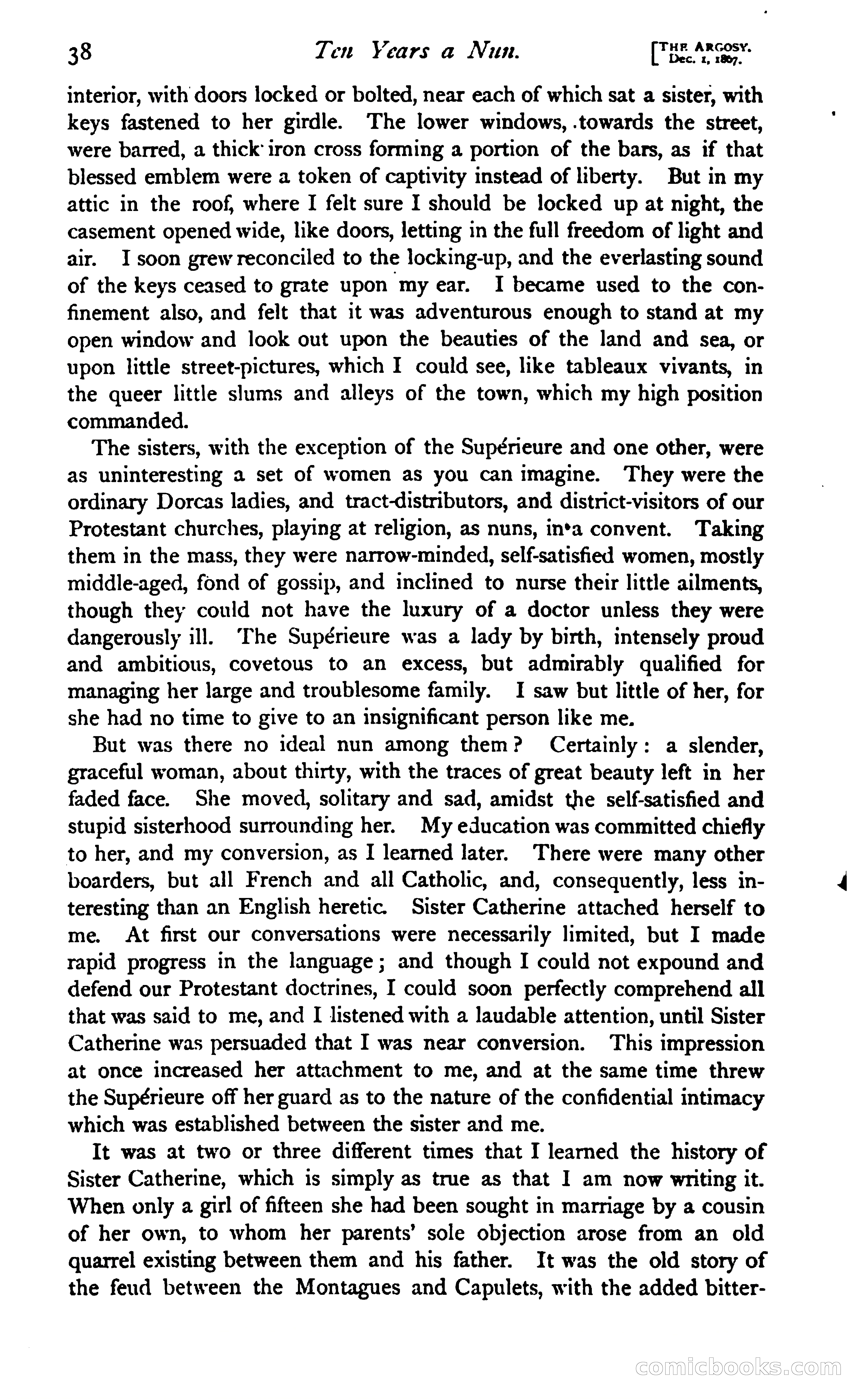
A restored page from Pulp Fiction, 1901. Page through the whole issue in the reader above.
📄 Transcribed text from this page (OCR, searchable)
Machine-transcribed from the original scan — historical spelling and the odd misread are preserved.
38 den Years a Nun. Tae Amaowr. interior, with doors locked or bolted, near each of which sat a sister, with keys fastened to her girdle. The lower windows, .towards the street, were barred, a thick’ 1ron cross forming a portion of the bars, as if that blessed emblem were a token of captivity instead of liberty. But in my attic in the roof, where I felt sure I should be locked up at night, the casement opened wide, like doors, letting in the full freedom of light and air. I soon grew reconciled to the locking-up, and the everlasting sound of the keys ceased to grate upon my ear. I became used to the con- finement also, and felt that it was adventurous enough to stand at my open window and look out upon the beauties of the land and sea, or upon little street-pictures, which I could see, like tableaux vivants, in the queer little slums and alleys of the town, which my high position commanded. The sisters, with the exception of the Supérieure and one other, were as uninteresting a set of women as you can imagine. ‘They were the ordinary Dorcas ladies, and tract-distributors, and district-visitors of our Protestant churches, playing at religion, as nuns, in‘a convent. Taking them in the mass, they were narrow-minded, self-satisfied women, mostly middle-aged, fond of gossip, and inclined to nurse their little ailments, though they could not have the luxury of a doctor unless they were dangerously ill. The Supérieure was a lady by birth, intensely proud and ambitious, covetous to an excess, but admirably qualified for managing her large and troublesome family. I saw but little of her, for she had no time to give to an insignificant person like me. But was there no ideal nun among them? Certainly: a slender, graceful woman, about thirty, with the traces of great beauty left in her faded face. She moved, solitary and sad, amidst the self-satisfied and stupid sisterhood surrounding her. My education was committed chiefly to her, and my conversion, as I learned later. There were many other boarders, but all French and all Catholic, and, consequently, less in- teresting than an English heretic. Sister Catherine attached herself to me. At first our conversations were necessarily limited, but I made rapid progress in the language; and though I could not expound and defend our Protestant doctrines, I could soon perfectly comprehend all that was said to me, and [I listened with a laudable attention, until Sister Catherine was persuaded that I was near conversion. This impression at once increased her attachment to me, and at the same time threw the Supérieure off her guard as to the nature of the confidential intimacy which was established between the sister and me. It was at two or three different times that I learned the history of Sister Catherme, which is simply as true as that I am now wniting it. When only a girl of fifteen she had been sought in marnage by a cousin of her own, to whom her parents’ sole objection arose from an old quarrel existing between them and his father. It was the old story of the feud between the Montagues and Capulets, with the added bitter- comicaocks (GO)