
Pulp Fiction, 1901 · page 50 of 400
The Argosy — page 50: what you’re looking at
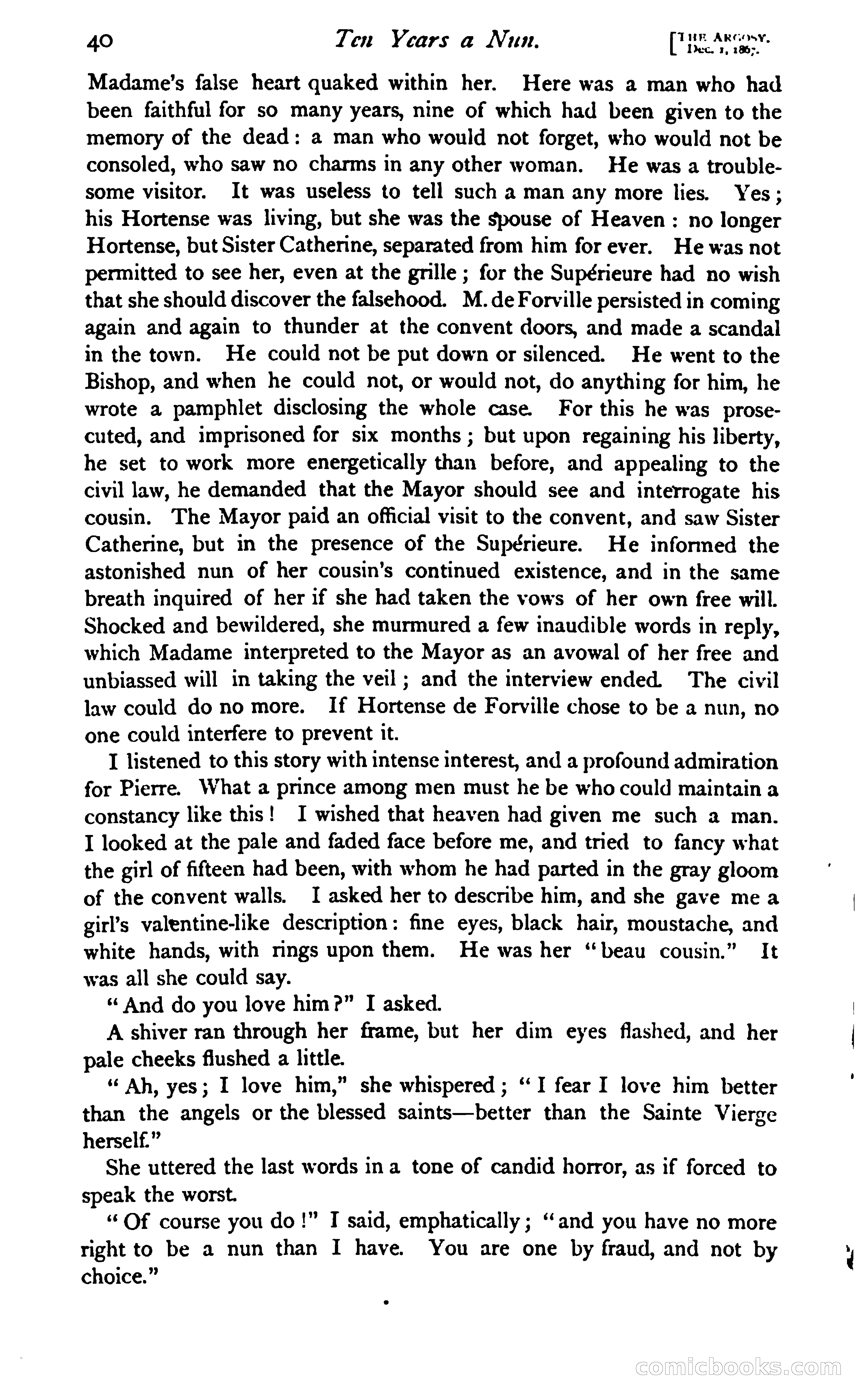
A restored page from Pulp Fiction, 1901. Page through the whole issue in the reader above.
📄 Transcribed text from this page (OCR, searchable)
Machine-transcribed from the original scan — historical spelling and the odd misread are preserved.
40 Ten Years a Nun. THE ARCOSY, Dec. 3, 186>. Madame’s false heart quaked within her. Here was a man who had been faithful for so many years, nine of which had been given to the memory of the dead: a man who would not forget, who would not be consoled, who saw no charms in any other woman. He was a trouble- some visitor. It was useless to tell such a man any more lies. Yes; his Hortense was living, but she was the spouse of Heaven : no longer Hortense, but Sister Catherine, separated from him for ever. He was not permitted to see her, even at the grille ; for the Supérieure had no wish that she should discover the falsehood. M.deForville persisted in coming again and again to thunder at the convent doors, and made a scandal in the town. He could not be put down or silenced. He went to the Bishop, and when he could not, or would not, do anything for him, he wrote a pamphlet disclosing the whole case. For this he was _ prose- cuted, and imprisoned for six months ; but upon regaining his liberty, he set to work more energetically than before, and appealing to the civil law, he demanded that the Mayor should see and interrogate his cousin. The Mayor paid an official visit to the convent, and saw Sister Catherine, but in the presence of the Supérieure. He informed the astonished nun of her cousin’s continued existence, and in the same breath inquired of her if she had taken the vows of her own free will. Shocked and bewildered, she murmured a few inaudible words in reply, which Madame interpreted to the Mayor as an avowal of her free and unbiassed will in taking the veil; and the interview ended. The civil law could do no more. If Hortense de Forville chose to be a nun, no one could interfere to prevent it. I listened to this story with intense interest, and a profound admiration for Pierre. What a prince among men must he be who could maintain a constancy like this! I wished that heaven had given me such a man. I looked at the pale and faded face before me, and tned to fancy what the girl of fifteen had been, with whom he had parted in the gray gloom of the convent walls. I asked her to describe him, and she gave me a girl’s valentine-like description: fine eyes, black hair, moustache, and white hands, with mngs upon them. He was her “beau cousin.” It was all she could say. “ And do you love him?” I asked. A shiver ran through her frame, but her dim eyes flashed, and her pale cheeks flushed a little. “Ah, yes; I love him,” she whispered ; “I fear I love him better than the angels or the blessed saints—better than the Sainte Vierge herself.” She uttered the last words ina tone of candid horror, as if forced to speak the worst. “Of course you do!” I said, emphatically ; ‘“‘and you have no more right to be a nun than I have. You are one by fraud, and not by choice.” comicaocks (GO) yd