
Pulp Fiction, 1901 · page 47 of 400
The Argosy — page 47: what you’re looking at
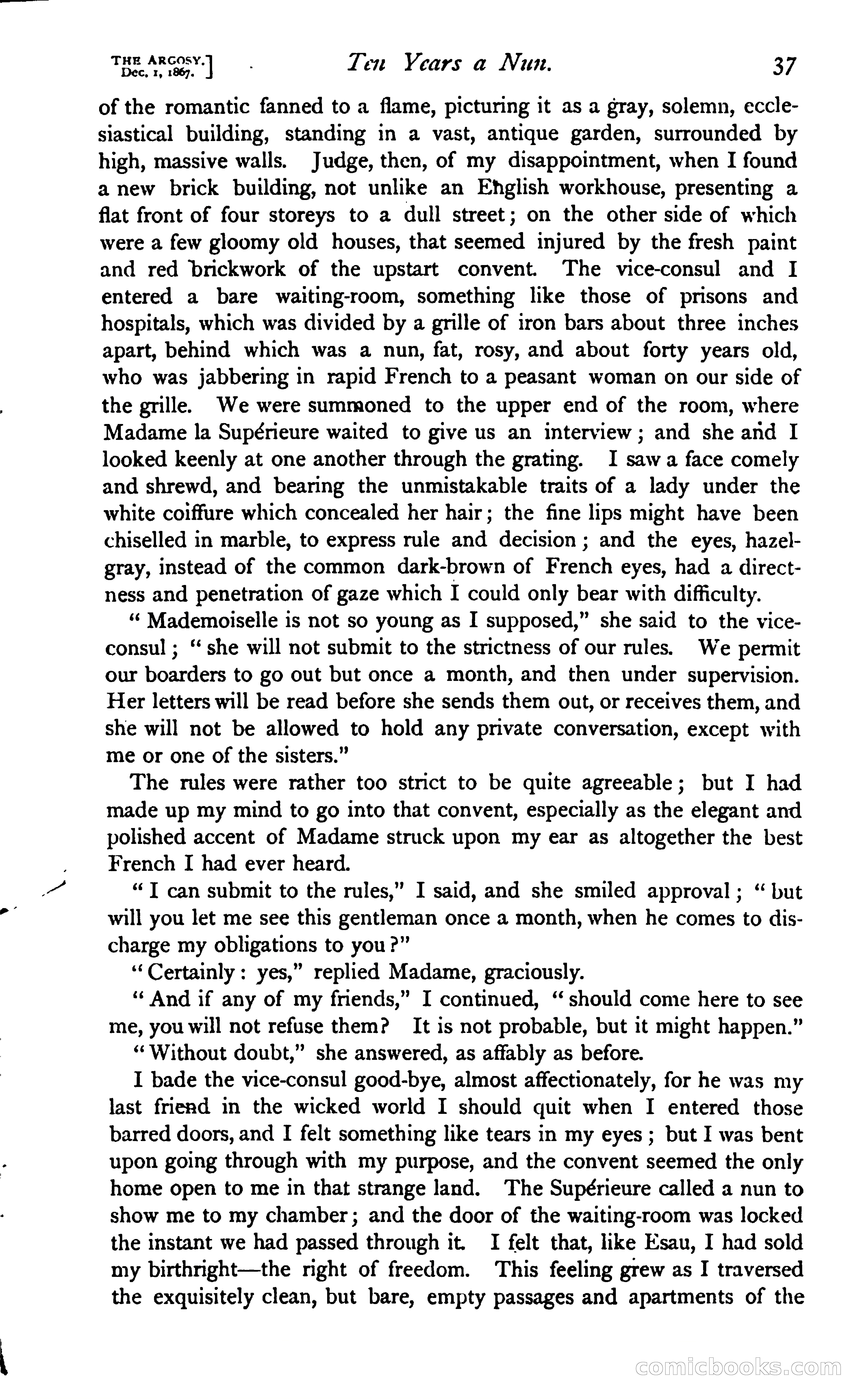
A restored page from Pulp Fiction, 1901. Page through the whole issue in the reader above.
📄 Transcribed text from this page (OCR, searchable)
Machine-transcribed from the original scan — historical spelling and the odd misread are preserved.
2 A Sy, Tye Ancosy.] Ten Years a Nun. 37 of the romantic fanned to a flame, picturing it as a gray, solemn, eccle- siastical building, standing in a vast, antique garden, surrounded by high, massive walls. Judge, then, of my disappointment, when I found a new brick building, not unlike an Ehglish workhouse, presenting a flat front of four storeys to a dull street; on the other side of which were a few gloomy old houses, that seemed injured by the fresh paint and red brickwork of the upstart convent. The vice-consul and I entered a bare waiting-room, something like those of pnsons and hospitals, which was divided by a grille of iron bars about three inches apart, behind which was a nun, fat, rosy, and about forty years old, who was jabbering in rapid French to a peasant woman on our side of the gnlle. We were summoned to the upper end of the room, where Madame la Supérieure waited to give us an interview; and she and I looked keenly at one another through the grating. I saw a face comely and shrewd, and bearing the unmistakable traits of a lady under the white coiffure which concealed her hair; the fine lips might have been chiselled in marble, to express rule and decision; and the eyes, hazel- gray, instead of the common dark-brown of French eyes, had a direct- ness and penetration of gaze which I could only bear with difficulty. ‘¢ Mademoiselle is not so young as I supposed,” she said to the vice- consul ; “ she will not submit to the strictness of our rules. We permit our boarders to go out but once a month, and then under supervision. Her letters will be read before she sends them out, or receives them, and she will not be allowed to hold any private conversation, except with me or one of the sisters.” The rules were rather too stnct to be quite agreeable; but I had made up my mind to go into that convent, especially as the elegant and polished accent of Madame struck upon my ear as altogether the best French I had ever heard. “IT can submit to the rules,” I said, and she smiled approval; “ but will you let me see this gentleman once a month, when he comes to dis- charge my obligations to you ?” ‘Certainly : yes,” replied Madame, graciously. ‘¢ And if any of my fnends,” I continued, “ should come here to see me, you will not refuse them? It is not probable, but 1t might happen.” “Without doubt,” she answered, as affably as before. I bade the vice-consul good-bye, almost affectionately, for he was my last fnend in the wicked world I should quit when I entered those barred doors, and I felt something like tears in my eyes ; but I was bent upon going through with my purpose, and the convent seemed the only home open to me in that strange land. The Supérieure called a nun to show me to my chamber; and the door of the waiting-room was locked the instant we had passed through it. I felt that, like Esau, I had sold my birthright—the right of freedom. This feeling grew as I traversed the exquisitely clean, but bare, empty passages and apartments of the ECOMiIcoOolxs.cO©