
Pulp Fiction, 1901 · page 375 of 400
The Argosy — page 375: what you’re looking at
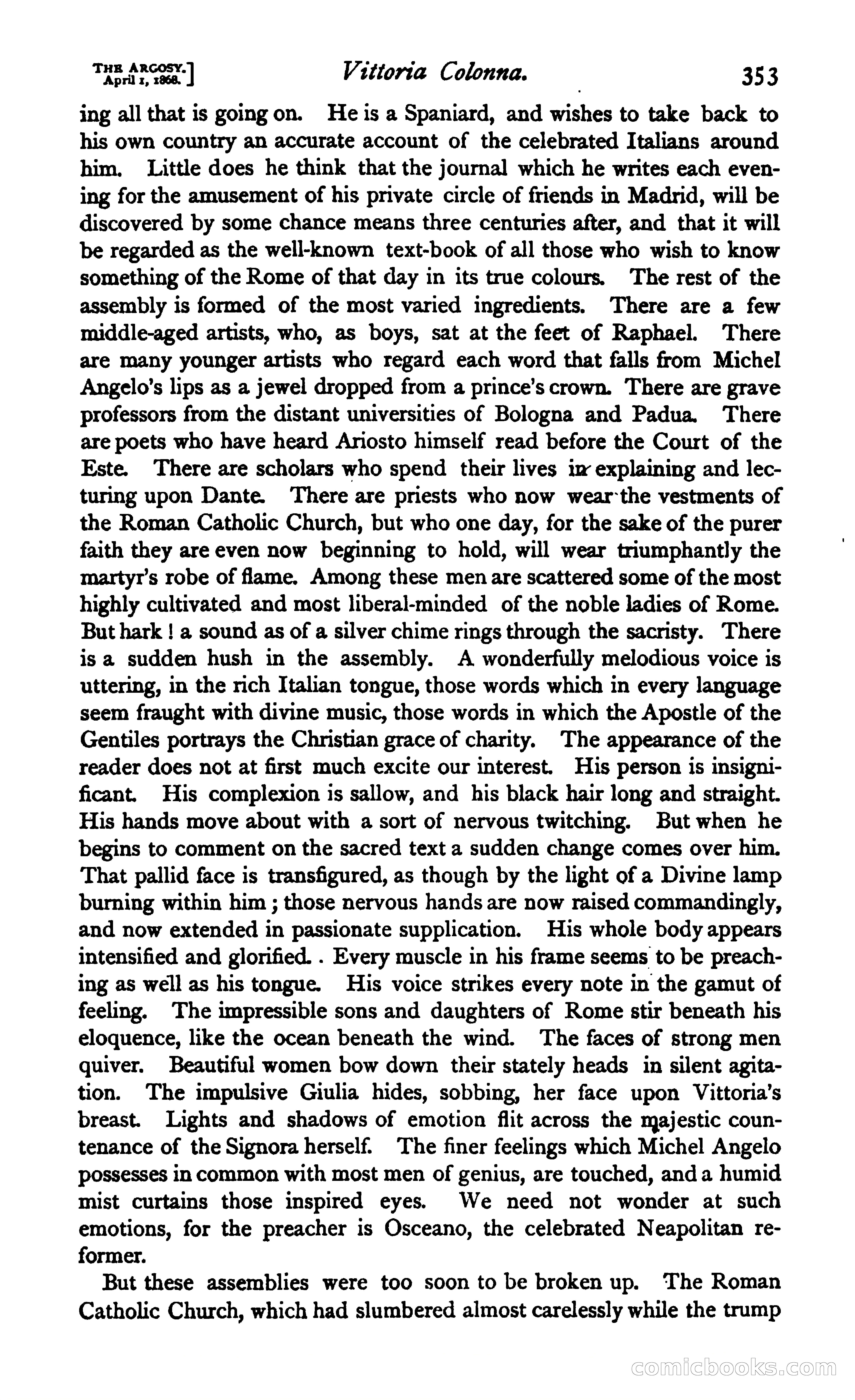
A restored page from Pulp Fiction, 1901. Page through the whole issue in the reader above.
📄 Transcribed text from this page (OCR, searchable)
Machine-transcribed from the original scan — historical spelling and the odd misread are preserved.
THE ARCOSY. Vittorta Colonna. 353 ing all that is goingon. He1is a Spaniard, and wishes to take back to his own country an accurate account of the celebrated Italians around him. Little does he think that the journal which he writes each even- ing for the amusement of his private circle of friends in Madrid, will be discovered by some chance means three centuries after, and that it will be regarded as the well-known text-book of all those who wish to know something of the Rome of that day in its true colours. The rest of the assembly is formed of the most varied ingredients. There are a few middle-aged artists, who, as boys, sat at the feet of Raphael. There are many younger artists who regard each word that falls from Michel Angelo’s lips as a jewel dropped from a prince’s crown. There are grave professors from the distant universities of Bologna and Padua. There are poets who have heard Anosto himself read before the Court of the Este. There are scholars who spend their lives ur explaining and lec- turing upon Dante. There are priests who now wear-the vestments of the Roman Catholic Church, but who one day, for the sake of the purer faith they are even now beginning to hold, will wear triumphantly the martyr’s robe of flame. Among these men are scattered some of the most highly cultivated and most liberal-minded of the noble ladies of Rome. But hark !| a sound as of a silver chime rings through the sacristy. There is a sudden hush in the assembly. A wonderfully melodious voice is uttering, in the rich Italian tongue, those words which in every language seem fraught with divine music, those words in which the Apostle of the Gentiles portrays the Christian grace of charity. The appearance of the reader does not at first much excite our interest. His person 1s insigni- ficant. His complexion is sallow, and his black hair long and straight. His hands move about with a sort of nervous twitching. But when he begins to comment on the sacred text a sudden change comes over him. That pallid face is transfigured, as though by the light of a Divine lamp burning within him ; those nervous hands are now raised commandingly, and now extended in passionate supplication. His whole body appears intensified and glorified. . Every muscle in his frame seems to be preach- ing as well as his tongue. His voice strikes every note in the gamut of feeling. The impressible sons and daughters of Rome stir beneath his eloquence, like the ocean beneath the wind. The faces of strong men quiver. Beautiful women bow down their stately heads in silent agita- tion. The impulsive Giulia hides, sobbing, her face upon Vittoria’s breast. Lights and shadows of emotion flit across the majestic coun- tenance of the Signora herself. The finer feelings which Michel Angelo possesses in common with most men of genius, are touched, anda humid mist curtains those inspired eyes. We need not wonder at such emotions, for the preacher 1s Osceano, the celebrated Neapolitan re- former. But these assemblies were too soon to be broken up. The Roman Catholic Church, which had slumbered almost carelessly while the trump comicloooks (CO) mn _