
Pulp Fiction, 1901 · page 376 of 400
The Argosy — page 376: what you’re looking at
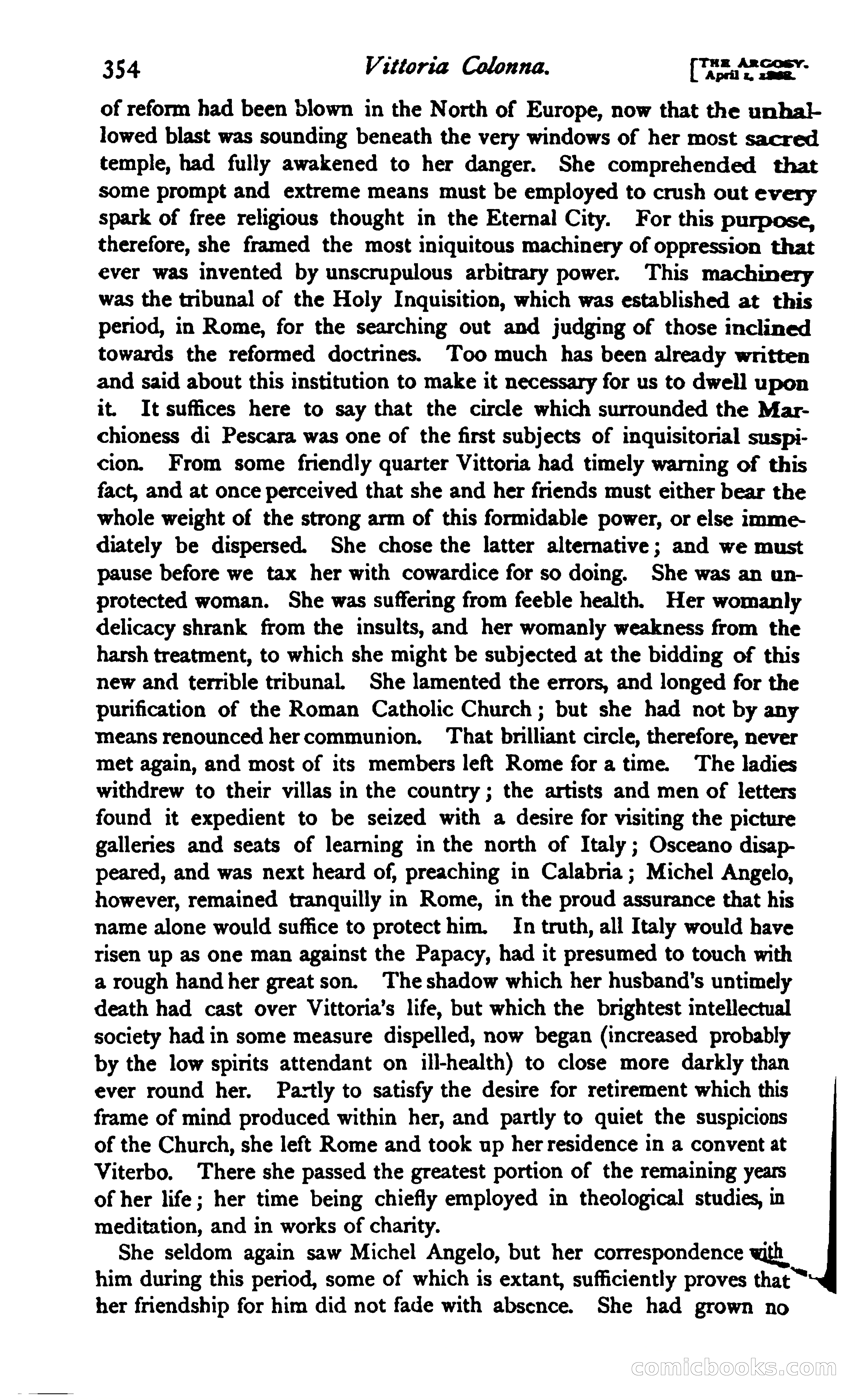
A restored page from Pulp Fiction, 1901. Page through the whole issue in the reader above.
📄 Transcribed text from this page (OCR, searchable)
Machine-transcribed from the original scan — historical spelling and the odd misread are preserved.
354 Vittoria Colonna. ae ta of reform had been blown in the North of Europe, now that the unhal- lowed blast was sounding beneath the very windows of her most sacred temple, had fully awakened to her danger. She comprehended that some prompt and extreme means must be employed to crush out every spark of free religious thought in the Eternal City. For this purpose, therefore, she framed the most iniquitous machinery of oppression that ever was invented by unscrupulous arbitrary power. This machinery was the tnbunal of the Holy Inquisition, which was established at this period, in Rome, for the searching out and judging of those inclined towards the reformed doctrines. Too much has been already written and said about this institution to make it necessary for us to dwell upon it. It suffices here to say that the circle which surrounded the Mar- chioness di Pescara was one of the first subjects of inquisitorial suspi- cion. From some fnendly quarter Vittoria had timely warning of this fact, and at once perceived that she and her frends must either bear the whole weight of the strong arm of this formidable power, or else imme- diately be dispersed. She chose the latter alternative; and we must pause before we tax her with cowardice for so doing. She was an un- protected woman. She was suffering from feeble health. Her womanly delicacy shrank from the insults, and her womanly weakness from the harsh treatment, to which she might be subjected at the bidding of this new and terrible tribunal. She lamented the errors, and longed for the purification of the Roman Catholic Church ; but she had not by any means renounced hercommunion. That brilliant circle, therefore, never met again, and most of its members left Rome for atime. The ladies withdrew to their villas in the country; the artists and men of letters found it expedient to be seized with a desire for visiting the picture galleries and seats of learning in the north of Italy ; Osceano disap- peared, and was next heard of, preaching in Calabria; Michel Angelo, however, remained tranquilly in Rome, in the proud assurance that his name alone would suffice to protect him. In truth, all Italy would have risen up as One man against the Papacy, had it presumed to touch with a rough hand her great son. ‘The shadow which her husband's untimely death had cast over Vittoria’s life, but which the brightest intellectual society had in some measure dispelled, now began (increased probably by the low spirits attendant on ill-health) to close more darkly than ever round her. Partly to satisfy the desire for retirement which this frame of mind produced within her, and partly to quiet the suspicions of the Church, she left Rome and took up her residence in a convent at Viterbo. There she passed the greatest portion of the remaining years of her life; her time being chiefly employed in theological studies, in meditation, and in works of charity. She seldom again saw Michel Angelo, but her correspondence wth him during this period, some of which is extant, sufficiently proves that ~ her friendship for him did not fade with absence. She had grown no COMIC OOOKS. EO _