
Pulp Fiction, 1901 · page 374 of 400
The Argosy — page 374: what you’re looking at
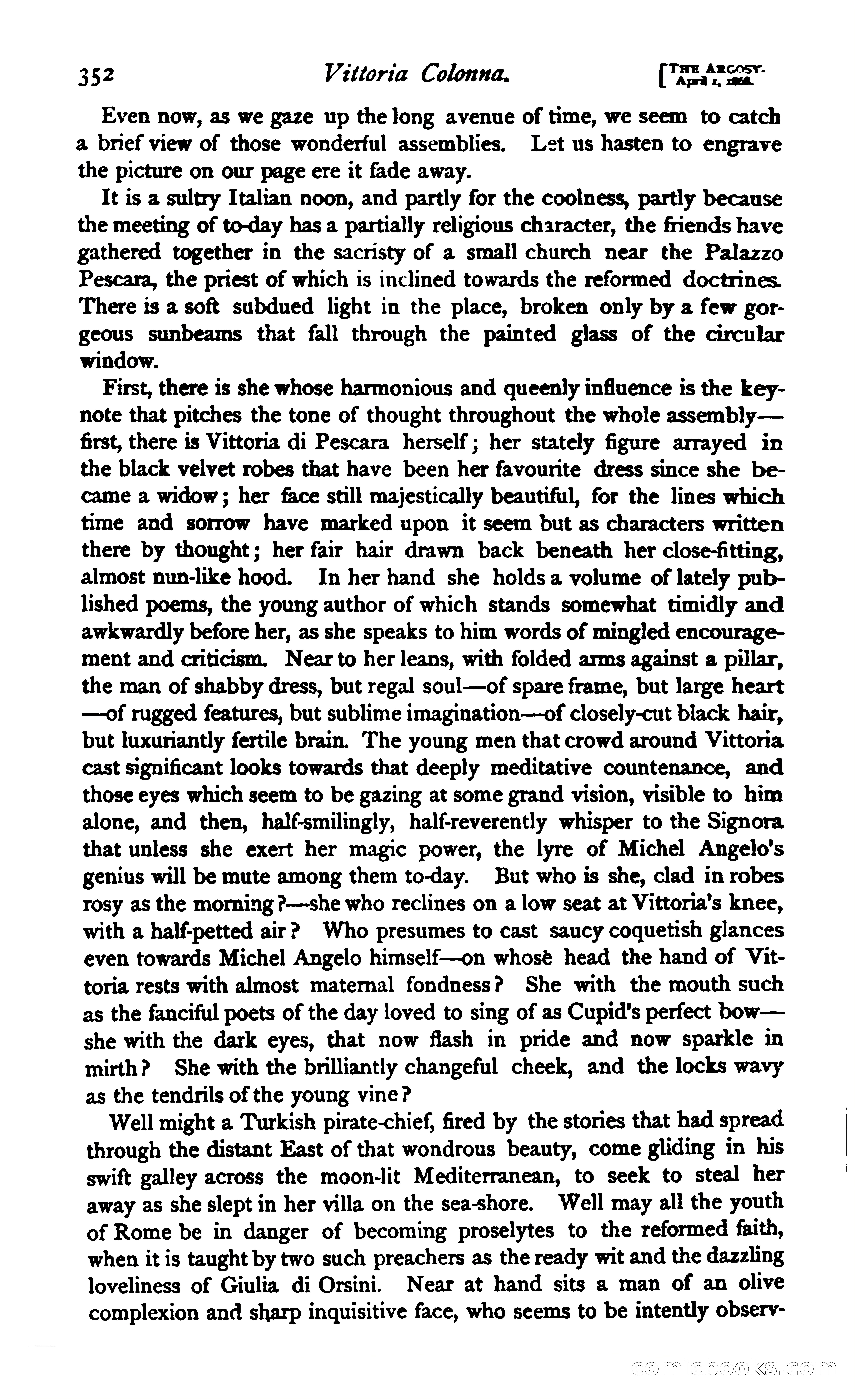
A restored page from Pulp Fiction, 1901. Page through the whole issue in the reader above.
📄 Transcribed text from this page (OCR, searchable)
Machine-transcribed from the original scan — historical spelling and the odd misread are preserved.
352 Vittoria Colonna. ("Apa ne see Even now, as we gaze up the long avenue of time, we seem to catch a bnef view of those wonderful assemblies. Let us hasten to engrave the picture on our page ere it fade away. It is a sultry Italian noon, and partly for the coolness, partly because the meeting of to-day has a partially religious character, the friends have gathered together in the sacnsty of a small church near the Palazzo Pescara, the priest of which is inclined towards the reformed doctrines. There 1s a soft subdued light in the place, broken only by a few gor- geous sunbeams that fall through the painted glass of the circular window. First, there is she whose harmonious and queenly influence 1s the key- note that pitches the tone of thought throughout the whole assembly — first, there is Vittoria di Pescara herself; her stately figure arrayed in the black velvet robes that have been her favounte dress since she be- came a widow; her face still majestically beautiful, for the lines which time and sorrow have marked upon it seem but as characters written there by thought; her fair hair drawn back beneath her close-fitting, almost nun-like hood. In her hand she holdsa volume of lately pub- lished poems, the young author of which stands somewhat timidly and awkwardly before her, as she speaks to him words of mingled encourage- ment and criticism. Near to her leans, with folded arms against a pillar, the man of shabby dress, but regal soul—of spare frame, but large heart —of rugged features, but sublime imagination—of closely-cut black hair, but luxuriantly fertile bra. The young men that crowd around Vittona cast significant looks towards that deeply meditative countenance, and those eyes which seem to be gazing at some grand vision, visible to him alone, and then, half-smilingly, half-reverently whisper to the Signora that unless she exert her magic power, the lyre of Michel Angelo's genius will be mute among them to-day. But who is she, clad in robes rosy as the morning ?—she who reclines on a low seat at Vittoria’s knee, with a half-petted air? Who presumes to cast saucy coquetish glances even towards Michel Angelo himself—on whosé head the hand of Vit- toria rests with almost maternal fondness? She with the mouth such as the fanciful poets of the day loved to sing of as Cupid’s perfect bow— she with the dark eyes, that now flash in pride and now sparkle in mirth? She with the brilliantly changeful cheek, and the locks wavy as the tendrils of the young vine? Well might a Turkish pirate-chief, fired by the stories that had spread through the distant East of that wondrous beauty, come gliding in his swift galley across the moon-lit Mediterranean, to seek to steal her away as she slept in her villa on the sea-shore. Well may all the youth of Rome be in danger of becoming proselytes to the reformed faith, when it is taught by two such preachers as the ready wit and the dazzling loveliness of Giulia di Orsini. Near at hand sits a man of an olive complexion and sharp inquisitive face, who seems to be intently observ- COMIC OOOKS. EO mn _